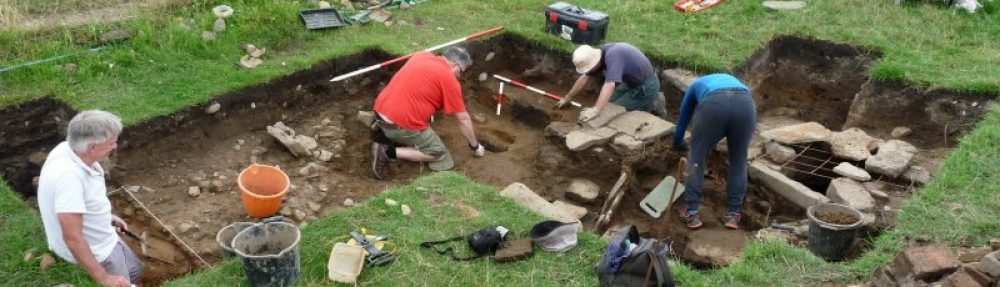
Thursday 1st October
Day 40
Joining Chris today were Isabel, Peter, Jon, Alison, Jen, Louise, Colin and John Needle.
Chris and Isabel continued the slow process of lifting the B7 bones (Feature F2) in 1cm quarter spits. The bones were extremely fragile and great care was taken to try to preserve the larger fragments. In the afternoon, supervised by Isabel, other diggers were given the opportunity to work on B7 for a while so that everyone gained some experience of working on an exhumation. 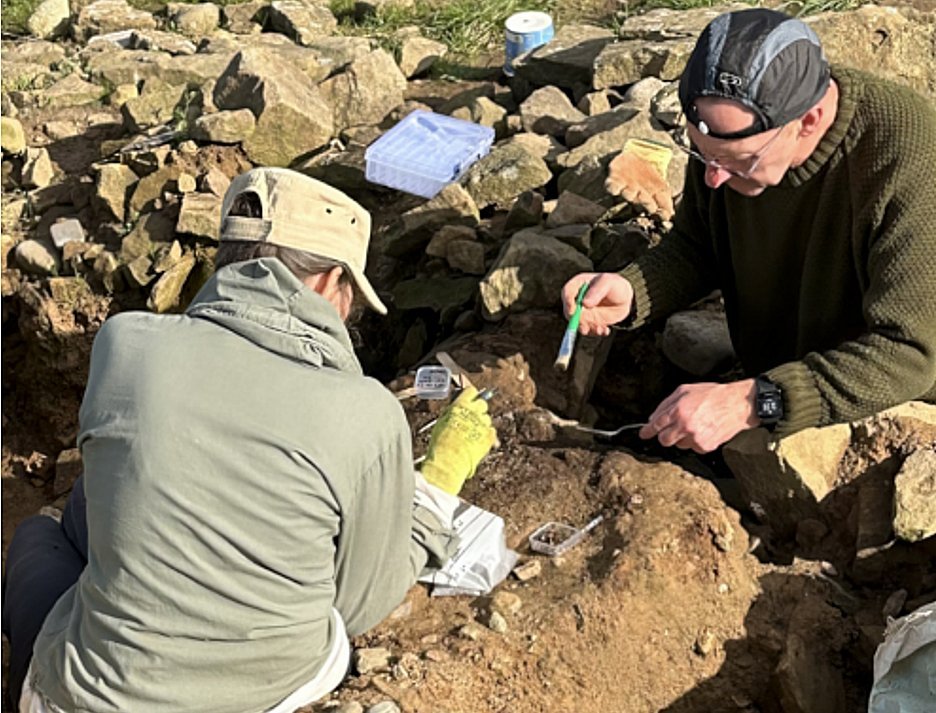
Peter and Jon continued the micro excavation of B27 (Feature F9). 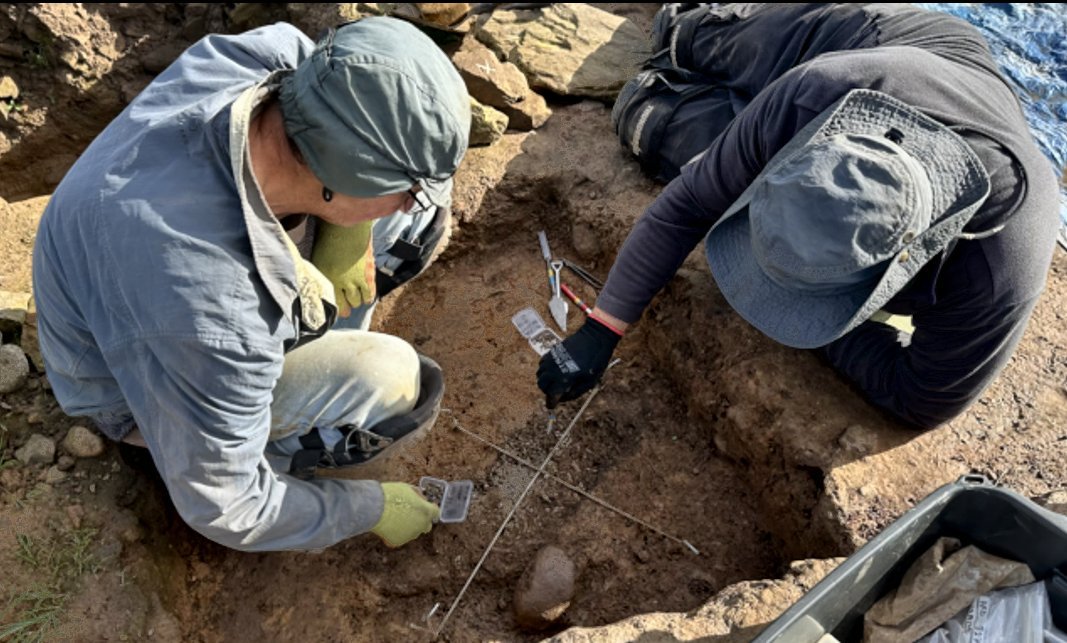 It was noticeable that this burial had little fill and the bones and fill could be lifted out at a much quicker rate that the B7 excavation.
 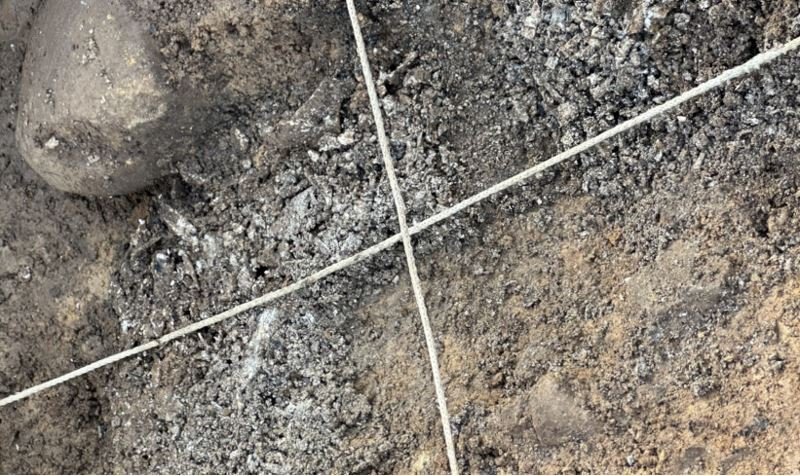 It is expected that the B27 excavation will be completed early next week.
John N, Jen, Alison, Colin and Louise worked in the trench where the newly exposed compacted small stones had been exposed in the step. It is still unclear if this is a natural feature or man-made. 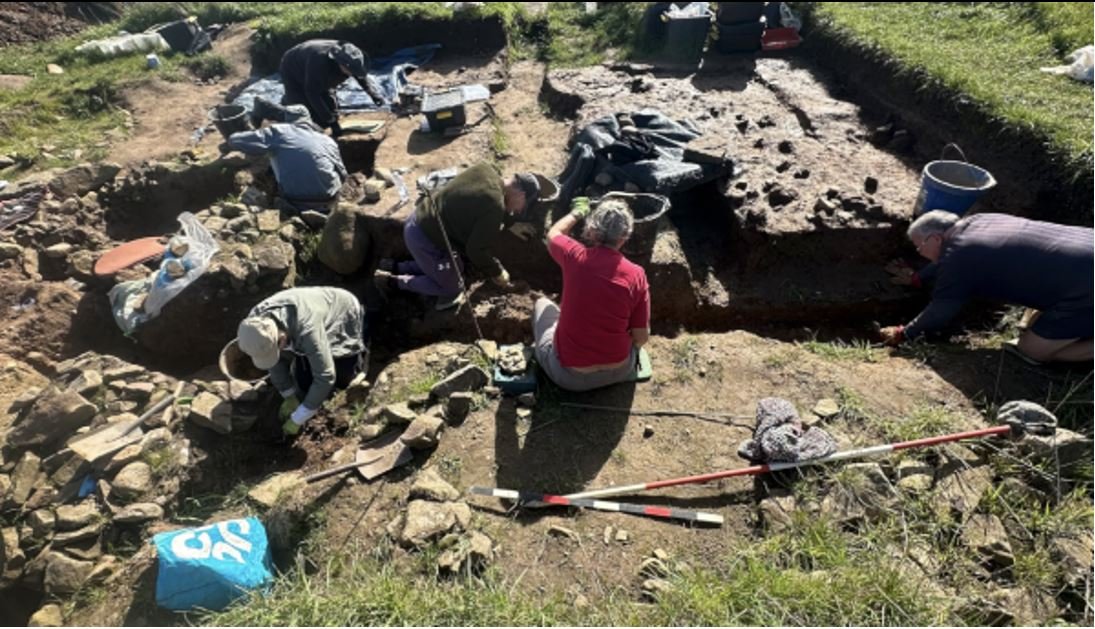 The trench was extended to the northwest side, again into an area that had been previously opened to the higher level but it was still difficult to explain the stones that were found. A heavy spell of rain meant that this task had to be abandoned and will be carried over into next week.
Tuesday 29th September
Day 40
With Bill being unavailable this week Chris was in charge. Joining him today were Isabel, Peter, Jon, Susan, Louise and Paul Langin
It was decided we needed to start the micro excavate the material from the 2 remaining burials i.e. B7 (Feature F2) and B27 (Feature F9) rather than try to cover and re-bury them to protect them over winter. Also, the team at Bolton Museum Stores had almost completed the cleaning of the previous burials. 2 teams were set up. Jon and Peter worked on the recently discovered B27, and Susan and Chris worked on B7 (the burial next to Urn2).
On uncovering B27 it was clear that it had been greatly disturbed by some animal which had cut through the sheet covering the burial and redistributed the larger bones at the southern end of the burial. This was recorded and the burial split into quarters. Peter and Jon then proceeded to take each quarter down in 1cm spits.
Susan and Chris carefully examined the area where Urn2 had been positioned. 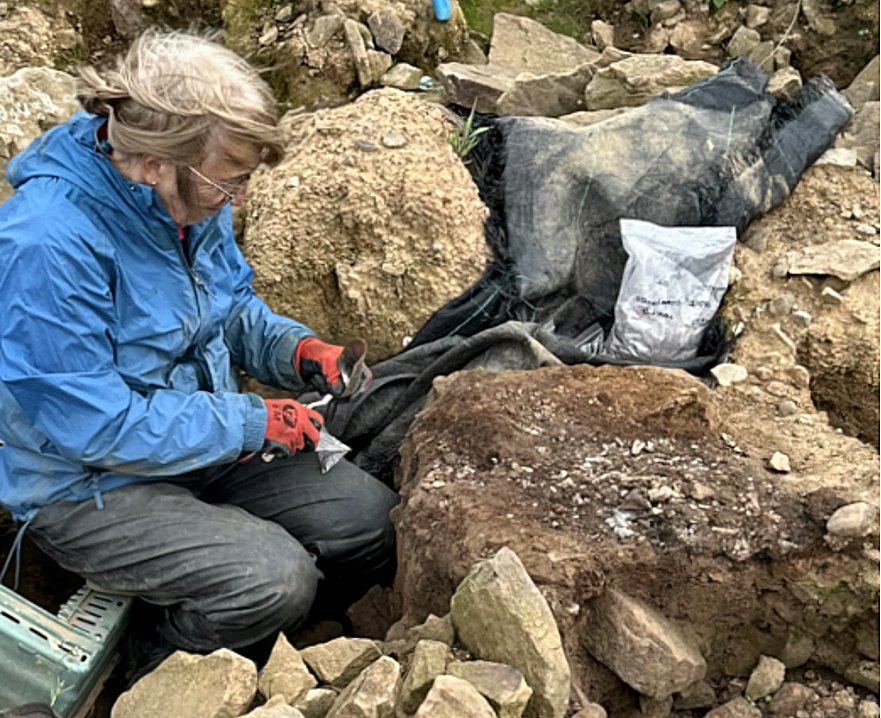 There was a small mound shape approximately where the upturned urn had rested (presumably the contents of the urn).
 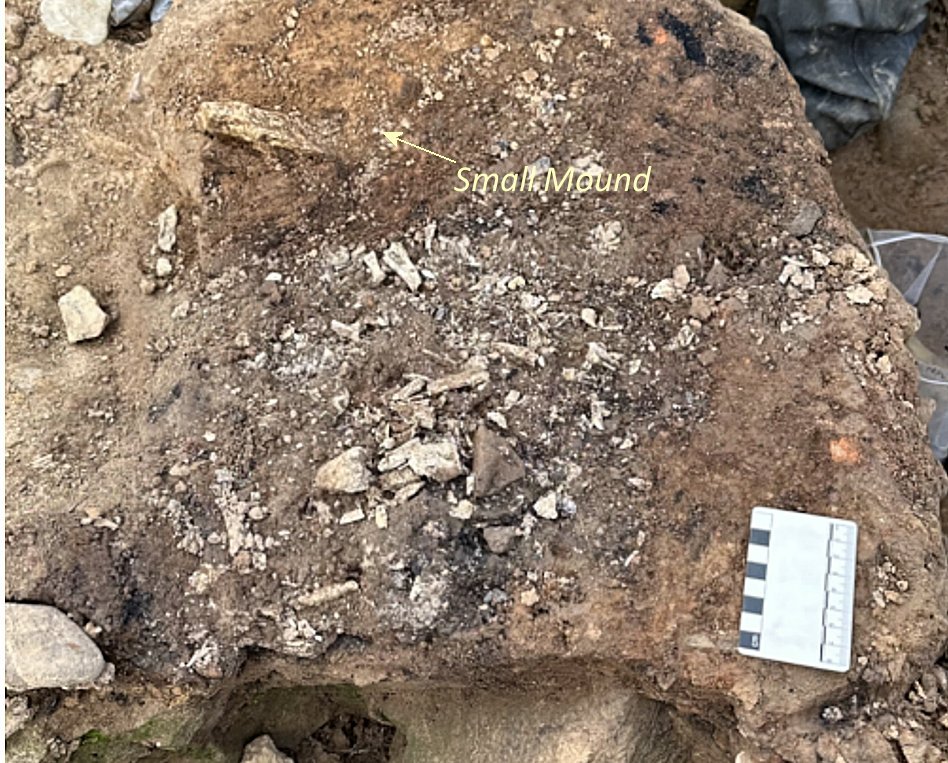 This was removed in 1cm spits but, disappointingly, it was mostly sand with very little charcoal and bone in it.
Paul, Louise and Isabel worked on the newly exposed patch of small compacted stones in the step of the trench extending southwest from the rising sandy clay mound (Section V-V). After cleaning the lower levels to expose more stones, Paul expanded the width of the trench to try to establish if the step change in the hard stony floor extended to the southeast. 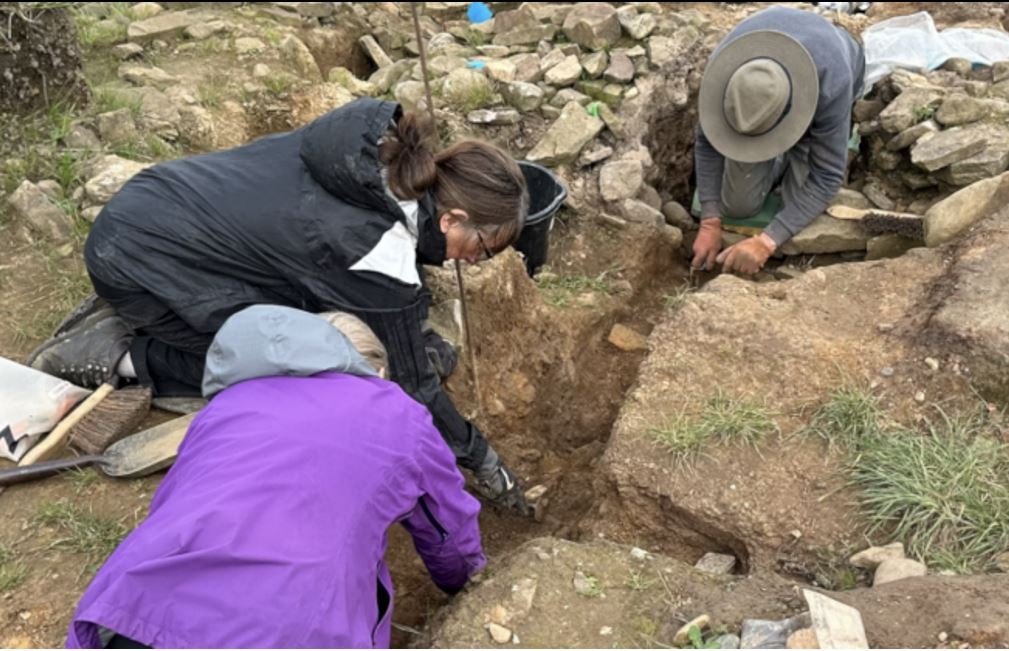 He observed that there were a large number of round pebbles, including quartz included in the layer. On close inspection most of this layer of stones looked rounded as if they had been affected by water.
Thursday 24th September
Day 39
Joining Bill and Chris today were Andrew, Peter, Gaby, Jen, Susan, Isabel, Colin and Paul Langin.
With the problem of the stony layer still unresolved on the northwest side of Trench 1b, Bill asked Jen to continue in the cut Andrew had started on Tuesday. Andrew had not encountered anything other than the soft sandy clay below the stony layer so Jen extended the cut towards Trench 1c. Here she came across stones at depth but still no burnt layer which suggests these are the embedded stones previously revealed in this area. 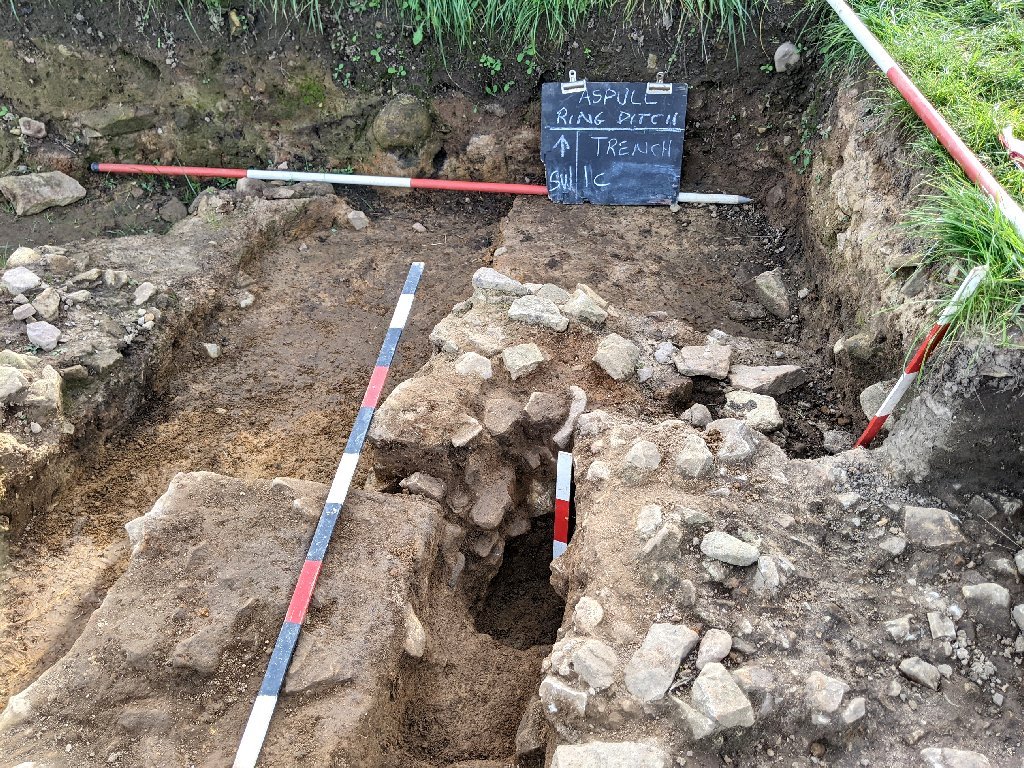
Previous work on the northwest side of Trench 1b and the northeast side of Trench 1d had convinced us that we had established the extent of the general stony layer in this side of the monument. The edge of it seemed to be describing an arc respecting the curve of the large stone alignment. Bill was curious though how far the layer with the green tinged stones went the northwest so he asked Colin and Andrew to extend a small section in that direction (we couldn’t go too far as the new fence line was not much more than a metre away). The half metre extension revealed more stones but green tinged ones but more of the general stones, one in particular quite large. 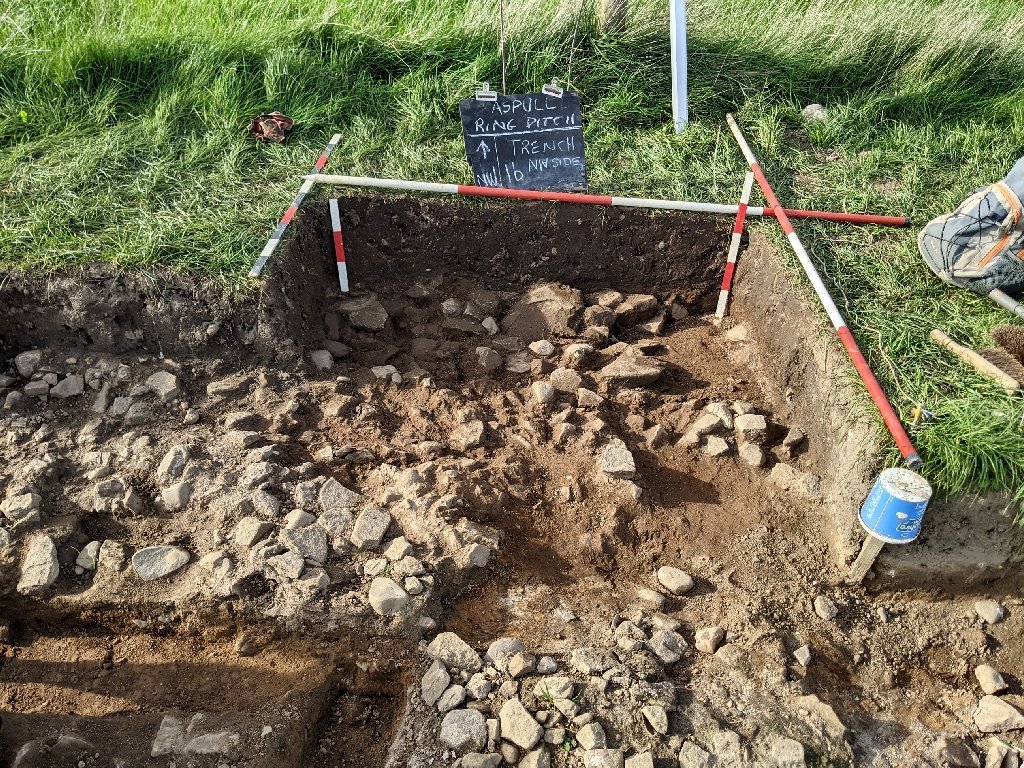 This would suggest we still hadn’t reached the extent of the stony layer on this side but we’ll have to ask the farmer to move the fence line if we are to extent this trench any further.
Chris and Paul continued working on the burnt layer on the south side of Trench 3a trying to eke the extent of the apparent tree roots. Meanwhile Peter and Susan continued trowelling down to the burnt layer on the southeast side of the Trench 3a. This revealed a scatter of stones in the mottled clay layer. They were also getting quite close to the clay lined pit burial (F4) and could see at that point, there were two layers of burning. 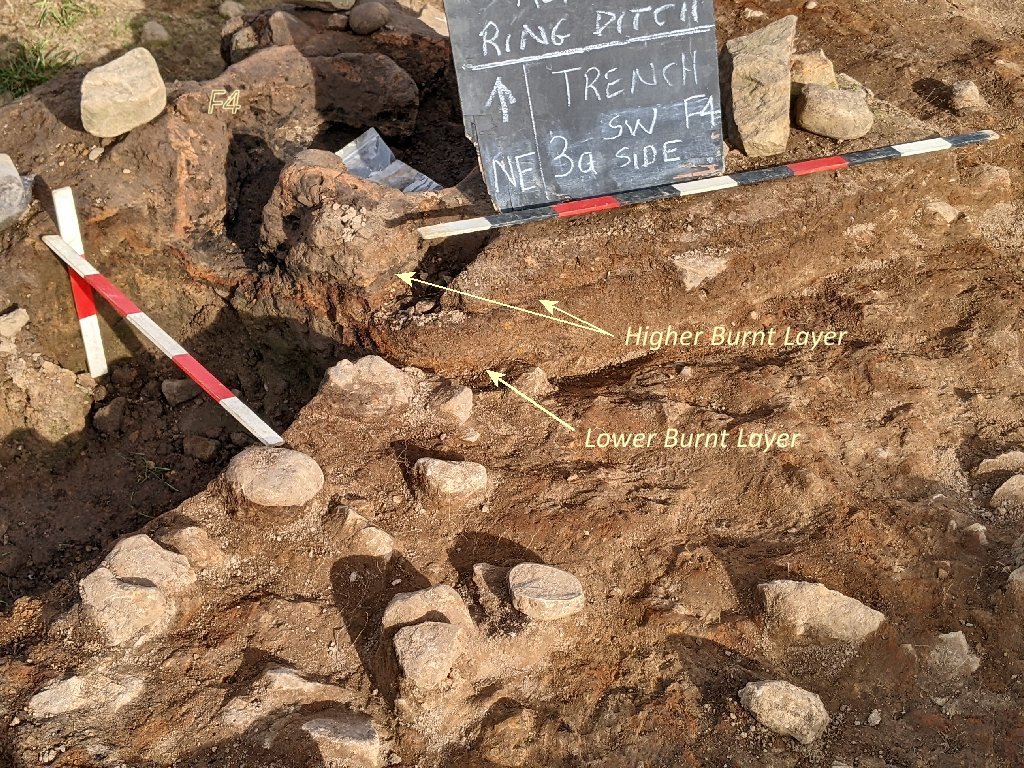 This double level of burning has been see in other places in this area (particularly on the other side of F4.
Bill asked Isabel to continue working in the cut revealing more of the section V-V. Bill was wanting to re-establish the lower limit where the soft sandy clay changed to a harder stonier layer. This layer could be seen in the area where the large stone slab had been removed and working back from there southeast-wards she was able to find it although uneven in places. When this cut was previously opened, there was a step in the lower level half way along and Isabel came up against this once again. This time though Isabel was able to uncover the reason perhaps for the step. Under the soft sandy clay she revealed a random clump of small stones compacted together with little or no fill of sandy clay. 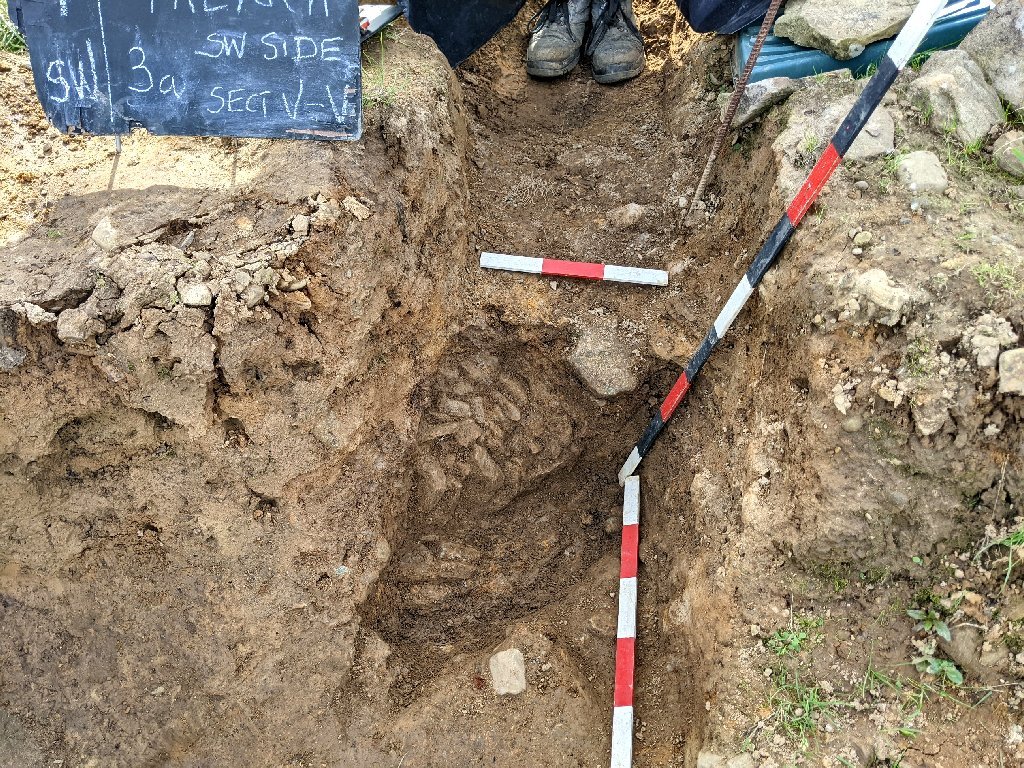 It’s yet another strange feature for us to ponder over – it looks manmade but it could be a natural formation (we’ve been fooled before).
Gaby continued working on the supposed post pipe which was still going despite beginning to taper at the bottom. Some small stones began to appear at this lower level corresponding to a layer of small stones seen at this level on the other side of the cut next to Feature F2. 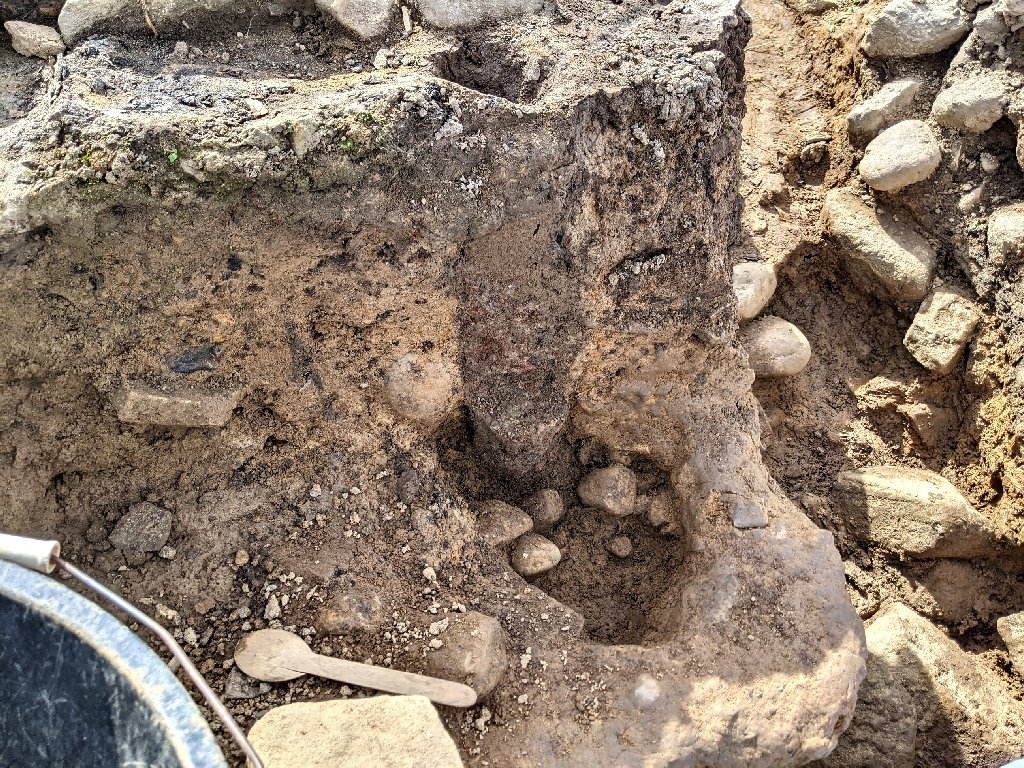 This was Gaby’s last day on site as she was off to Durham Uni to start a degree in Archaeology. We all wished her well and was sure she would with all the experience gained (although she might come back to tell us how it should be done).
Tuesday 22nd September
Day 38
Another great turnout with Andrew, Peter, Susan, Isabel, Gaby, Louise and Jon joining Bill, Chris and Patrick. Our tent had suffered so wind damage over the weekend developing a new entrance on the opposite side but, given some maintenance, it was still serviceable.
On site Peter continued looking at the southwest side of Trench 3a where the mottled clay and burnt layers were getting convoluted. Bill asked Alison to clear out the cut on the northwest edge of this area so he update the section drawing. Chris, Jon and Louise concentrated their efforts on the south side of Trench 3a trying to understand what was going on with the strange patterns in the burnt layer. 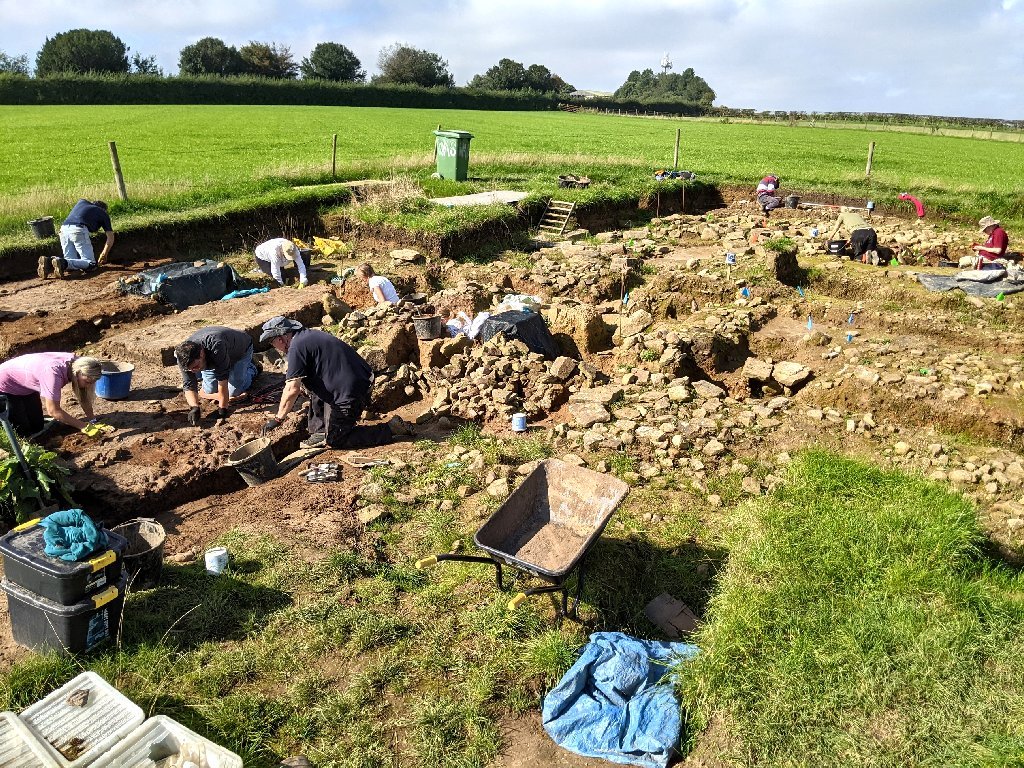 It now seems certain the large pieces of charcoal under the crusty orange patches are the remains of tree roots.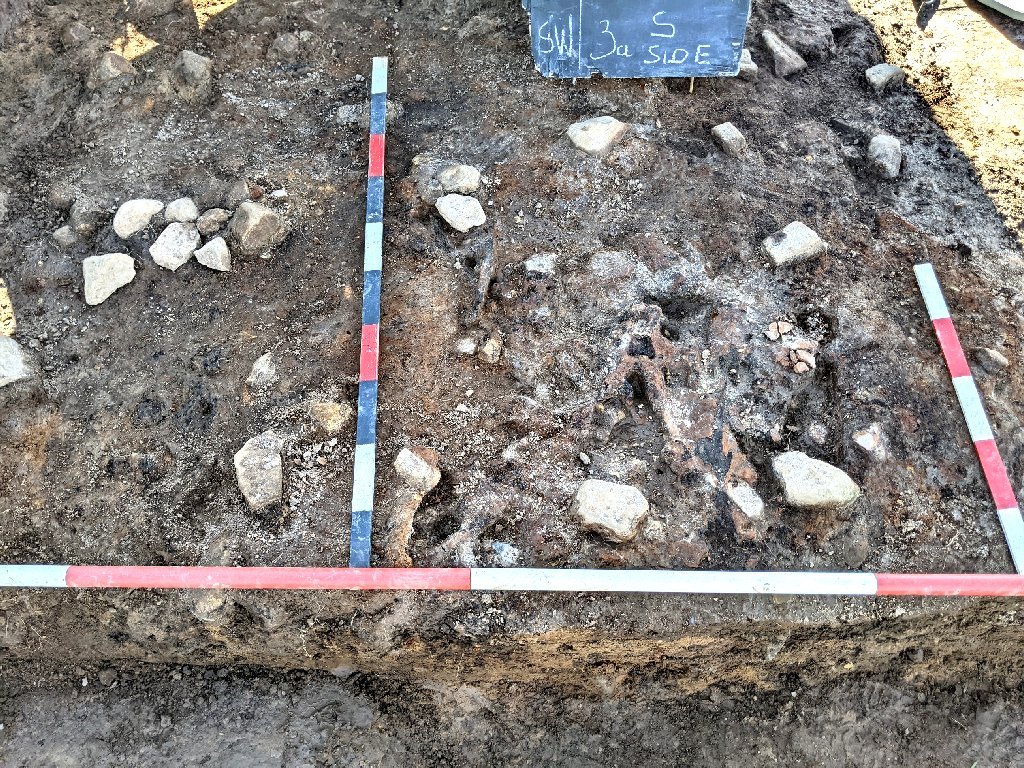
Bill asked Isabel to clean the newly founds stones lying under the large slab which was removed last week. this was so that Bill and Chris could record them photographically. The existence of the cavity further along the cut indicated that this lay continued under the sandy clay mound.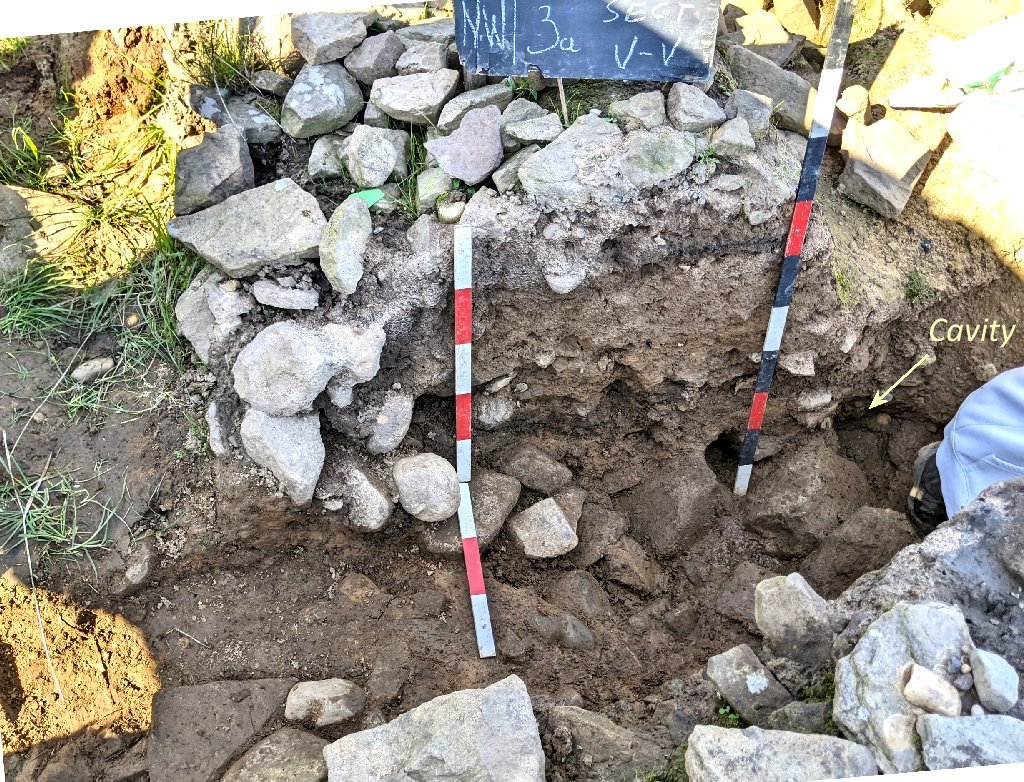 Once done, Bill asked Isabel to remove some of the stones just to see what lay below. This reveal a hard compacted surface which had an edge to it suggesting a pit cut into the surrounding hard surface into which the stones had been placed.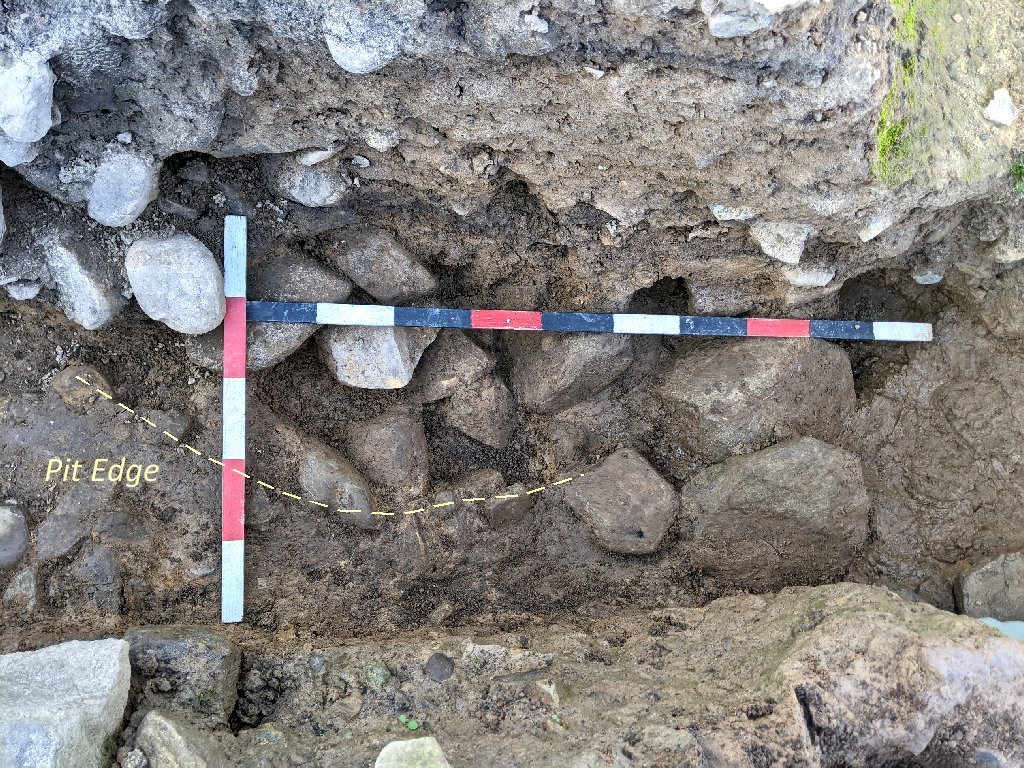
Gaby continued her methodical excavation on the post pipe in the adjacent cut. The bottom seemed to be tapering slightly which is perhaps what you would expect if it was originally a post. 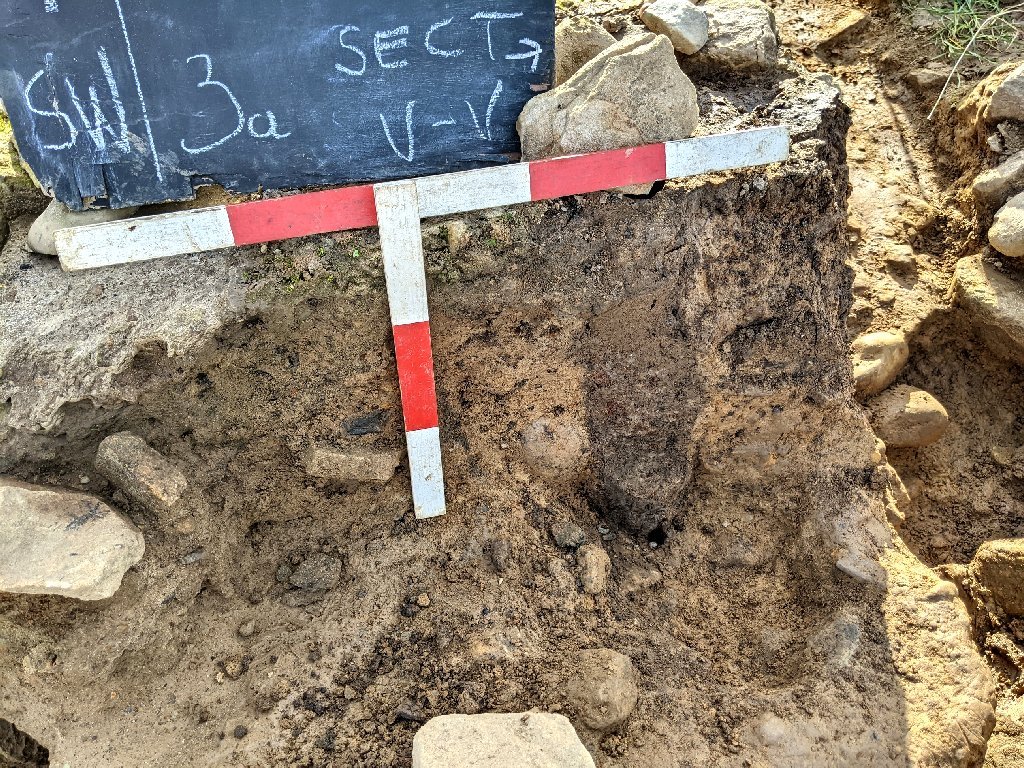
Andy was asked to look at the stony layer on the northwest side of Trench 1b (the layer containing green tinged stones next to Trench 1c). Bill asked him to put a cut through it to see if he could see any evidence of the burnt layer (there was sparse evidence of any in this area but it could be because it was lying under this upper layer). The cut so far showed no sign of a lower level, just the usual clean soft sandy clay.
As the site had dried out over the weekend, Patrick was able continue with his work on Feature F22. He continued with the cut on its northeast side seeing if he could Identify the extent of the pit the stones had been placed in. Bill asked Susan to look at the opposite side perhaps extending the cut in the underlying soft sandy clay towards the feature. This was to establish where it started which would help him with the section drawing. Chris though warned about removing stones close to the feature as they probably constitute the fill of the pit the feature was in. Bill asked about the extent of the pit as it wasn’t obvious on the surface. Chris pointed out the diagonal line of it in the section already exposed on the southeast side and Peter mentioned he had come across something similar in the section facing the northeast side (Chris suggested this should be recorded at some point in a section drawing). With Chris’ warning in mind, Susan just cleaned up the surface on the southwest side to see if the edge of the pit could be seen. 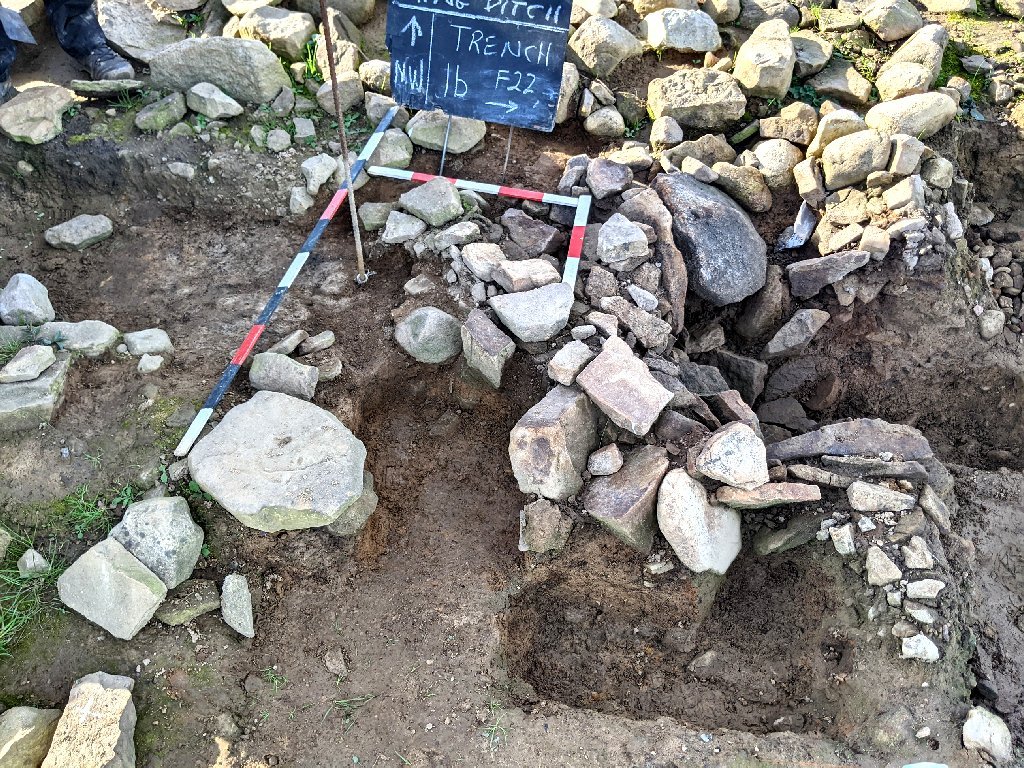
Wednesday 16th September
Day 37
Despite the unpredictable weather another decent turnout – joining Bill, Chris and Patrick today were Andrew, Peter, Jen, Susan and Paul Langin.
The site was still very wet so Peter and Susan continued working on the southwest side of Trench 3a, while Chris and Paul carried on trowelling the south side of Trench 3a. 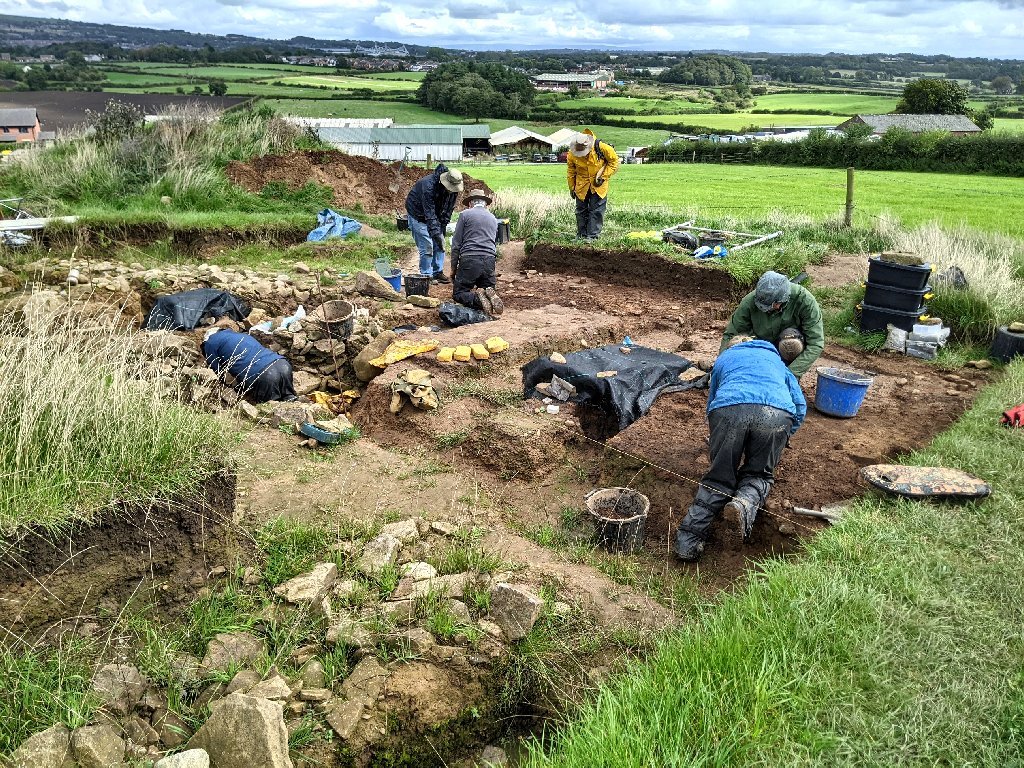 On the southwest side the trowelling had not yet reached the bottom of the mottled layer despite much evidence of charcoal.
 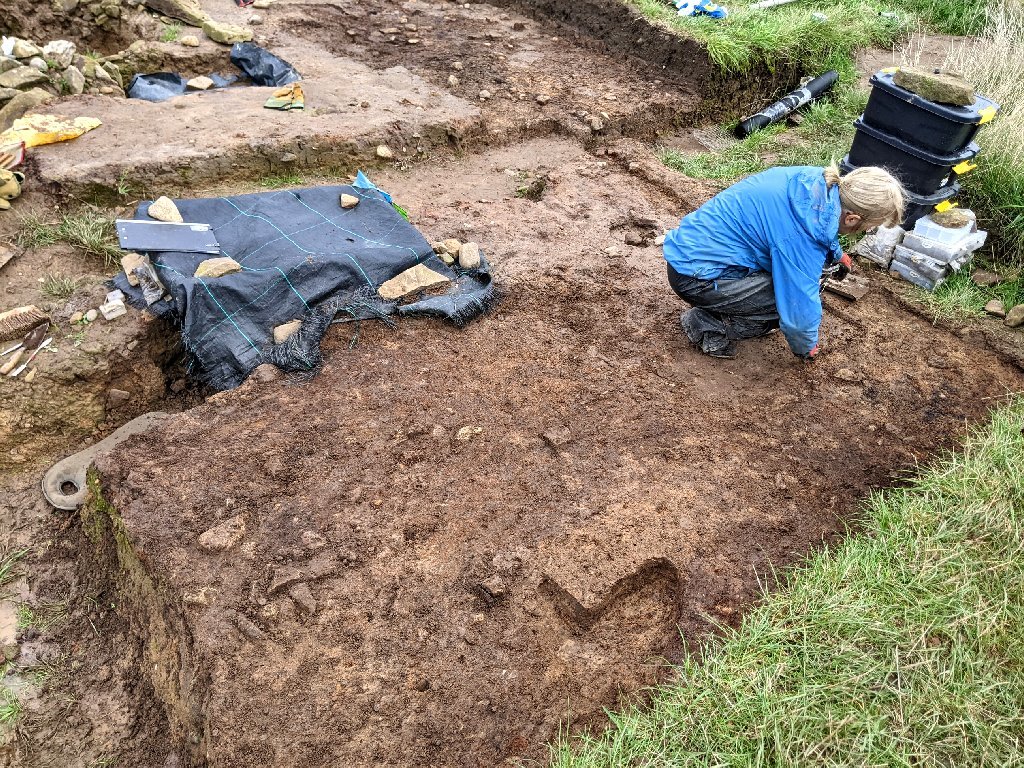 On the south side they were well into the burnt layer and it is thought the large piece of charcoal under the crusty orange patch could be a burnt root.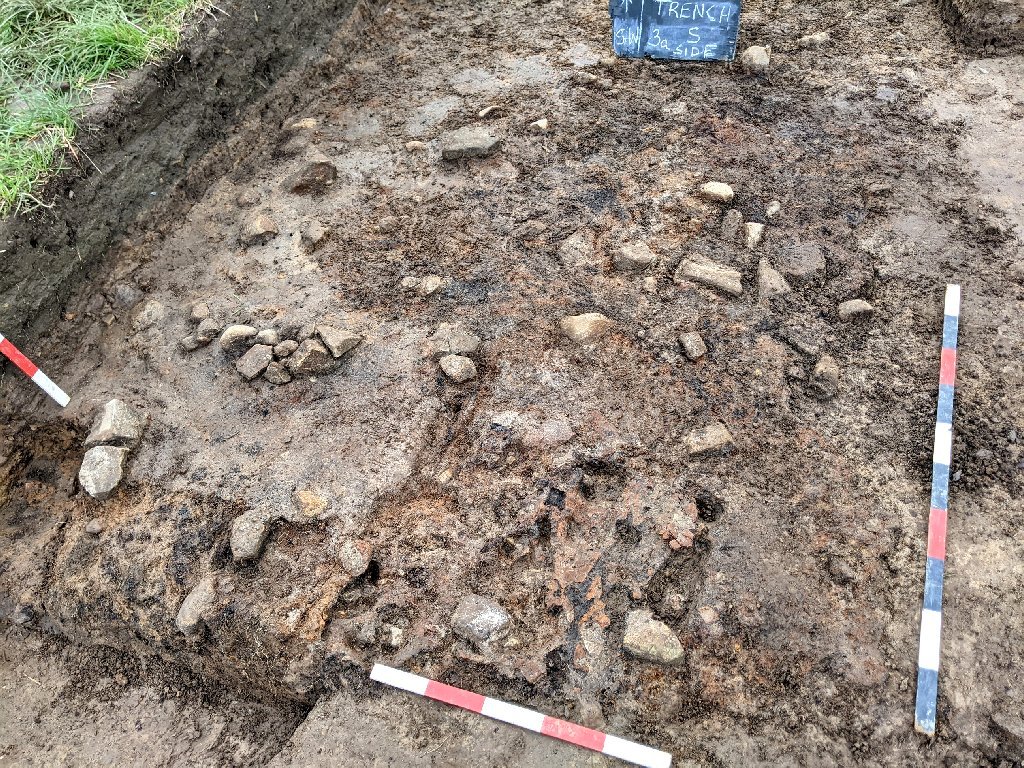
Jen continued trowelling the newly exposed area on the northwest side of the Trench 1b exposing more of the ‘green tinged’ stones. The extent of general consolidated stony layer can also now be seen as beyond the edge is an area of soft brown fill. 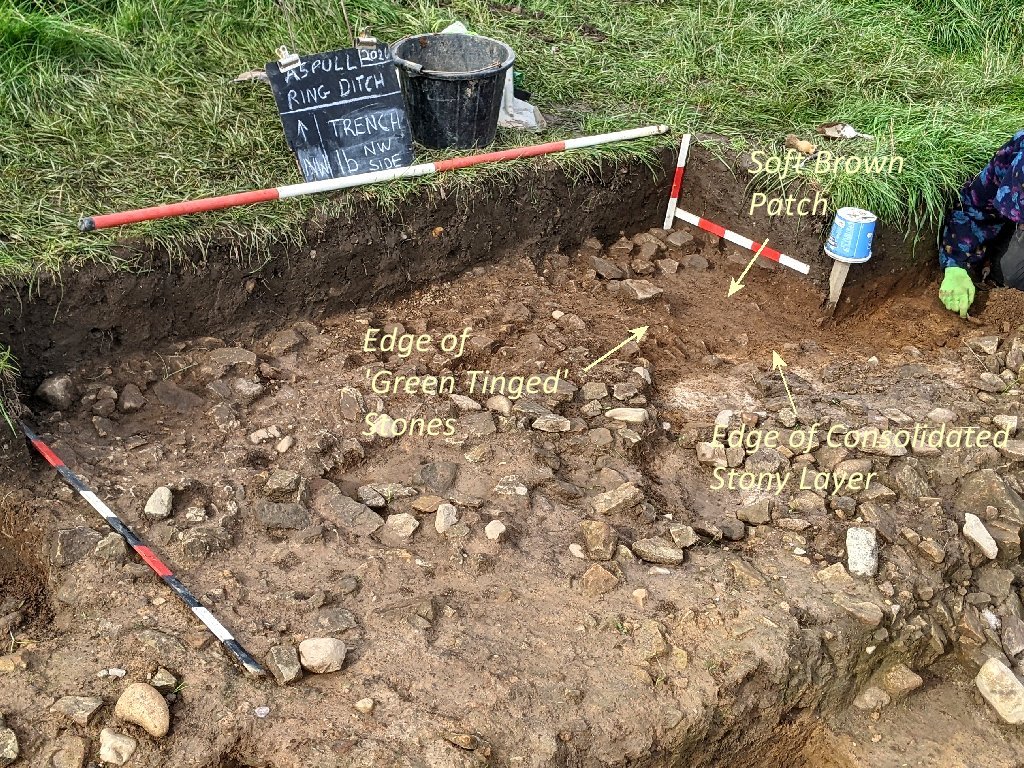 However it is still not clear how this stony layer interacts with the green tinged stones which as before seem to be embedded in the soft brown fill.
Bill asked Andrew to mop up the water in the cut (Section V-V) on the southwest side F2. This was so that it could be pushed back to expose enough of the large slab to enable it to be lifted. This revealed more detail of the section (which is now looking more like a Victoria Sponge cake) including more banding at a lower level (softer than the general sandy clay as it had partially collapsed in the recent wet weather). 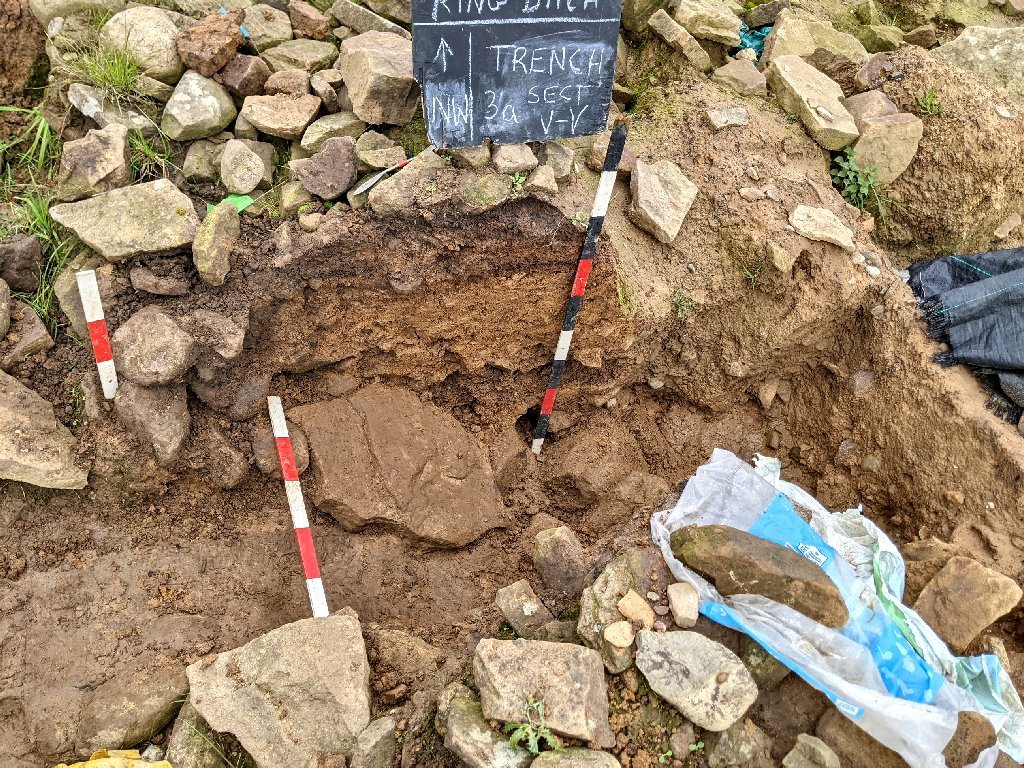 Before lifting the slab Chris did is drone survey and when it came to the lift, recorded it on video. Once lifted, all that could be seen were more stones but this did confirm that the archaeology here is much deeper than we thought.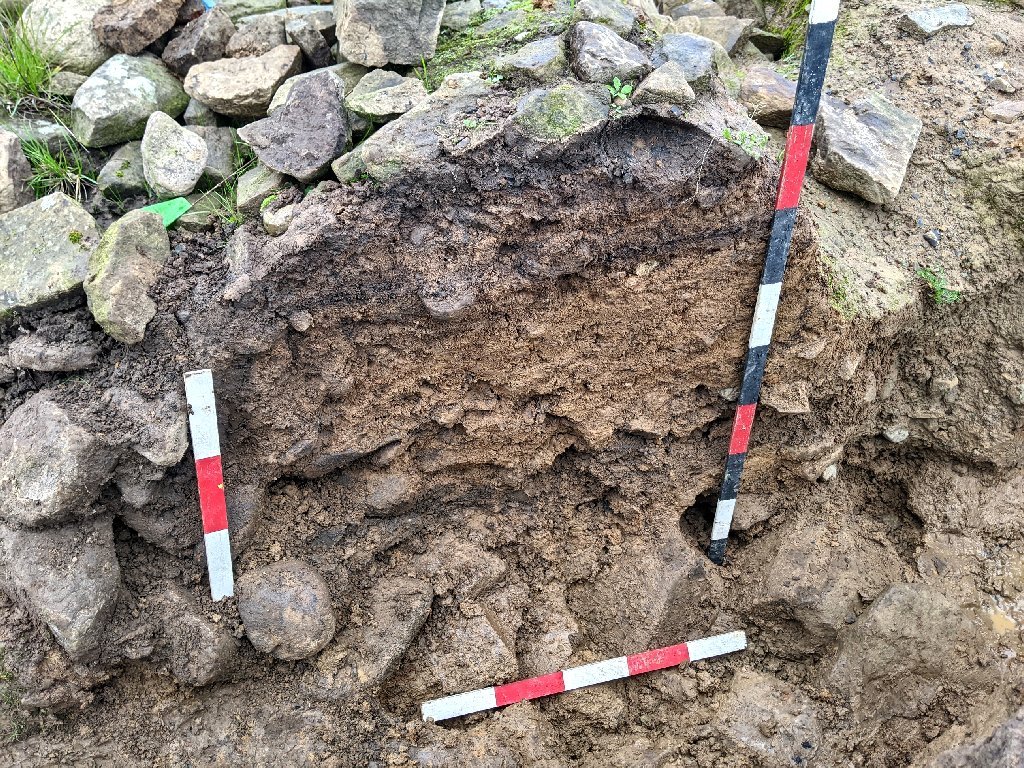
Tuesday 15th September
Day 36
Great turnout today – the team consisted of Bill, Chris, Peter, Jen, Jon, Susan, Alison and Dave North. The weather has become very changeable so trying to predict the best days to dig has become very difficult. The prediction was light showers for today but before we could get started the rain set in and so all 8 of us spent most of the morning ruminating in the tent. However an early lunch meant we could make an early start once the rain had eased in the afternoon (thank goodness for the tent which, despite the leaky (improvised) roof, is still holding out).
When we did get going it was clear we wouldn’t be able to work on the more sensitive areas. Chris and Peter therefore continued trowelling the mottle clay in the area to the south and west of Feature F4. Jon and Susan meanwhile carried on with the trowelling of the newly opened area south for the latest burial find. 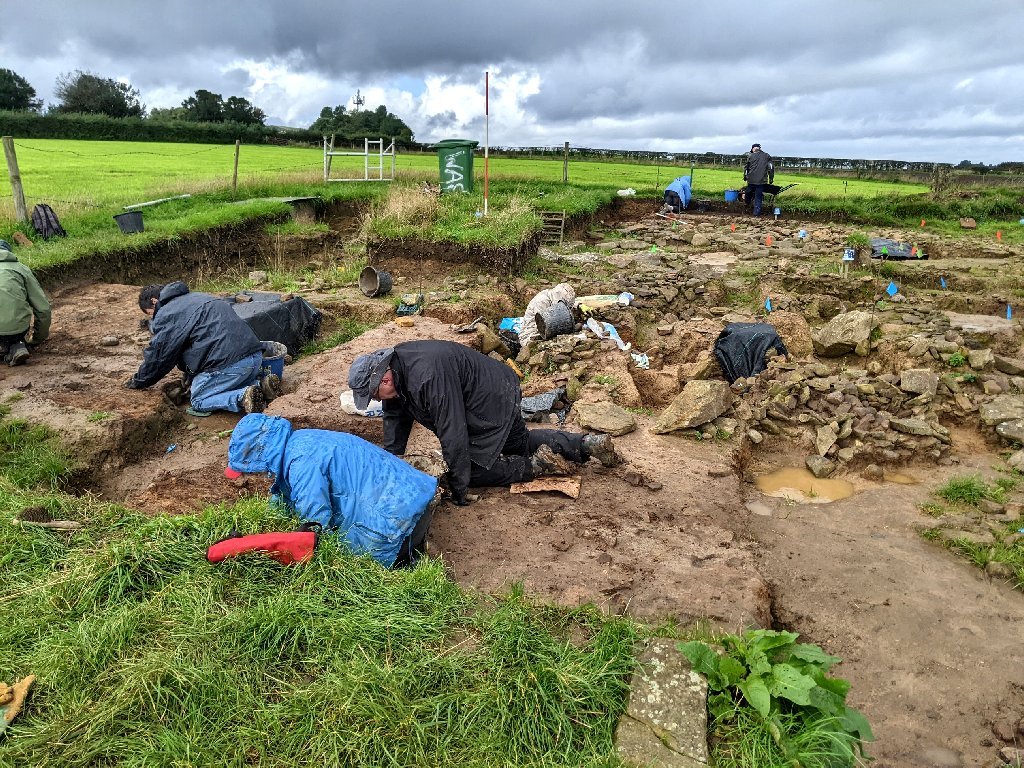 This continued to produced a complexed picture of the level just above the burnt layer – dark patches, light patches and in one particular spot near the edge of Trench 3c, a crusty orange patch overlaying thick pieces of charcoal.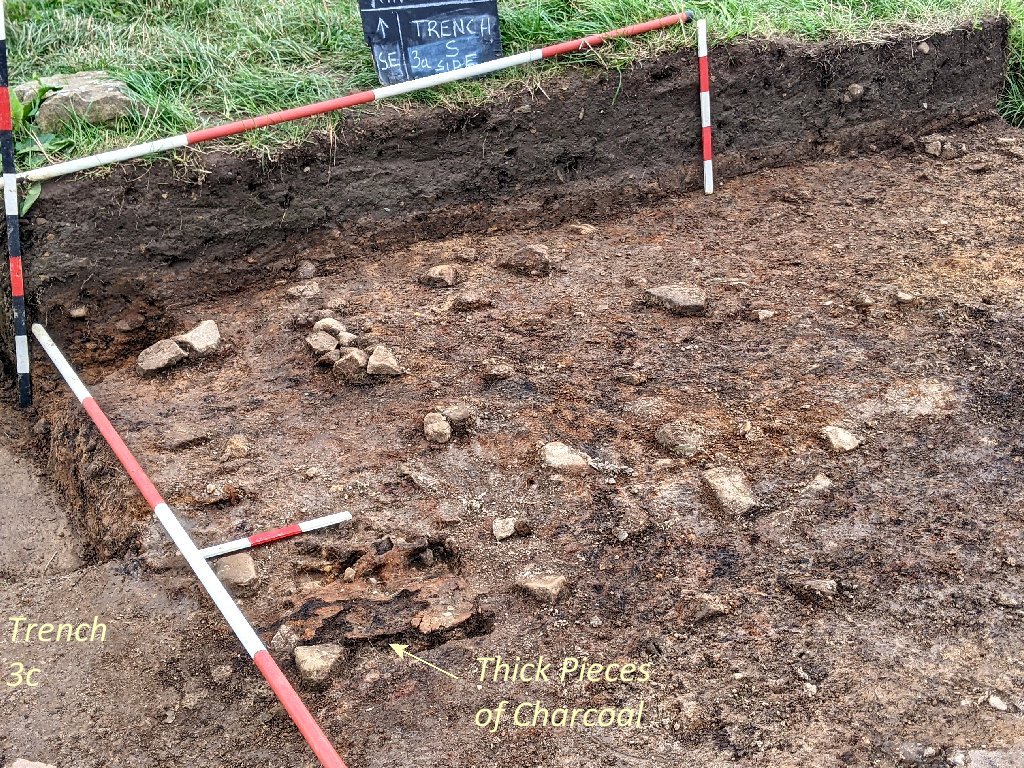
There was still the issue of how far the stony layer continued in the northwest direction in Trench 1b and how it interacted with the embedded (green tinged) stones we had originally come across in Trench 1c. These stones could now been seen spreading over the northwest side of Trench 1b. It was decided to extend the trench once again to the northwest and so Bill and Dave marked out a half metre section between Peg 10c and Trench 1c (leaving a small baulk next to Trench 1c. Before starting to de-turf Bill noticed the weather had cleaned the section in Trench 1c clearly revealing its backfill. 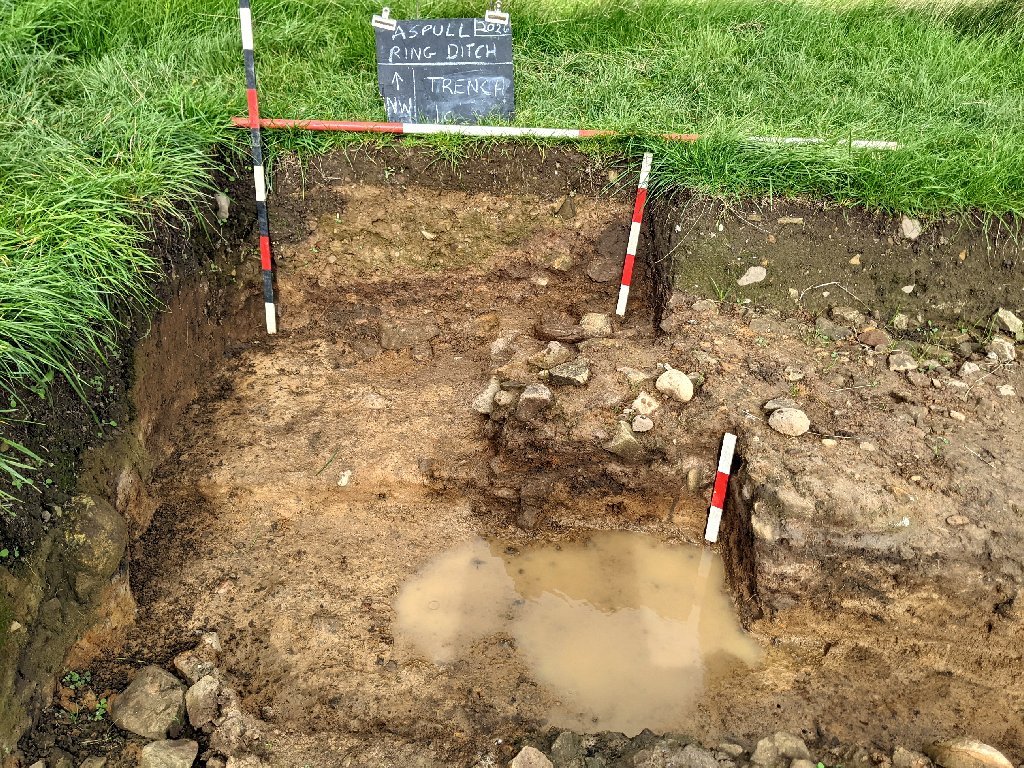 This seemed to show that the original trench did not reach all the way to the southwest edge. This seem to confirm what we had originally thought i.e. we had over cut the trench. Earlier in the year (Day 12) Bill had changed his mind on this, as soft backfill was being found all the way the to edge. However in the next session (Day 13) it was revealed we were in the area where Bill had cut a small test pit to retrieve a sample of the green tinged stones. This perhaps had coloured his thinking. Rechecking his drawing now confirmed that the original idea was correct that the new work had cut back the trench further to the southwest.
After the turf and most of the topsoil had been removed, Jen took over from Bill, joining Dave in trowelling down the half metre section to the next level. This revealed more of the green tinged stones going almost all the way across the section. However there were patches which had some of the traditional stones which suggests an intermingling of the two layers. 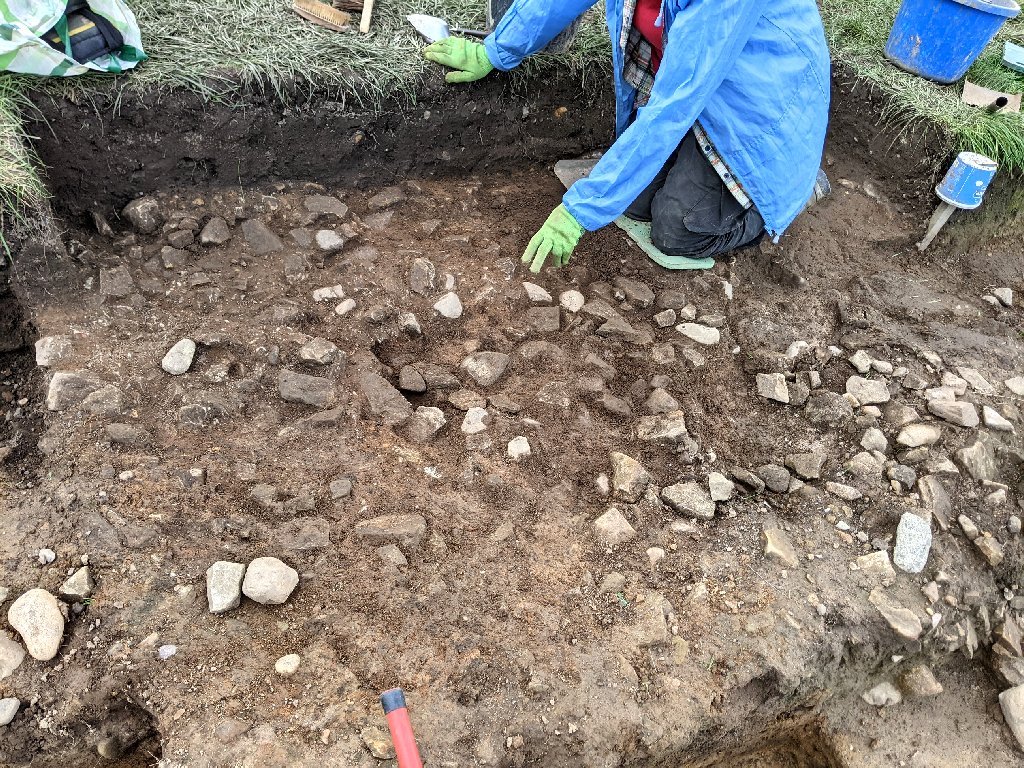
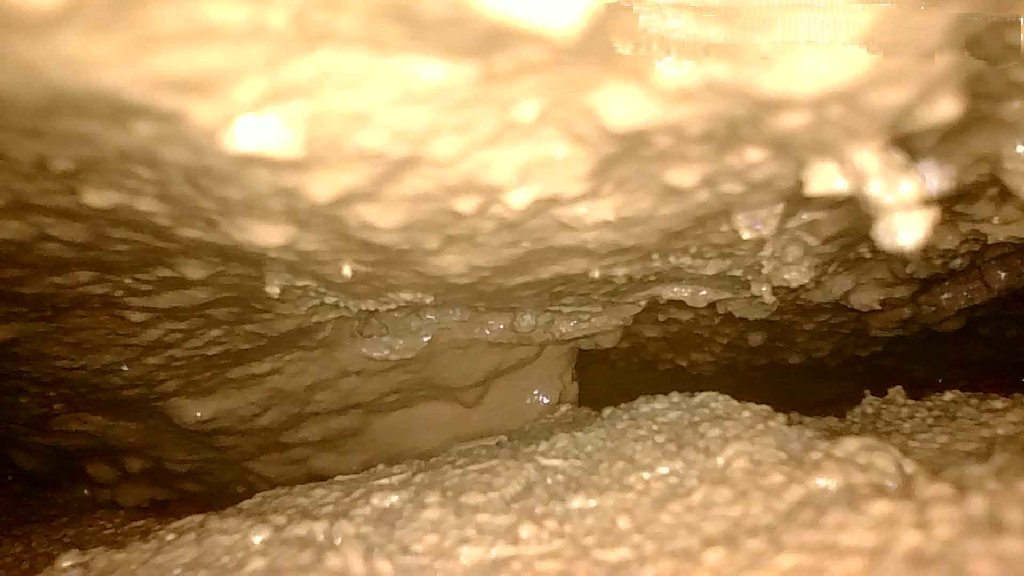
Bill asked Alison to work in the section on the southwest side of F2 where she had worked earlier in the year (now labelled Section V-V). He was particularly keen to get recorded the large stones appearing at the bottom of the section. Cleaning the section, Alison was able to reveal more of the stone revetment defining the extent of the rising sandy clay mound on the southwest side. We could also see there was quite a depth of banding below the stony layer on top of the mound. 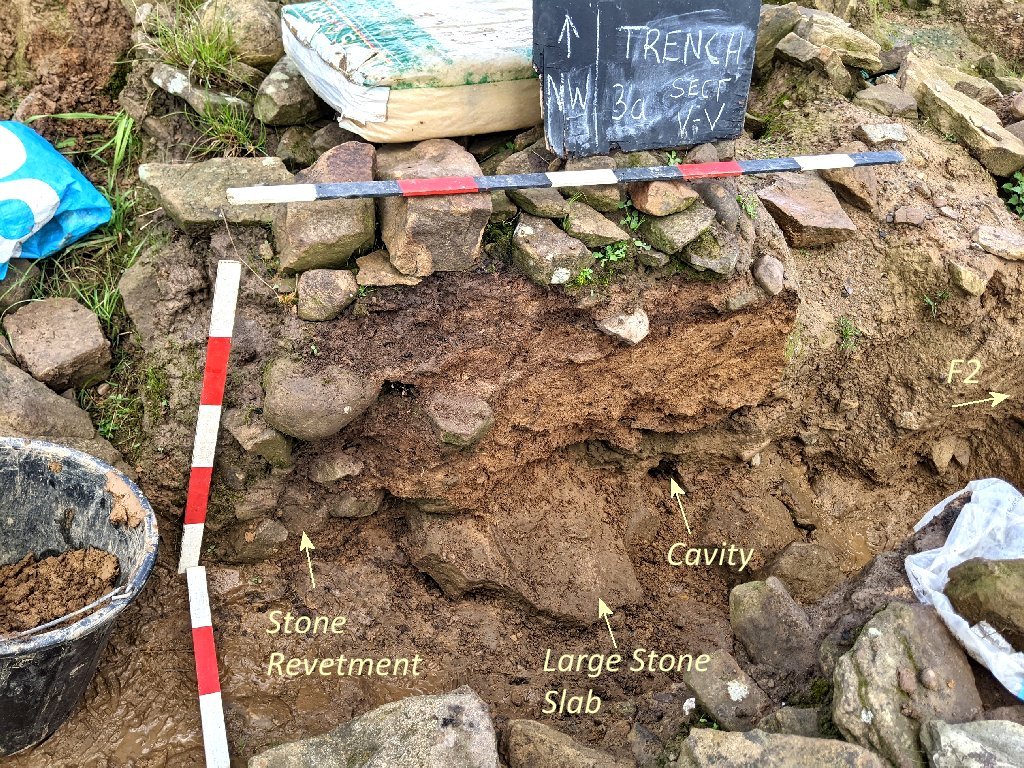 Bill had been looking at the large stone slab at the bottom of the section the week before and, working around the edge of it, had noticed a gap seemingly running underneath. He’d therefore brought the Society’s endoscope (that Janet McCarthy had donated in 2024) to see if it had any depth to it. It showed that it was a cavity (not just a result of over vigorous trowelling) and that it seemed to go all the way across the width of the stone slab.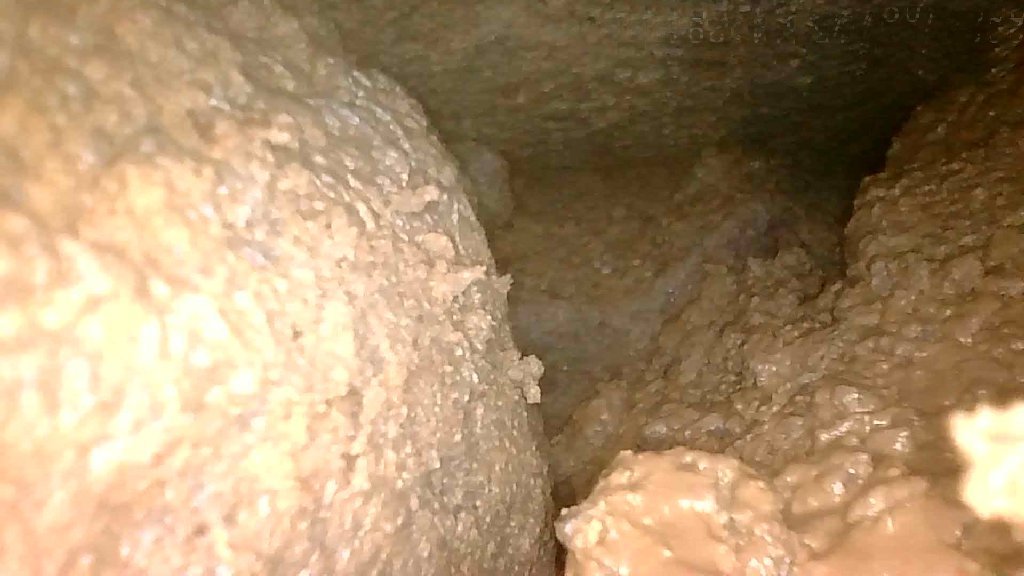
It wasn’t a deep hole though, with just more stones underneath the slab. However it did indicate that archaeology continues to go deep here. Alison pointed out another cavity a little further along the mound and again the endoscope revealed a deep cavity. This time it was at a steep angle but the bottom was couldn’t be investigated as it was just full of slutchy clay.
In the late afternoon Bill set up a string line across this section (Section V-V) and with the help of Alison to measurements so that he could update his drawing.
Thursday 10th September
Day 35
On site today joining Bill and Chris were Andrew, Peter, Jen, Steve, Gaby.
Bill asked Jen to continue trowelling the area she was working on the day before extending into Trench 1c. She was able to reveal the extent of the original Trench 1c and also what seemed like the edge of the stony layer on the northwest side of Trench 1b. 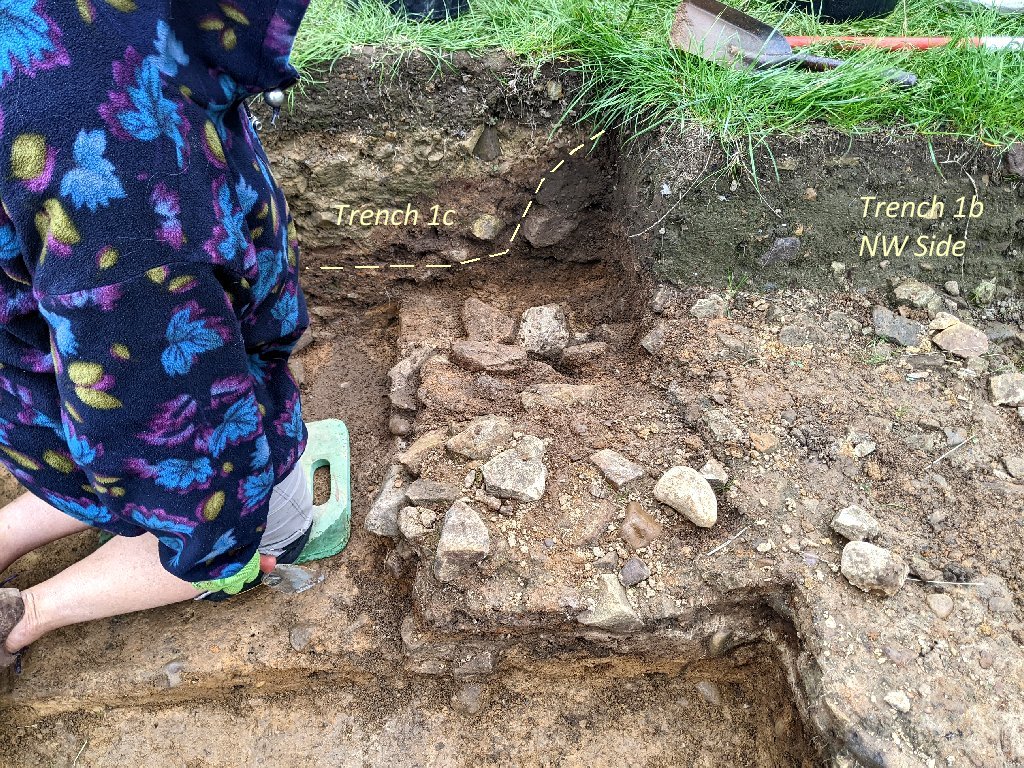
Carrying on with a series of test pits, Bill suggested an area that had appeared on the recent resistivity survey (and has it happens, on the original survey as well) just to the south of Trench 4 on the southwest side of the Ring Ditch. Here there appeared to be an outer ditch respecting the line of the first. Andrew and Steve were tasked with marking out the position that Bill had estimated from the plan layout drawing. This was 23m along the NE – SW baseline 5m offset to the southeast. Bill wanted the pit to be outside these coordinates but a misunderstand meant it ended up inside them. It was still however within the anomaly shown on the resistivity survey. As before the turf and plough soil was quickly which revealed a layer of compacted stone rubble. 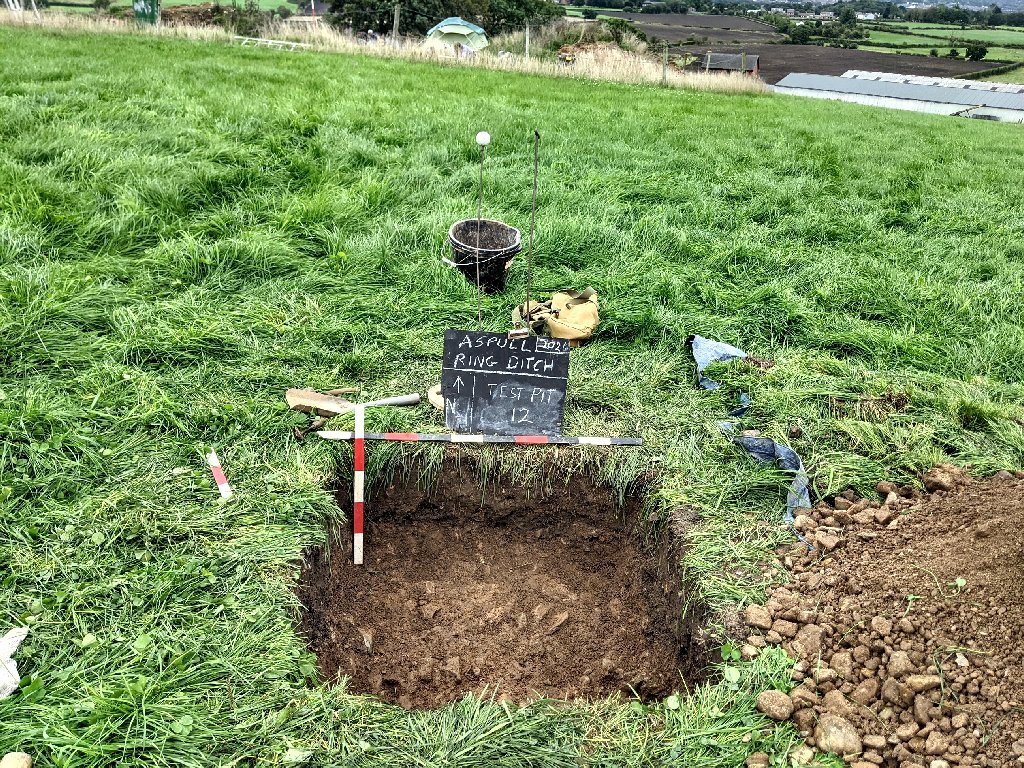 This was reminiscent of the rubble fill found in the pit excavated outside of the ditch in Trench 3 (i.e. Trench 3d). As this is now thought to be a natural formation, the conclusion was that the layer now seen also represents the original ground surface. As before the pit (now labelled TP12) was recorded and quickly back filled.
Meanwhile Peter carried on working on the area of embedded stones southeast of F2. After Chris had carefully recorded it, he removed the large stone next to where the flecks of cremated bone had been found (B9).
Gaby was given the task of carrying on where Isabel had been working exposing more of the possible post pipe she had discovered. Bill meanwhile to advantage of Patrick not being on site working on Feature F22, to finish putting his string line over it so that he could record the feature in detail.
At lunchtime Chris did a drone survey of the site (which he just about managed with blustery conditions). There was a forecast for rain in the afternoon and sure enough it arrived about 3.00 so early finish. Despite the wind, running repairs on the tent has meant we have been able to use it as a refuge between showers and also to keep things in it reasonably dry.
Wednesday 9th September
Day 34
Big turnout today with 14 volunteers on site. Joining Bill, Chris and Patrick were Peter, Andrew, Jen, Jon, Paul, Dave, Gaby, Alison, Isabel, Christine and John Needle.
With such a big turnout we took the opportunity to do some more test pitting out side the area of the Ring Ditch – following on from our first test pit (TP10a) carried out last month (Day 29) outside the Ring Ditch on the east side just outside Trench 10. There we found a thick sandy clay layer lying on top of a harder stony layer. Because of the very dry conditions it was difficult to say if it was the same as the soft sandy clay of the interior. However it certainly wasn’t the hard boulder clay we were used to seeing in the area outside or other Ring Ditch trenches. The selected location for our new test pit today way over on the southeast side of the Ring Ditch (along the NW – SE baseline, 45m from Peg 3a). The one metre square pit was planned on the northeast side of the baseline. Andrew and Dave took up the challenge and well before lunch the turfs and top soil had been removed to reveal the next layer. 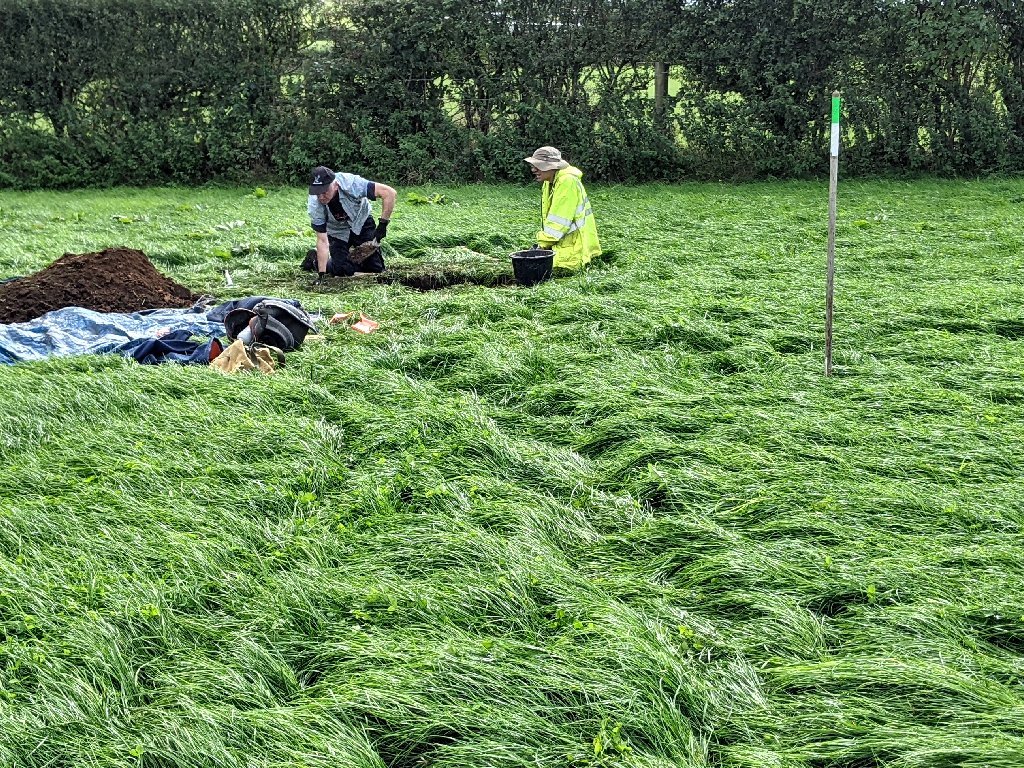 Cleaning up after lunch showed this to consist of stones perhaps broken bedrock.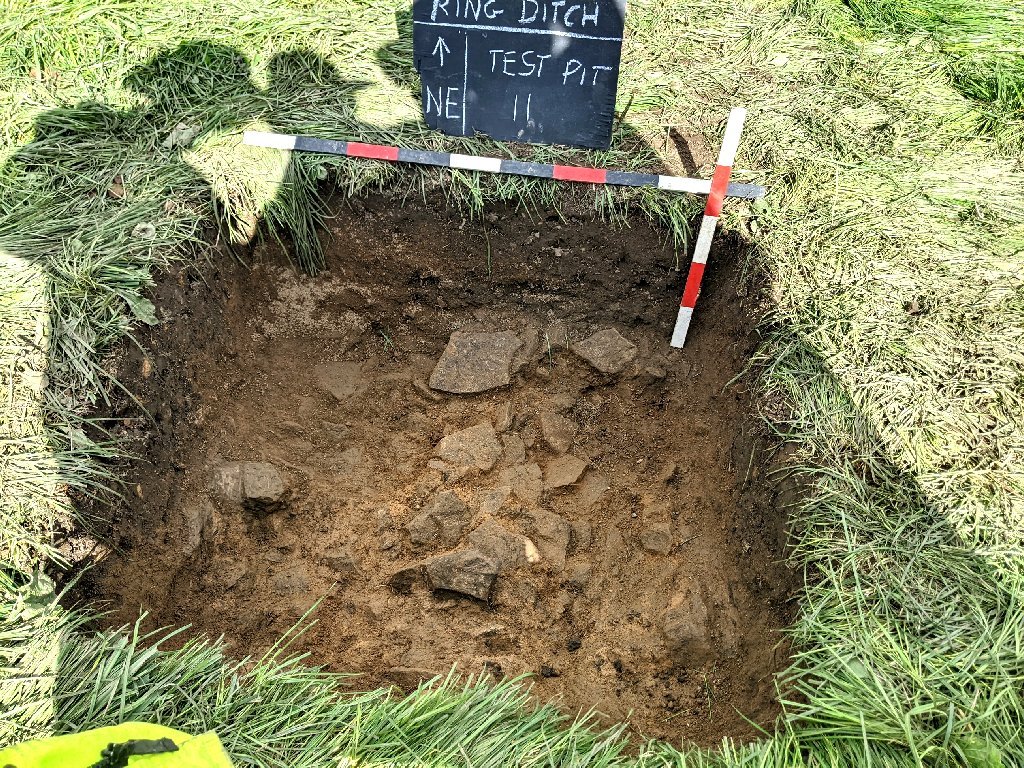
After recording the pit (labelled TP11) it was quickly back filled and Andrew and Dave turned their attention to another pit, one that had already been dug in the early days of our investigations in Trench 1. Having discovered the soft fill of the ditch we needed to be certain it was different from the surrounding compacted boulder clay. Therefore we cut (in fact it was Andrew who did it) a sondage (1.S1) a couple of metres outside the edge of the ditch. This convinced us that we had got the fill of a previously cut ditch. Andrew and Dave was now tasked with reopening the sondage so that a true comparison could be made with the previous test pit. Sure enough the boulder clay proved itself to be as hard to cut through as we had previously experienced and the bonus was that Dave and Andrew managed to reach down to the solid bedrock about 50cm below the plough soil. 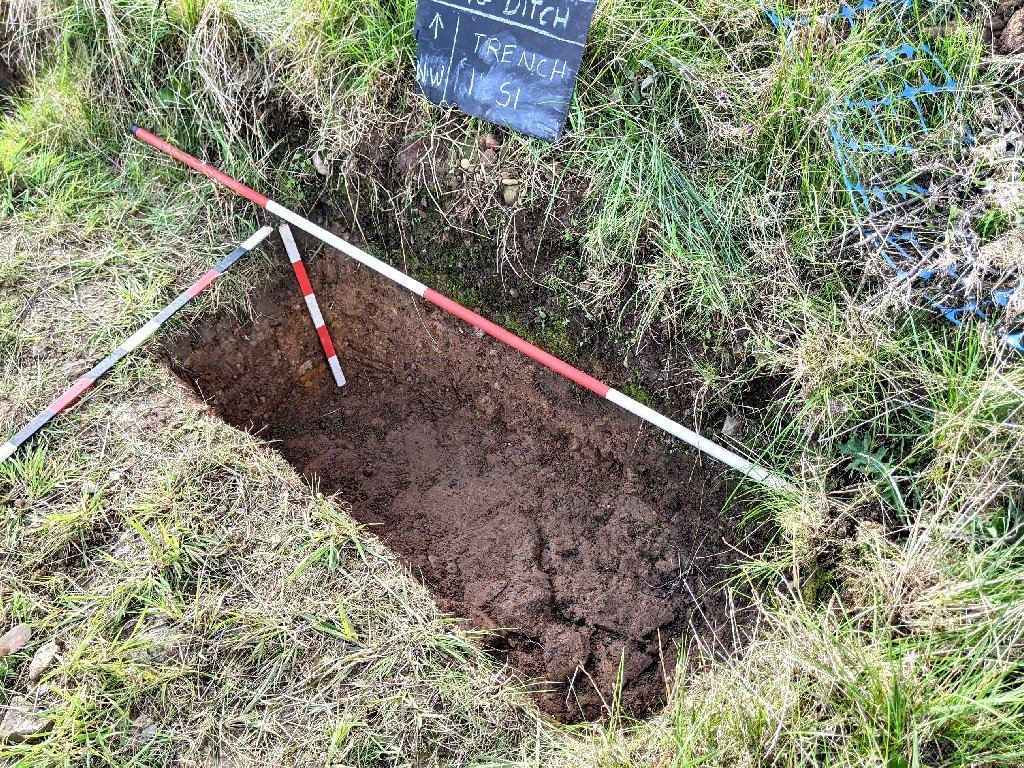
Bill asked Jen to return to the section cut through the northwest side of Trench 1b (now labelled M-M). She had opened up a section on the southwest of the strange white-ish patch she had previously discovered, taking it down the the next level (a harder stonier layer). Bill now asked her to extend this all the way southwest-wards towards and into Trench 1c. This was so that Bill could better understand the interaction between the ‘traditional’ stony layer and the imbedded stones previously seen in this area. The imbedded stones (with the greenish tinge) were certainly plentiful in this area, but so too were the ‘traditional’ stones (with the distinctive evidence of burning on them in the form of a burgundy coloured stain). 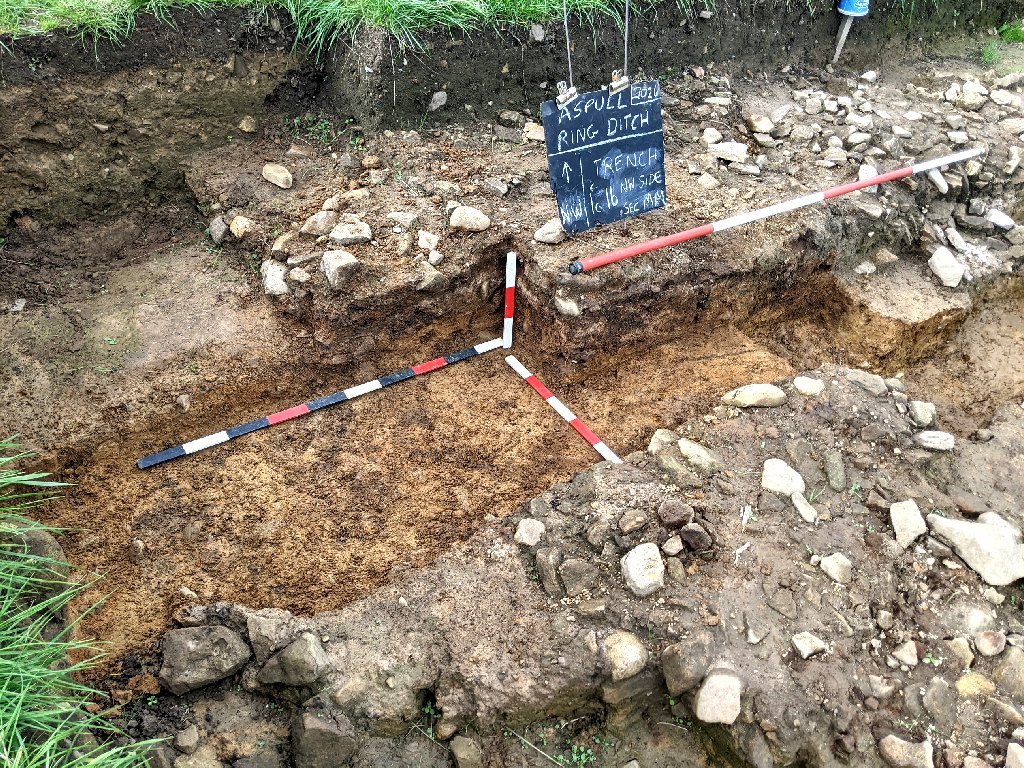 The conclusion was that the imbedded stone layer had be placed on top of the ‘traditional’ stone layer in this area (which was different for the situation in the Trench 1c section which seemed to show the stony layer diving down and finishing before the imbedded stone layer began).
John Needle was tasked with carrying on were John Trippier had been working in the section cut through the northeast side of Trench 3a (now labelled section R-R this section includes the burial F13 and ‘token’ burials F14 and F20). 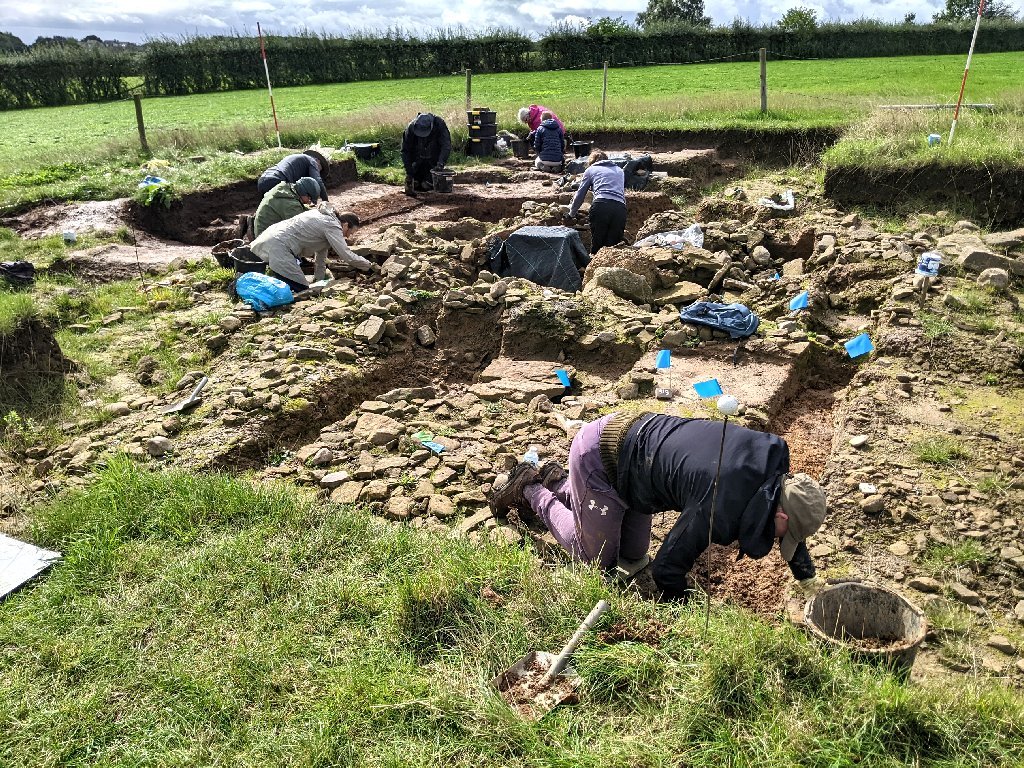 John T had come across a darker patch with fleck of charcoal and John N was able to reveal more of this patch. However no more charcoal showed up and John was able to show in the section that the patch did not extend into the upper layers indicating that it wasn’t a later cut.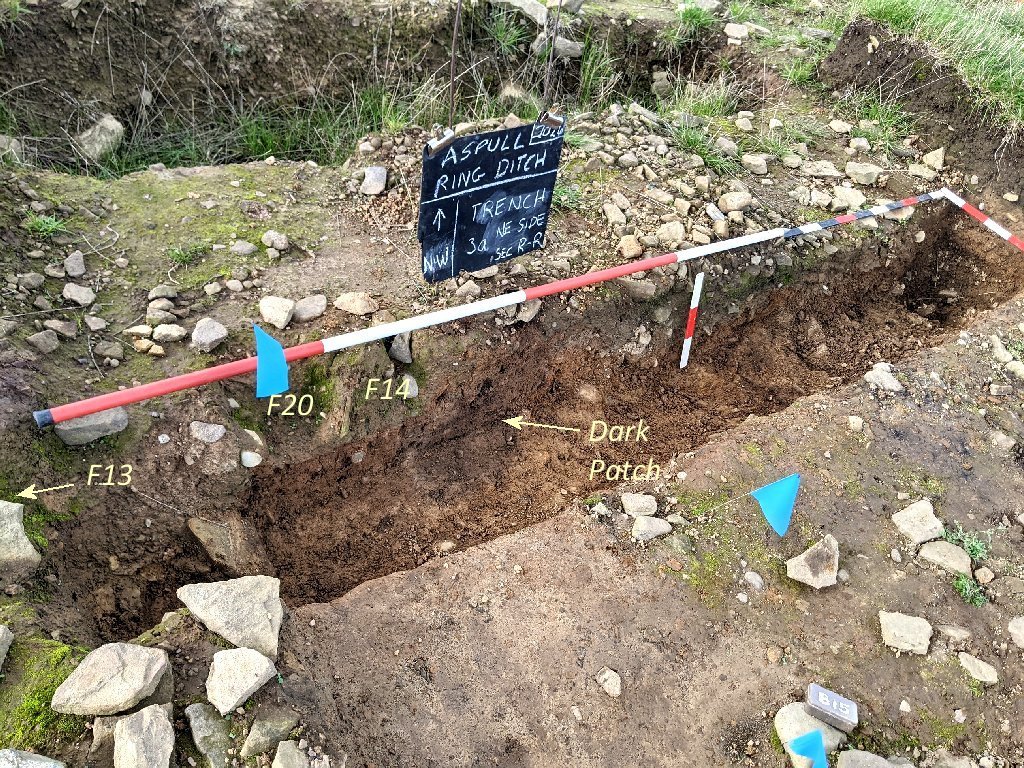
Paul and Jon continued working on the newly exposed area on the southeast side of the newly discovered burial (F9) exposing more of the red-ish black layer. Christine and Gaby continued working on the area to the southeast of F4 (the clay-line pit burial) taking the mottled clay layer down to the burnt layer. Meanwhile Patrick continued working on F22 carefully creating a section through the feature on the northeast side. Chris was monitoring the progress with his iPhone modelling software while Bill began to set up a string line along the full section through the circular aligned large stone feature.
Isabel carried on taking the section down on the southwest side of F2 where she had previously discovered a large piece of charcoal. This time she exposed what seemed like a post pipe (i.e what is left of what would have been a wooded post). We have seen these before cutting through the stony layer but sealed by the mottled clay layer. This one though was sealed by the stony layer. 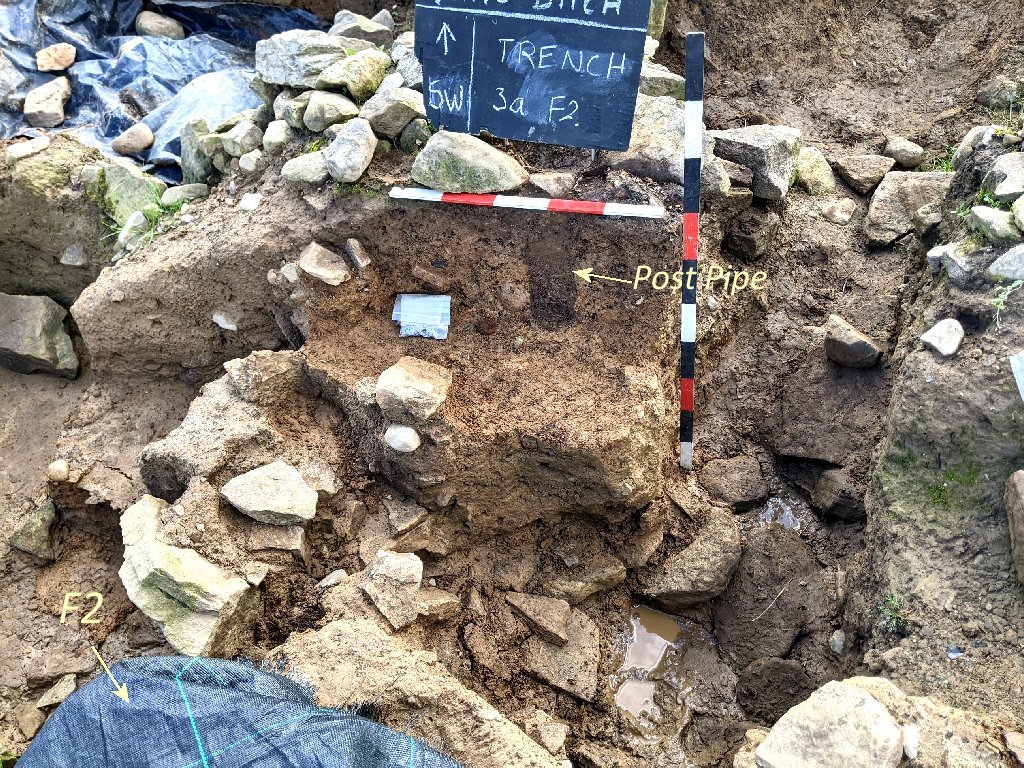
Peter and Alison meanwhile worked on the area of embedded stones southeast of F2 (next to Sondage 3a.S5 Ext) where Chris and Susan had been examining the week before. The were able to reveal a depth of stones defining the edge of the embedded stones in the rising sandy clay mound. 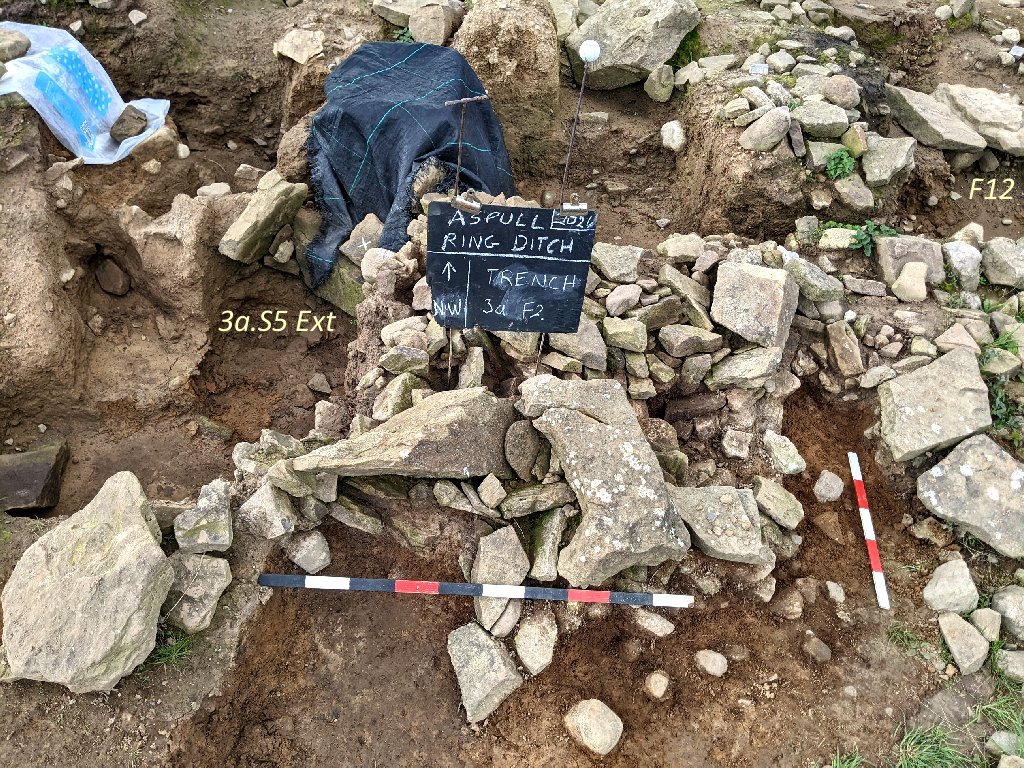
Thursday 3rd September
Day 33
Joining Bill (back from his hols), Chris and Patrick today were Gaby, Susan, Alison, Louise, Isabel and Christine Morton.
Chris and Patrick spent some time bringing Bill up to speed with the latest developments.
Isabel carried on working on the newly discovered deep stone feature on the southeast side of F2, while Alison expanded the cut connecting Isabel’s cut with Sondage 3a.S5 Ext. So far no more large stones were exposed. 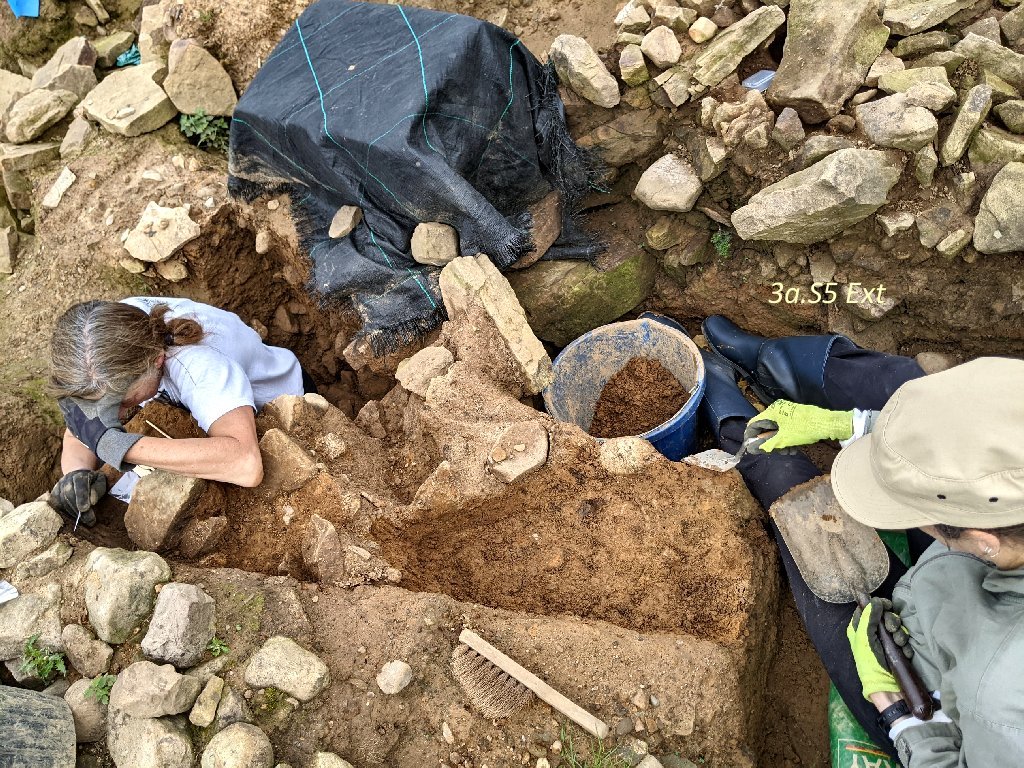 However Isabel found a large piece of charcoal, quite high up in the sequence just under the stony layer, that looked like a burnt branch.
 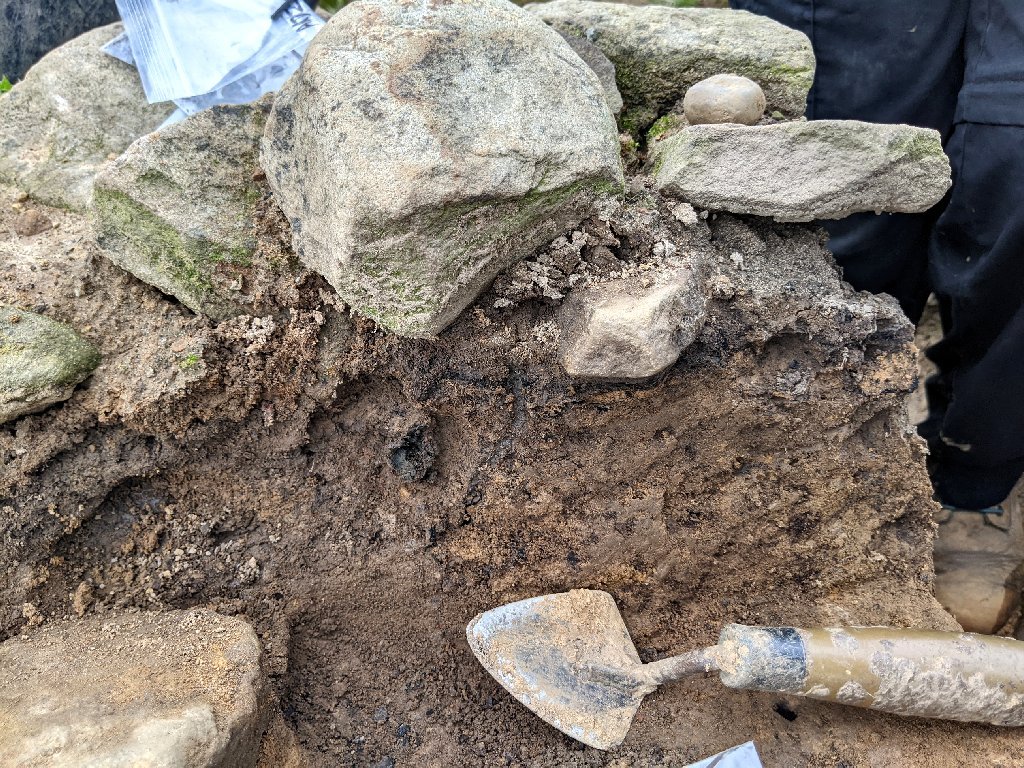 She has carefully worked round it (to be lifted next week).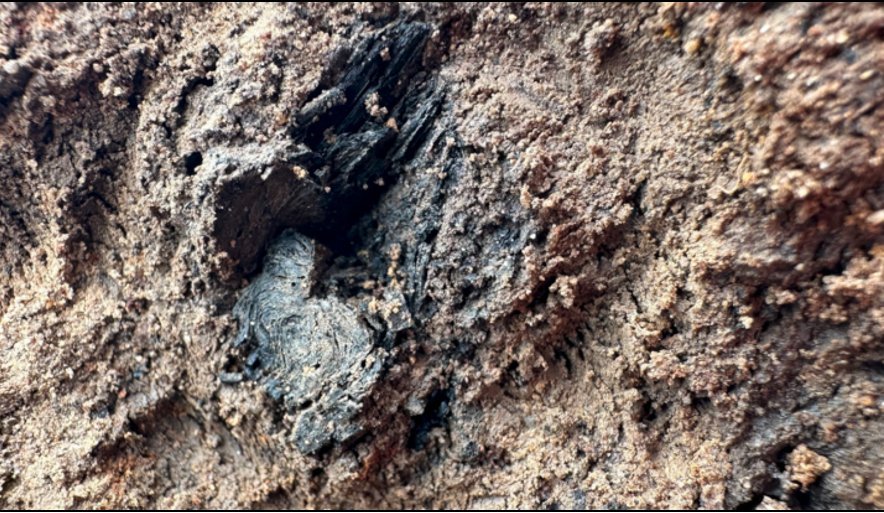
Colin and Louise continued the work on the newly opened area to the southeast of the latest burial (B27 F9) to expose more of the red/black layer. 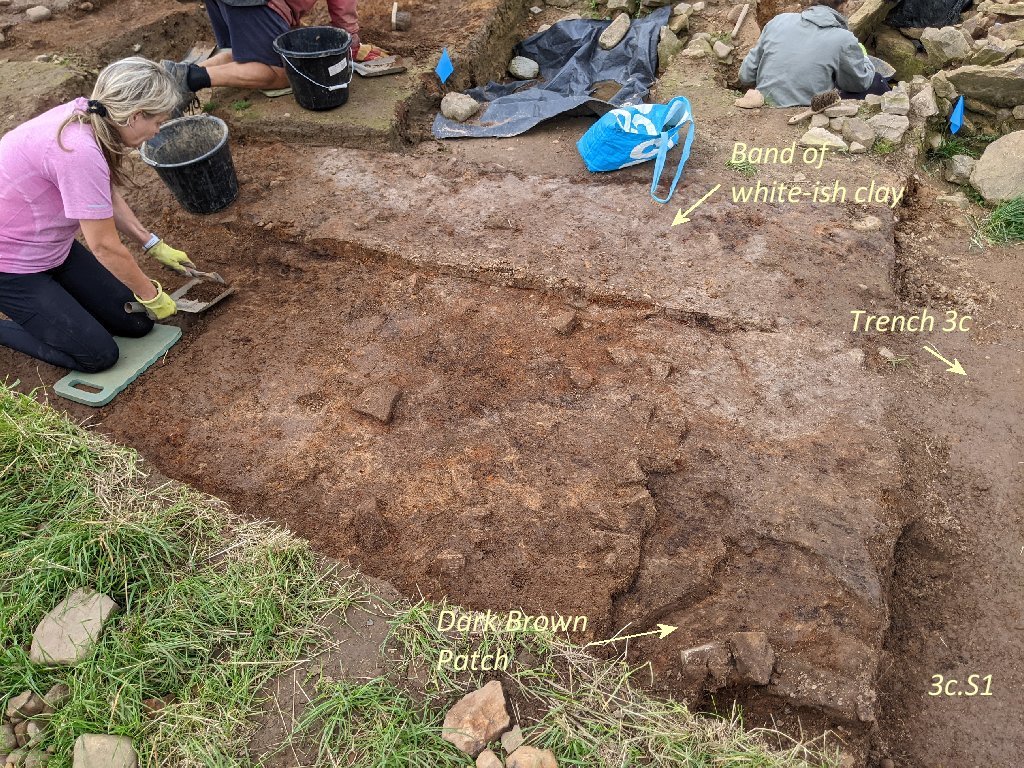 Colin then moved to the west of the burial to carry out the same exercise there.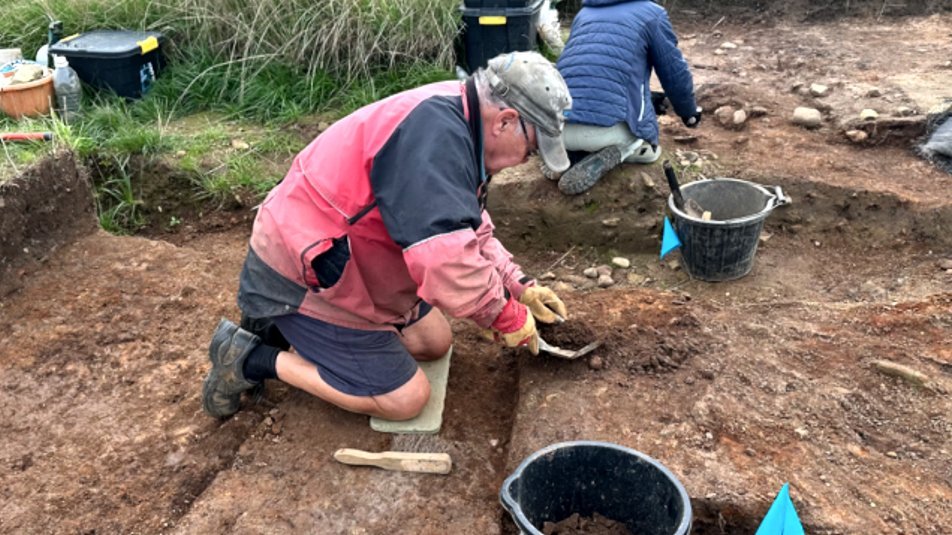
Christine and Gaby continued working on the area to the west of the clay-lined pit (F4). Gaby half sectioned an area with the collection of stones and a different fill to the surrounding area but proved inconclusive. 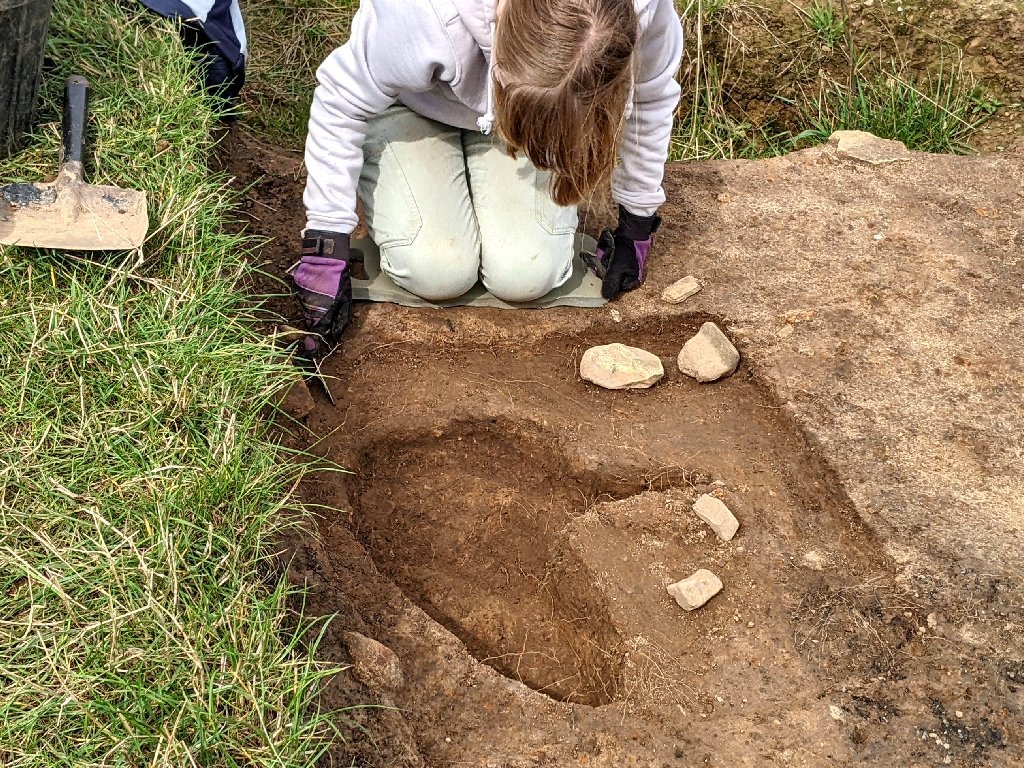 Christine found a similar area with a darker fill, which Gaby prepared for half sectioning next week.
Patrick continued to work on F22 lowering the level of ground that had been supporting the large stone block removed last week. An interesting cut started to appear filled with small stones, showing that this is a more complex feature. 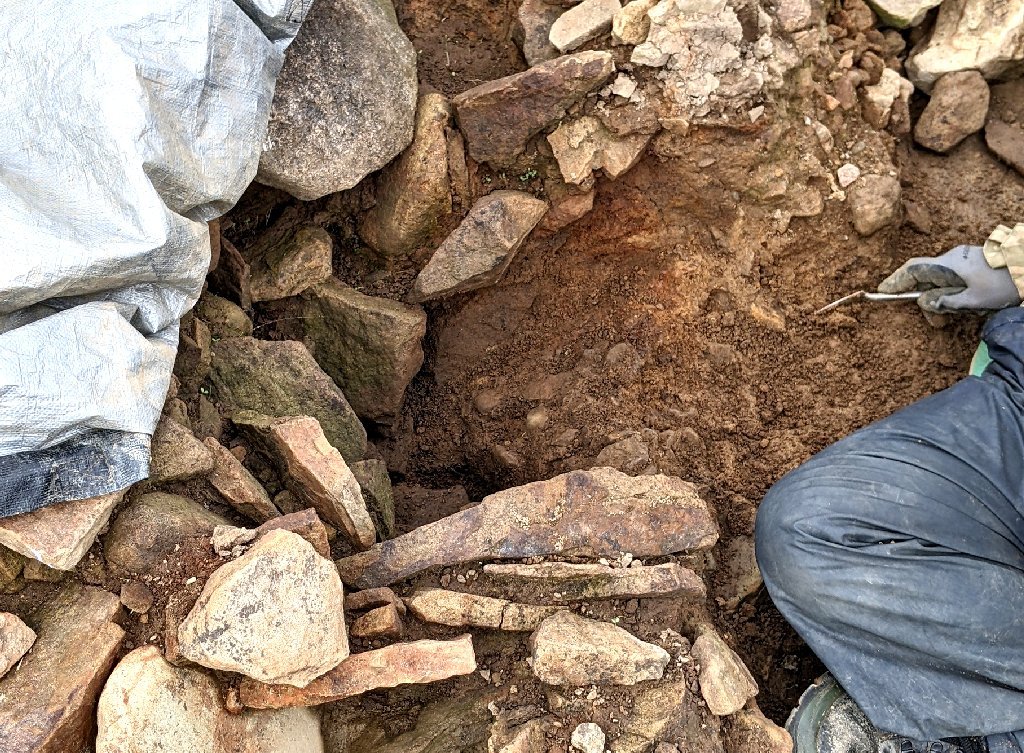
Chris and Susan examined an area in the embedded stones in the rising sandy clay mound southeast of F2 where flecks of cremated bone had been noticed earlier in the week (Bill noticed this was where flecks had been found before and been labelled B9). There was no evidence of more bones in the surrounding area. 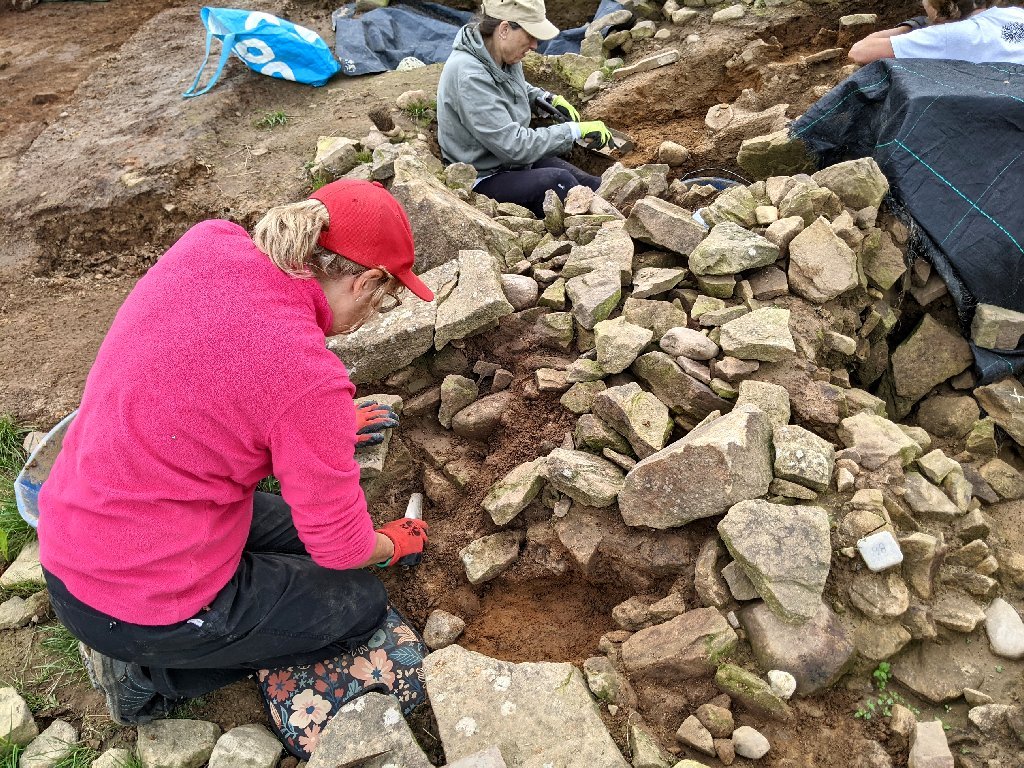 The investigation then moved to the other side of the collection of stones to try to find the spot where the deeper stones began.
Tuesday 1st September
Day 32
Ten volunteers on site today. Joining Chris and Patrick were Susan, Gaby, Isabel, Louise, Jen, Paul Langin, John Needle and Dave North.
Susan and Gaby continued to work on the area of mottled clay to the southwest of the clay-lined pit (F4). First, they investigated the small reddish clay area surrounded by a dark circle spotted last week. This disappeared after a few scrapes of the trowel. Gaby then started to clean an area where there was a small collection of stones which appeared to be in a different fill in the mottled clay. 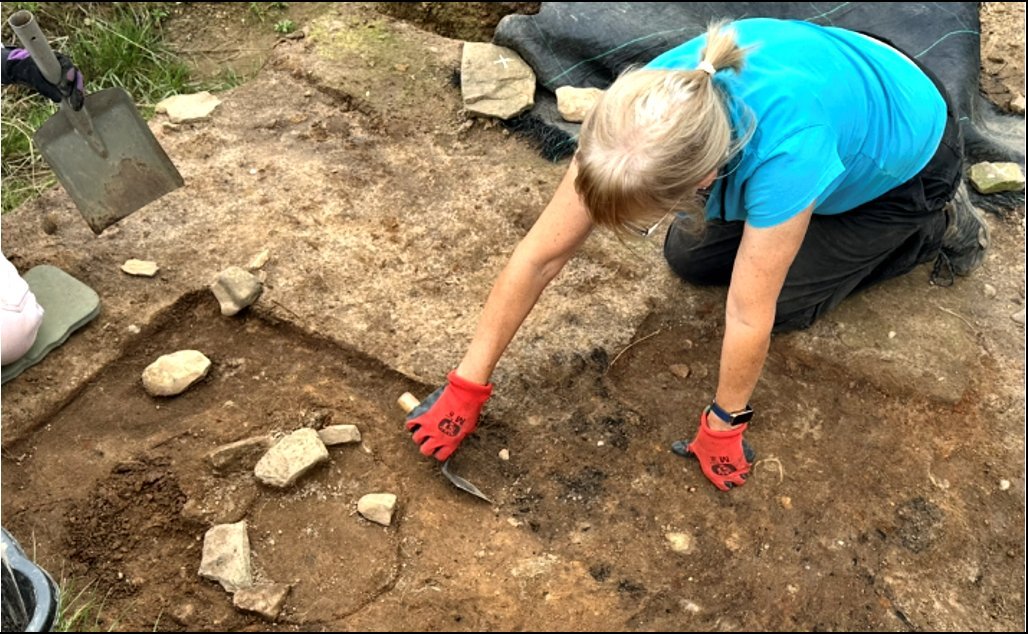 Once the area of the fill was defined, Chris asked Gaby to half section it to see how deep it was.
Jen was tasked with cleaning an area Bill opened up last year on the southwest side of the possible cist within the rising sandy clay mound (F11). After removing the loose clay she straightened the edges and went as low as possible. This was to see if there were more deep stones that match the deep stones found in adjacent trenches Alison has been working on. 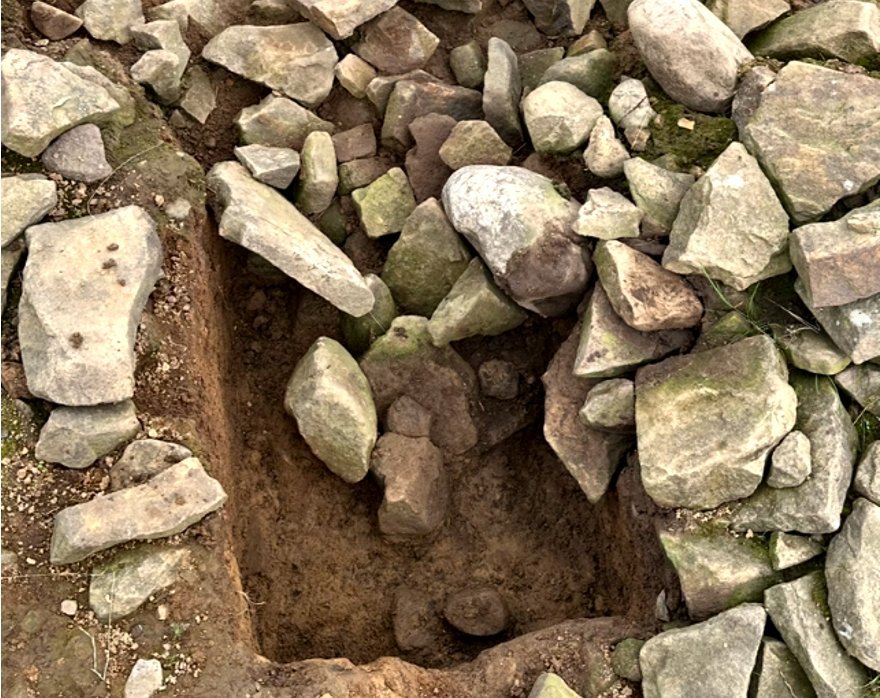
Isabel continued to expand the area on the southwest side of where Urn2 was lifted last year with the emphasis on investigating the lowest levels. She did indeed find more stones at depth, but they were smaller that their larger neighbours. 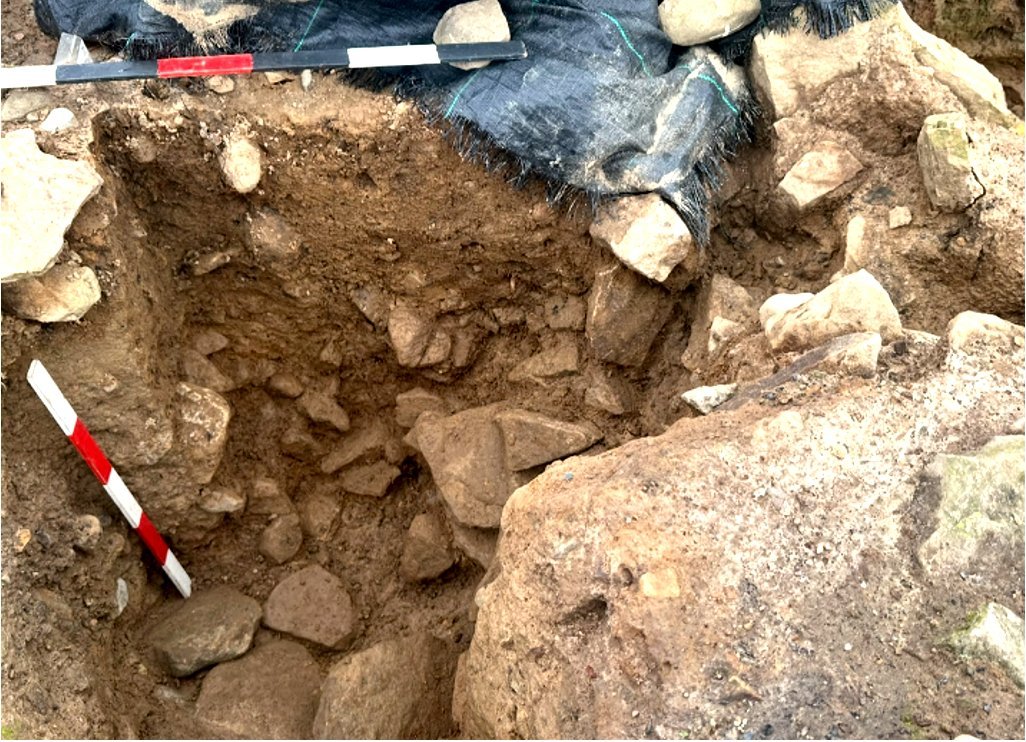
After improving the walkways he built last week around the site, Dave was tasked with opening up a new area of the ditch in Trench 1. This used to be the lower step of our entry point in previous years. More of the usual flat stone floor was exposed. 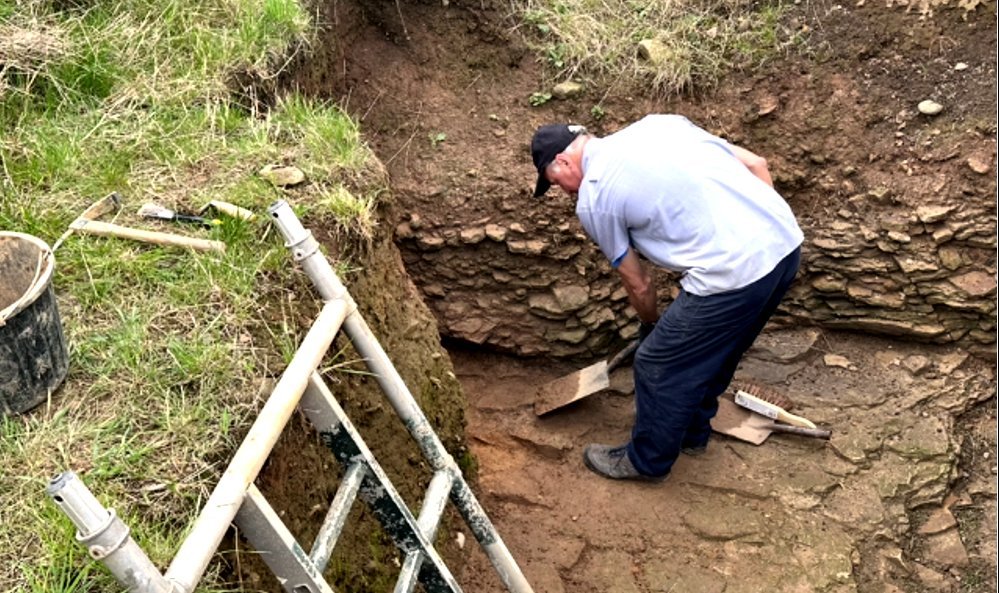
Paul, John and Louise continued the work on carefully removing the mottled layer to the southeast of the newly discovered burial (B27 F9) to allow the investigation of the burial to expand.
Paul then worked on an area on its northeast edge next to Trench 3c (Sondage S1). This is no far from where in our second season, we discovered that the red/black burning layer rose to the surface before disappearing and reappearing on the other side of the rising sandy clay mound. It is also noticed that the red layer (possibly iron pan) is much harder in this area. After cleaning the sections to check the depths of the red/black layer Paul came across a deeper section of darker brown material that seemed to have larger stones embedded. 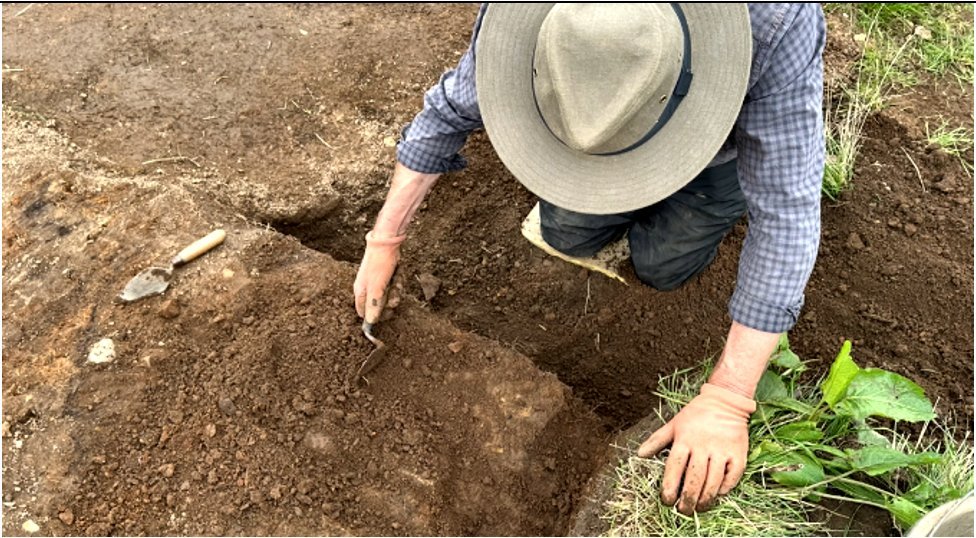 This was first seen in 2024 when the sondage (S1) was cut in Trench 3c (Bill has it recorded in his section drawing). This was then investigated by the team and will be continued on the next session.
Patrick continued working on the stone arrangement (F22) at the centre of the circular alignment of large stone. He tracked the area that contained charcoal which now can be shown to extend across the lower level. 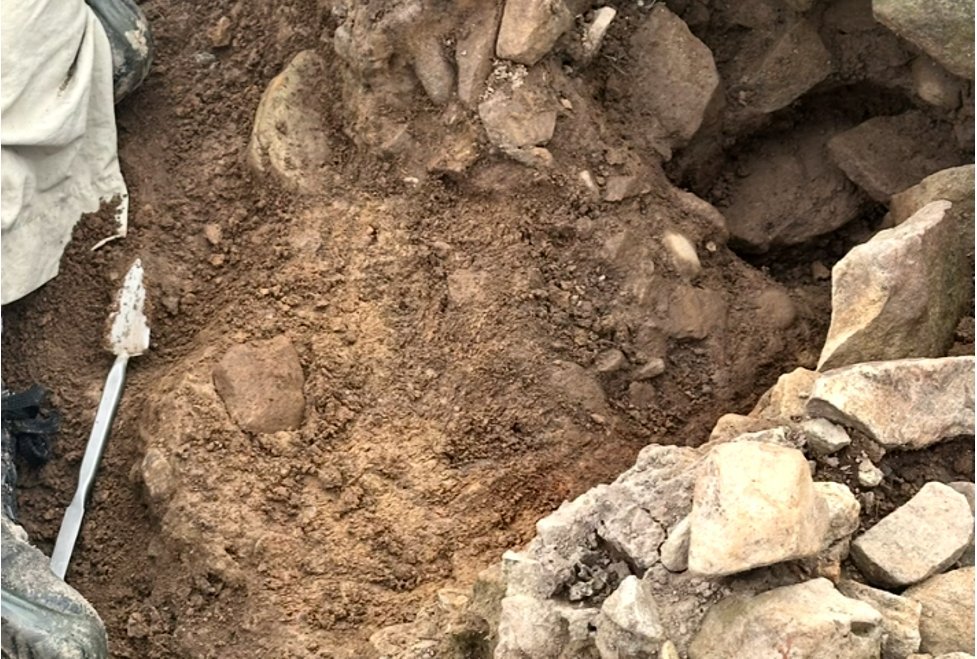 As a new layer of stones were now visible at the base of the pit, it was decided to approach from the side where the large block stone had been removed. This should give us the chance to see more of the lower layers of stone and allow a decision to be made how to proceed with this investigation.
Wednesday 26th August
Day 31
Another good turnout with Christine, Jon, Peter, Gaby, Susan, Paul Langin, Alison and Louise joining Chris and Patrick to today. The day started off with drizzle and the occasional shower but cleared up as the day progressed.
Peter continued working on the area to the south of the location of Urn 2 (F2) and was joined by Alison who was familiar with the new deeper stone area. She worked on the area close to where Urn2 was positioned before lifting, uncovering a thin layer of small pebbles which Chris remember seeing under Urn 2. 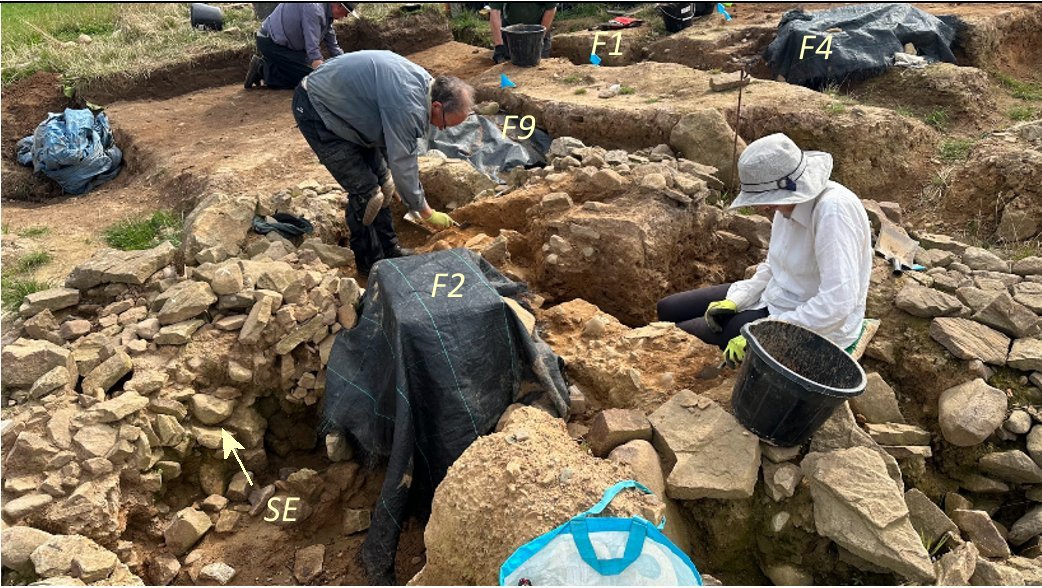 Alison expanded and recorded this area of pebbles which will be removed next week to expose more of the deeper stone work.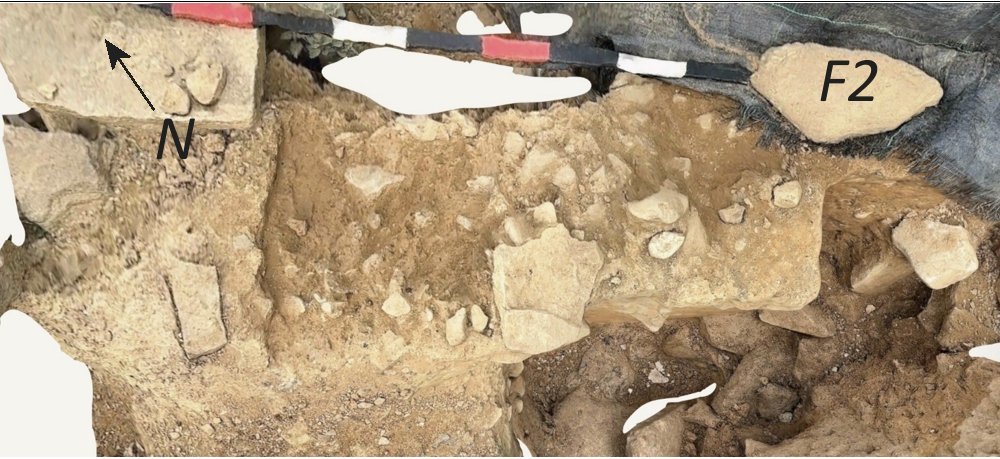
Peter meanwhile revisited the section he and Chris had originally cut 2 years ago (Sondage 3a.S5 Ext) to confirm that there were no stones adjacent to the newly discovered deep stones. 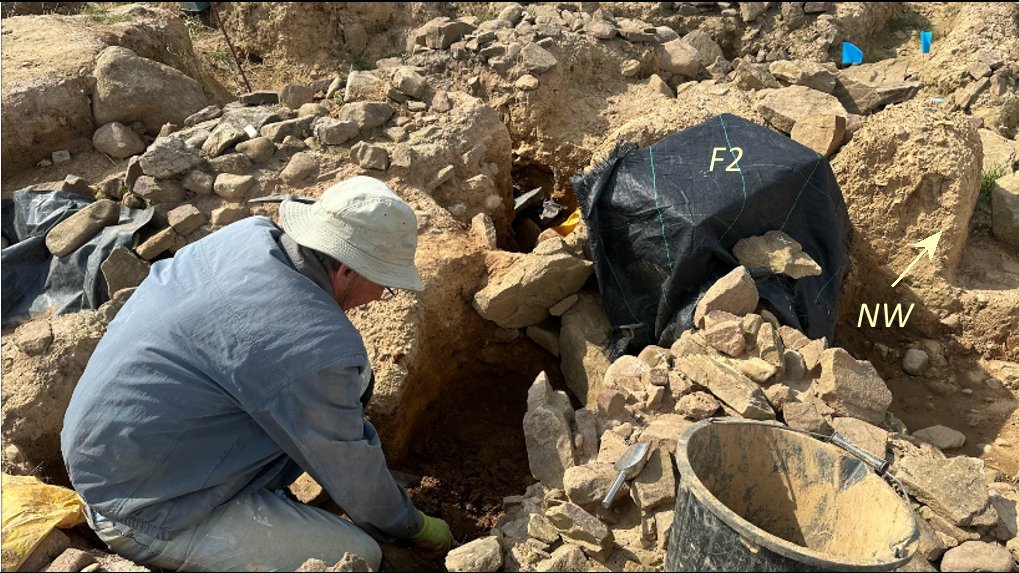
At the end of the previous day Patrick had spotted another fossil which was examined and recorded. 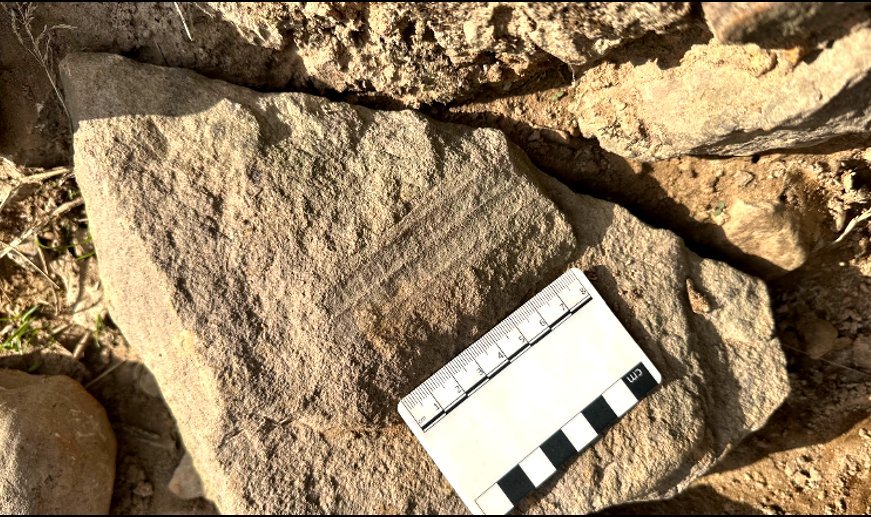
Paul continued to de-turf the area to the southeast of the newly discovered burial (F9 – B27) started by Colin the day before. This is to allow for further excavation and leave room for everyone to access the west side of the excavation. Jon and Louise then started cleaning the recently exposed area. In the afternoon Paul joined Jon in taking down the remnants of the mottled layer to examine the red layer beneath it. 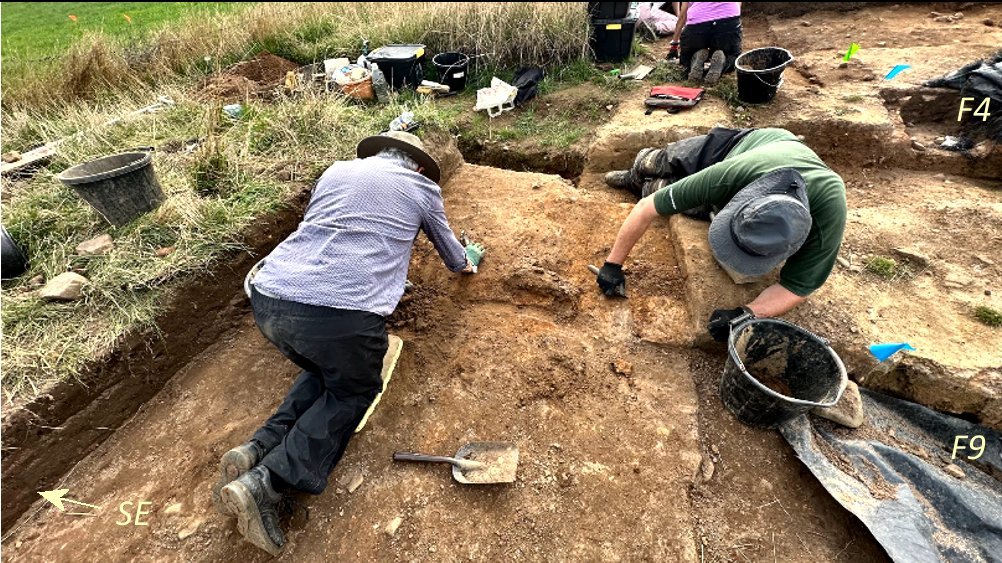
Christine joined Susan and Gaby cleaning the area southwest of F4 they started the day before. A large area (2m2) full of charcoal flecks was exposed. In the afternoon Susan and Gaby worked on the southern half of this area and discovered an intriguing red clay shape with a black outer lining. 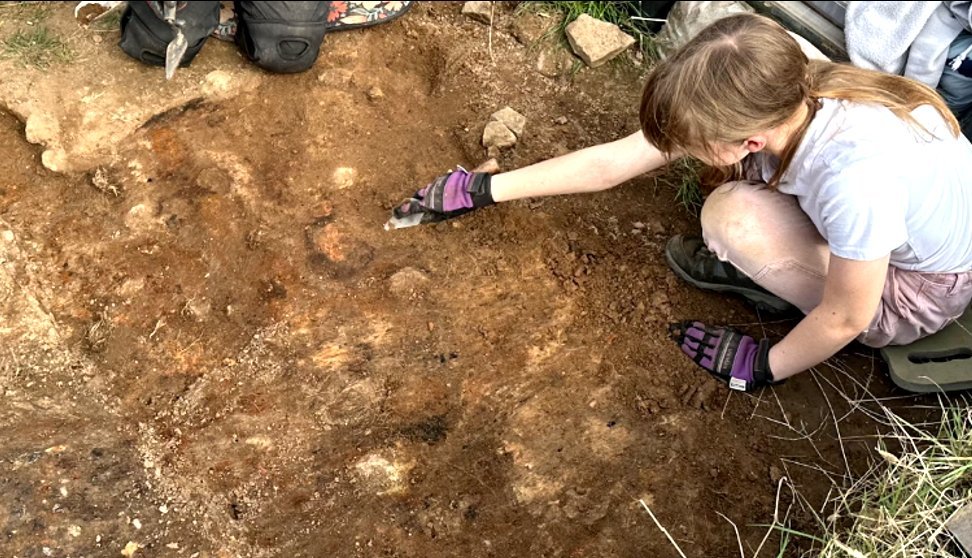 This looks too small to be another urn, and will be carefully excavated next week.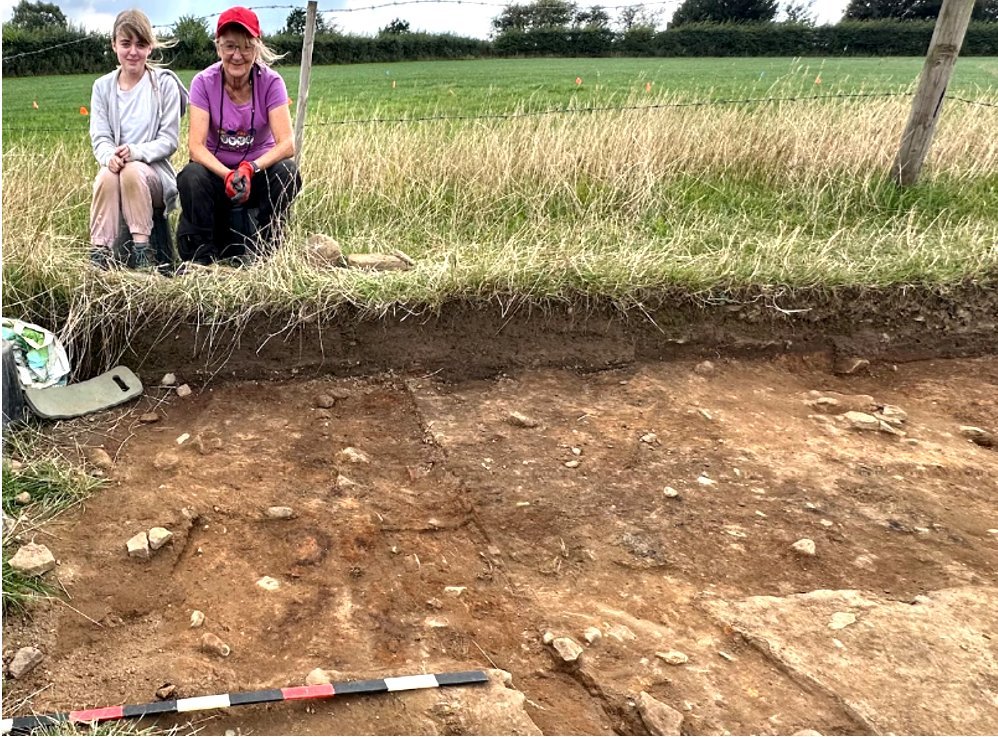
Patrick continued to carefully explore the base of the F22 pit he had been working on the day before. With himself and Chris recording events, he tried to reproduce the black stain we had seen with limited success. 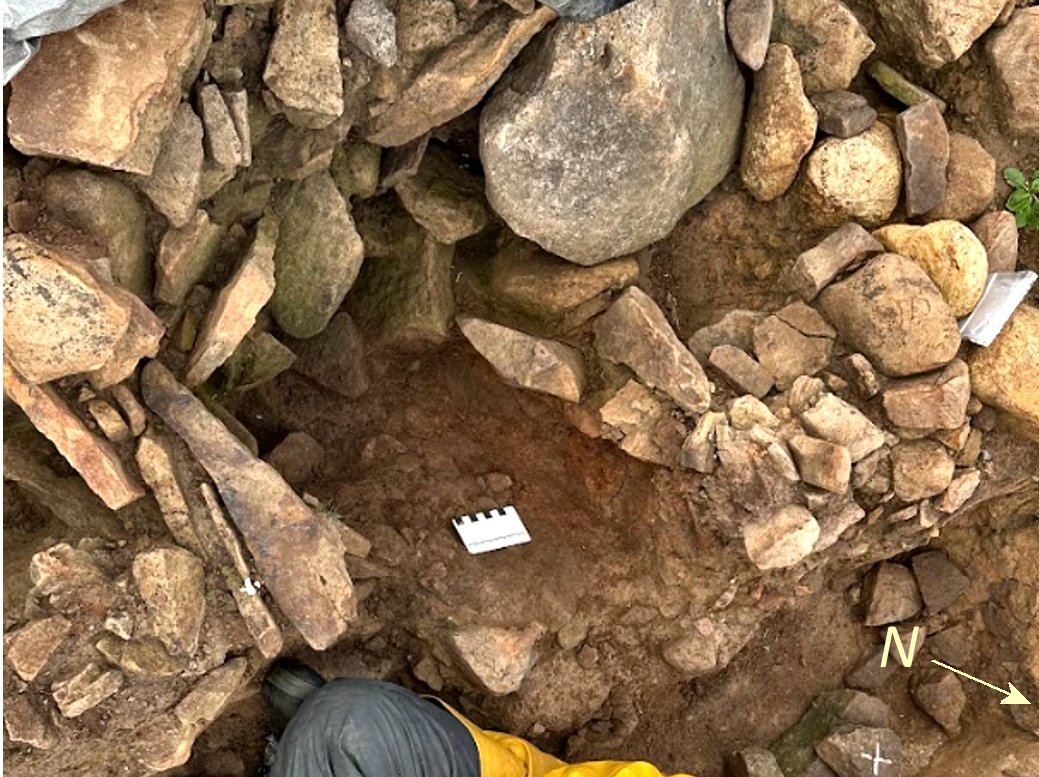 However, it was clear that there was plenty of charcoal in the base of the pit which was carefully collected and bagged. After hours of work on the floor of the pit, Patrick found evidence of a large area of charcoal.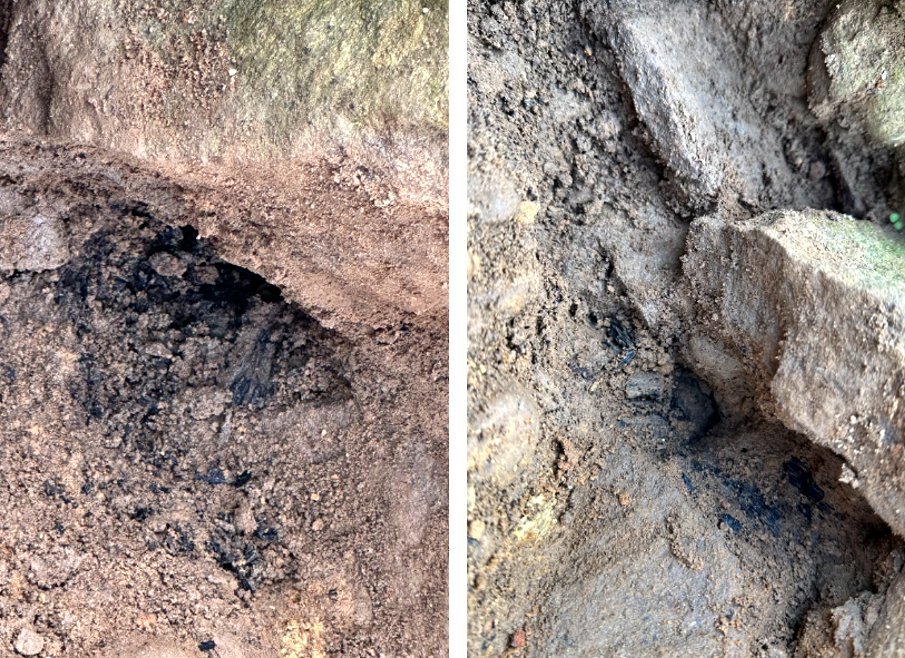
After recording 3D models of all the areas worked on today, Chris carried out a drone survey of the site. 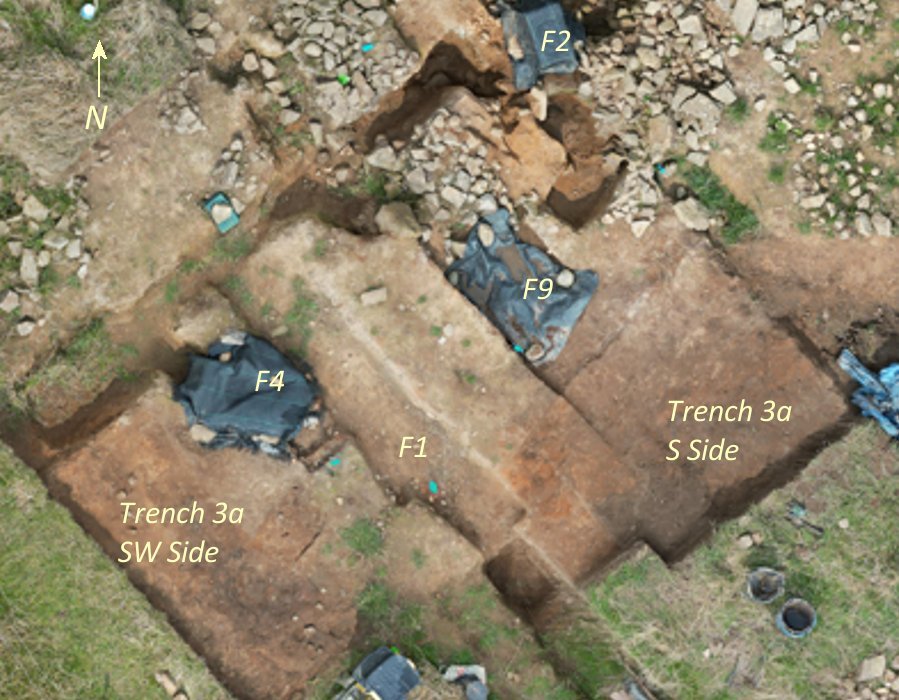
Tuesday 25th August
Day 30
Good turnout today – Chris in charge with Bill off on his hols again. Joining him and Patrick were Susan, John Trippier, Gaby, Peter, Isabel and Colin. We also had new starter Louise Vose (one of last week’s tour locals).
Louise’s first task was to start cleaning the mottled layer near our clay lined pit (F4) begun last year. 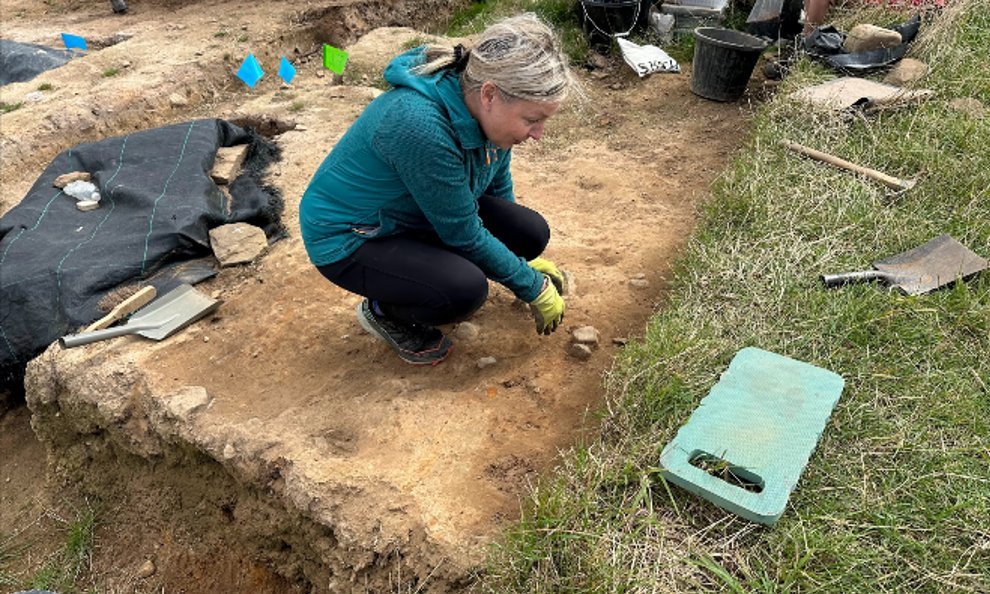 Susan, Gaby and Isabel joined Louise in cleaning this area. The red (possibly iron pan) layer around F4 is different to the rest of the site, being very hard. Hopefully by seeing more of this layer we will get a better understanding of it.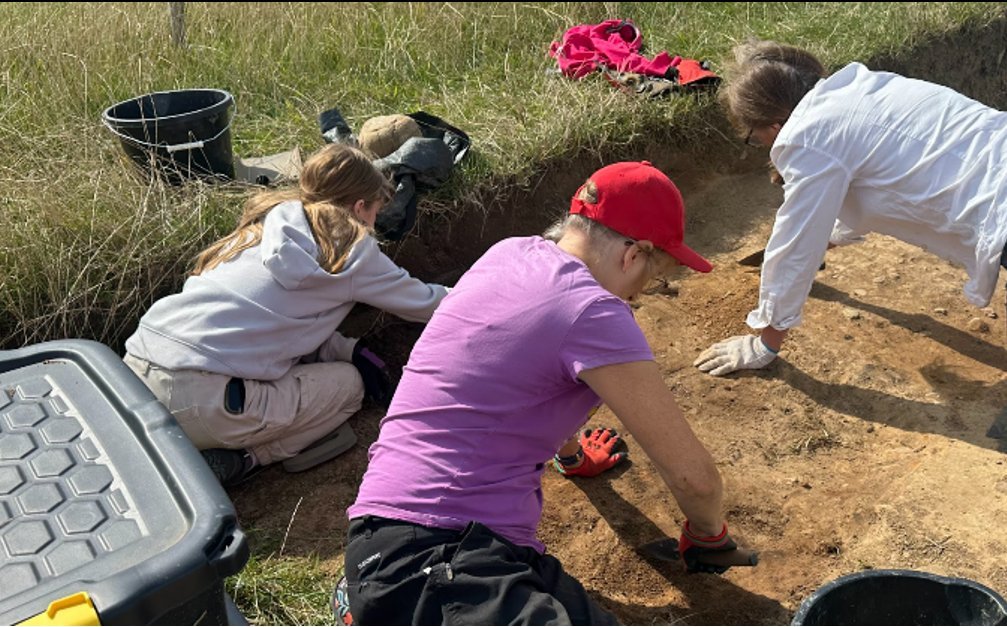
John Trippier continued the work he had started the previous week in the section with the major burial (F13) and ‘token’ burials (F20) and (F14). A dark semi-circular patch was still visible and after cleaning the area flecks of charcoal became visible. 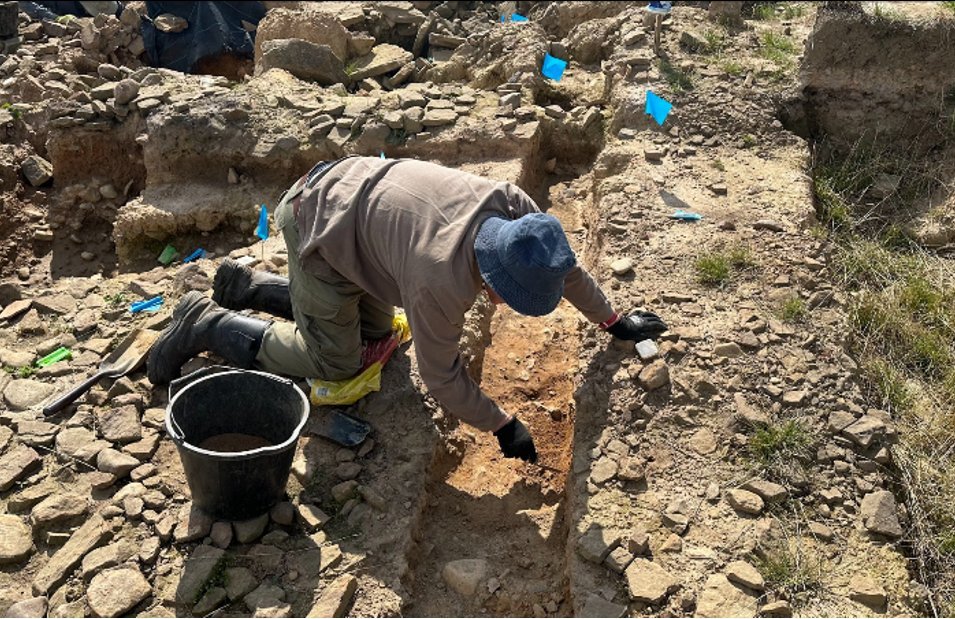
Colin removed a half meter section of turf on the southeast of the newly discovered burial (F9 – B27) to allow better access.
Peter continued to expand the area to the south of the location of Urn 2 (F2) and found more embedded stones rising up to where we had previously discovered a large stone block on the southeast side of Urn 2. 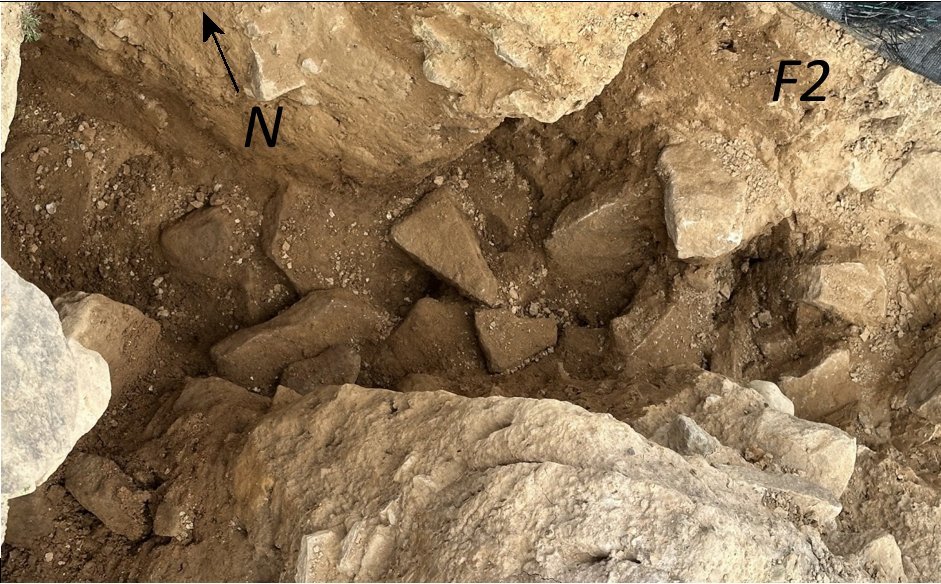 At the moment we have no explanation as to what this feature could be. It could possibly be foundations for our central rising sandy clay mound, or an earlier feature that was in position before the mound was built.
Chris and Peter began work on the stone arrangement (F22), the feature at the centre of the circular alignment of large stone. A large roughly circular stone (maybe a capping stone) was carefully recorded and then lifted to see how far the deep pit area extended. Disappointingly, there were no stones underneath. 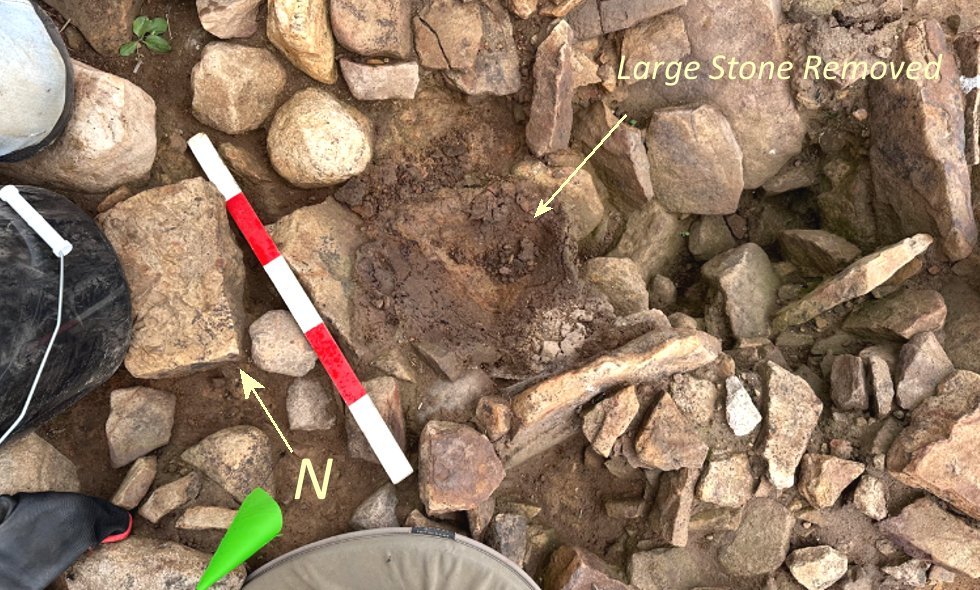 This area was then carefully recorded and the stone replaced. This suggested that the deep pit area was smaller than we thought.
After a discussion between Chris, Patrick, Peter and John, it was decided to lift the large stone on the northeast side of F22. Patrick and Chris recorded the removal of overlaying stones and then all gathered round to carefully slide the large block out. 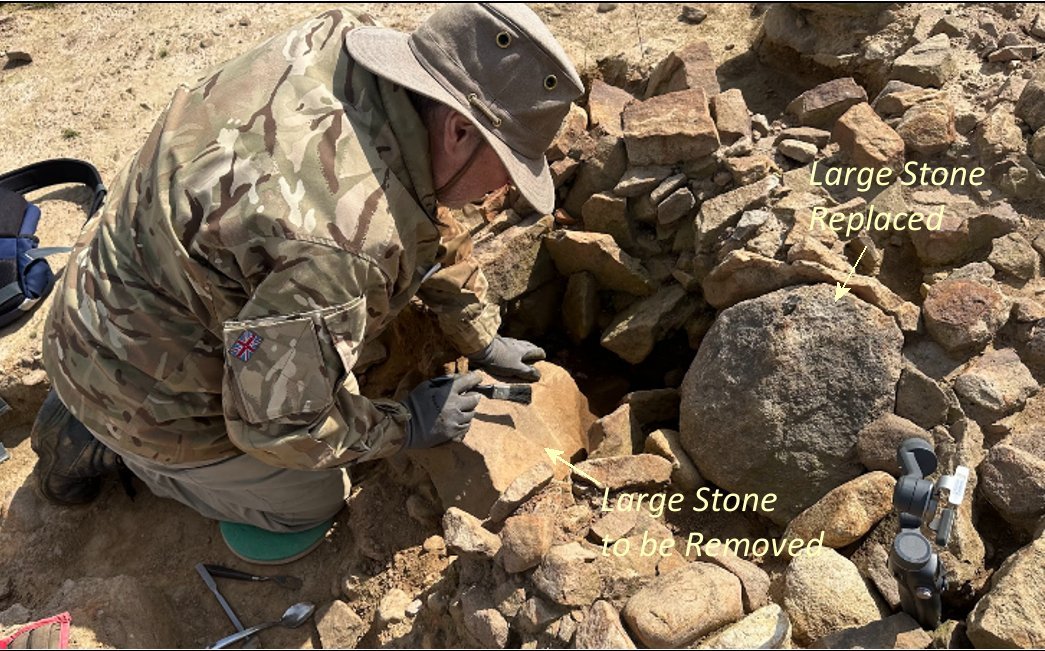 After cleaning away the loose material that had fallen in, again nothing of interest was revealed.
 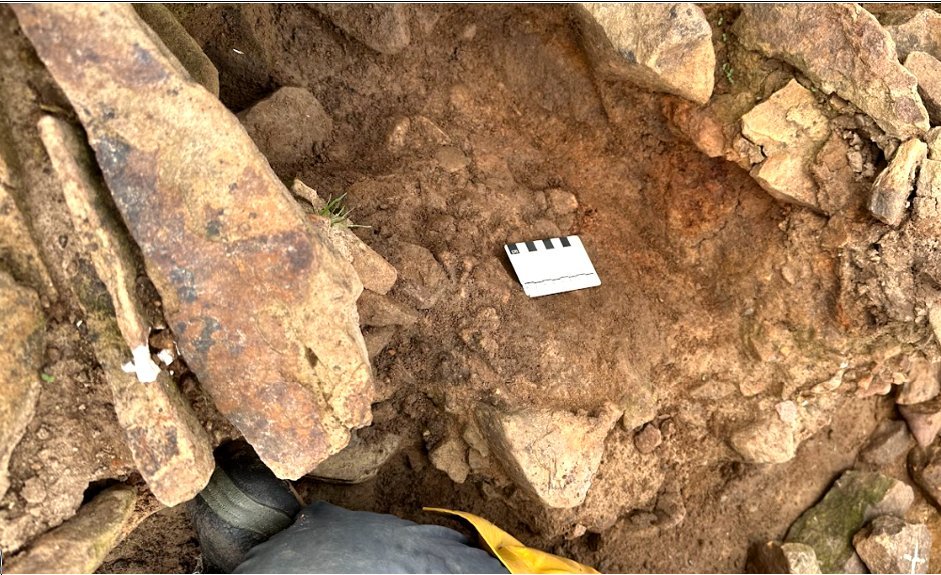 However, as a end of day test, Patrick inserted a leaf trowel through the clay at the base of the pit to check for any lower stones. No stones were detected, but when the leaf trowel was removed, it was covered in a substantial amount of a black substance which was wet probably charcoal.
Wednesday 19th August
Day 29
Not a great turnout today with only Andrew and Jen joining Bill and Chris with Susan arriving at lunch time.
Jen continued working on the section she had cut through the circular feature she had uncovered a few weeks ago on the northwest side of Trench 1b. Bill asked her this time to take it down through the underlying soft sandy clay till she reached the next level (presumably the harder stonier surface we’d seen in the other trenches). By lunch time she had reached this level and Bill the asked her to expand this as far as she could along the trench. 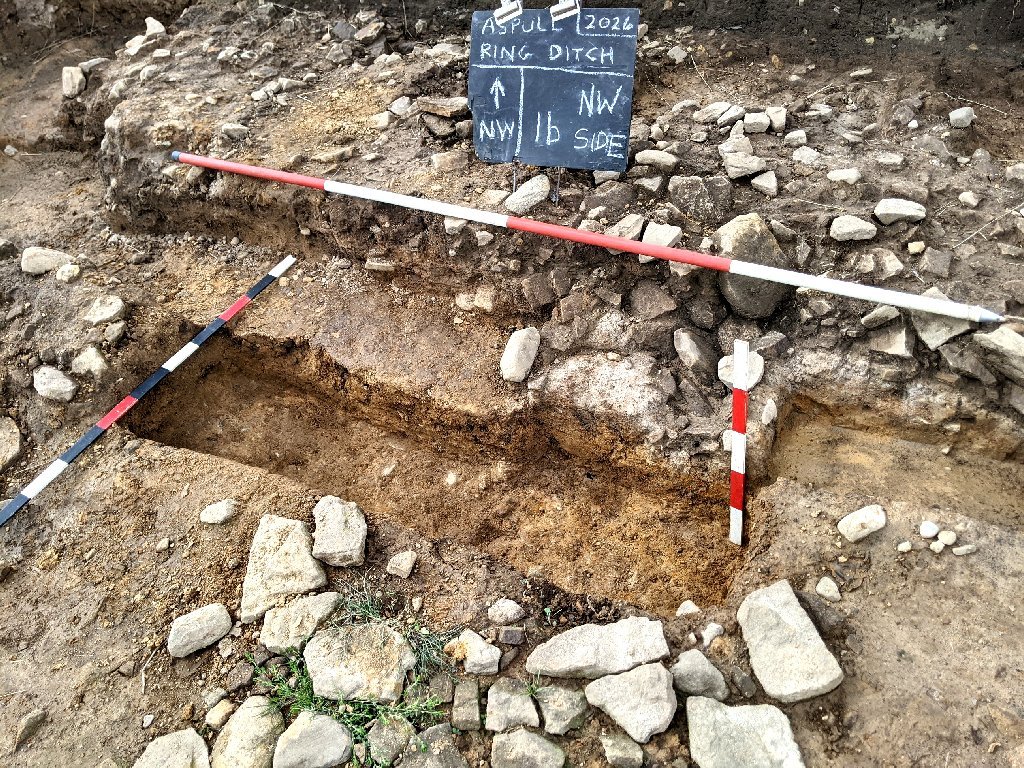 The change in the weather had certainly made a difference to our open workings, bringing out the colours and making it easier to excavate. Assuming this lower level to be the original natural surface (although it was shallower than usual), Bill will now be able get a full record of the section.
Chris meanwhile carried on where Peter left off opening up the cut that Alison had been working to the southwest of Feature F2. Reaching the bottom more large stones where exposed, he therefore decided to extend a narrow cut on the northeast side towards the southeast. This would eventually break through into sondage (3a.S5 Ext) on the southeast side of Feature F2. 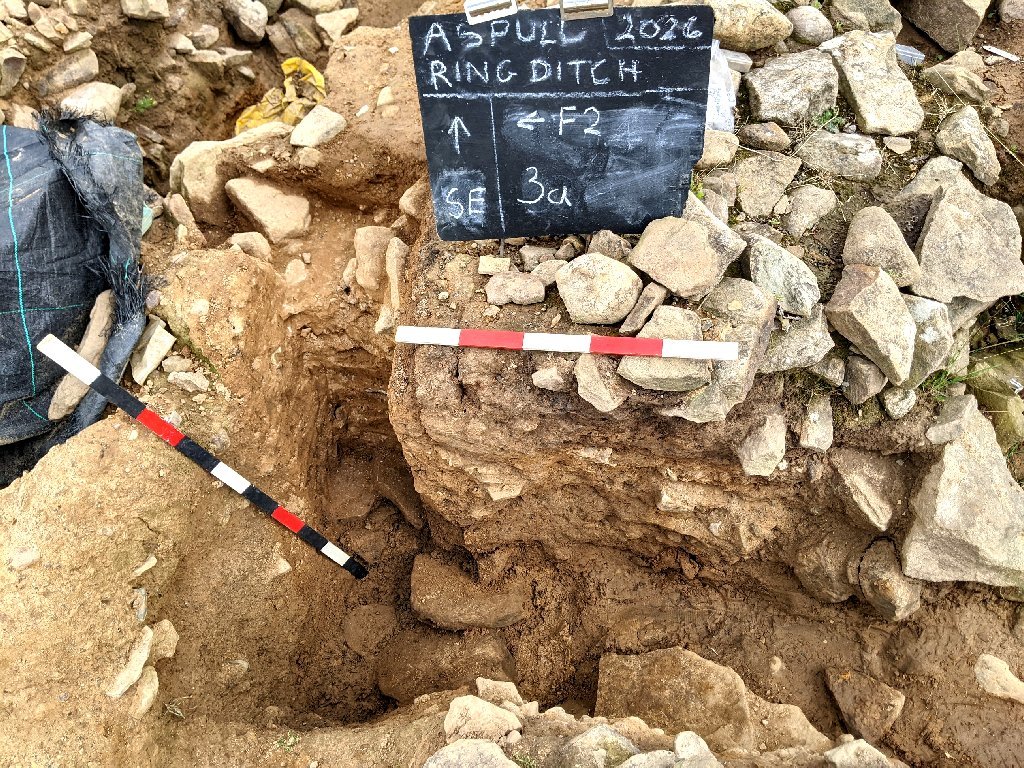
When Susan arrived Chris asked her to clean around the large-ish stones located within the circular alignment of large stones on the west side of Feature F22 continuing the work Peter had started the week before. Ben Dyson had suggest this collection of stones, which seem to have quite a number of large cobbles (rather than the usual sandstone slabs), could be significant and should be investigate perhaps even digging a section through it. 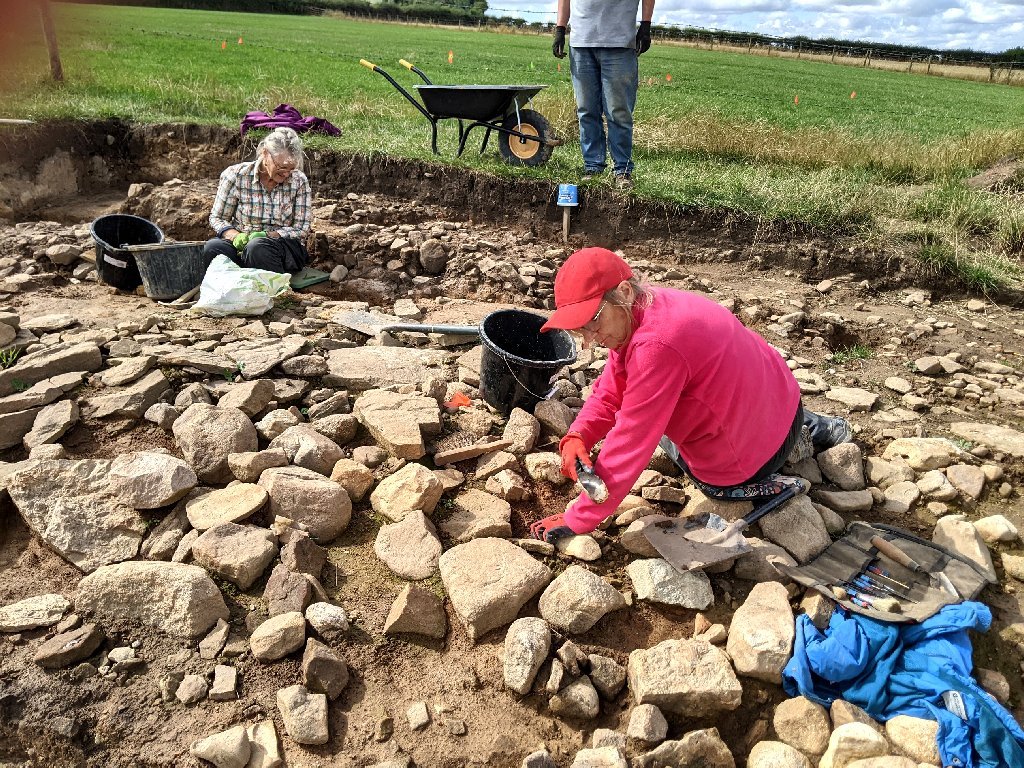
With the baseline already marked out from the previous day’s resistivity survey, Bill and Chris thought it a useful exercise to do another survey along it but on the east side of it over the Ring Ditch. This would overlap our previous survey done in 2021 but, with the recent very dry conditions, it was thought more detail might show up (the 2021 result here had shown the area to be very wet blanking out any details). With only Andrew to help Bill and the fence line of the excavations restricting a full scan, Bill had to work out a new working strategy to do the scan. Once he and Andrew got going though they were able to complete the scan by mid afternoon.
The result (which Bill generated when he got home) showed no sign of activity to the west of the entrance where we might have expected some. It did show the ditch better than the previous survey (and possibly our trenches) but surprisingly not the entrance. The previous survey picked up a possible second ditch outside the first on the SSW quadrant – this new survey also showed it and maybe therefore worth pursuing. 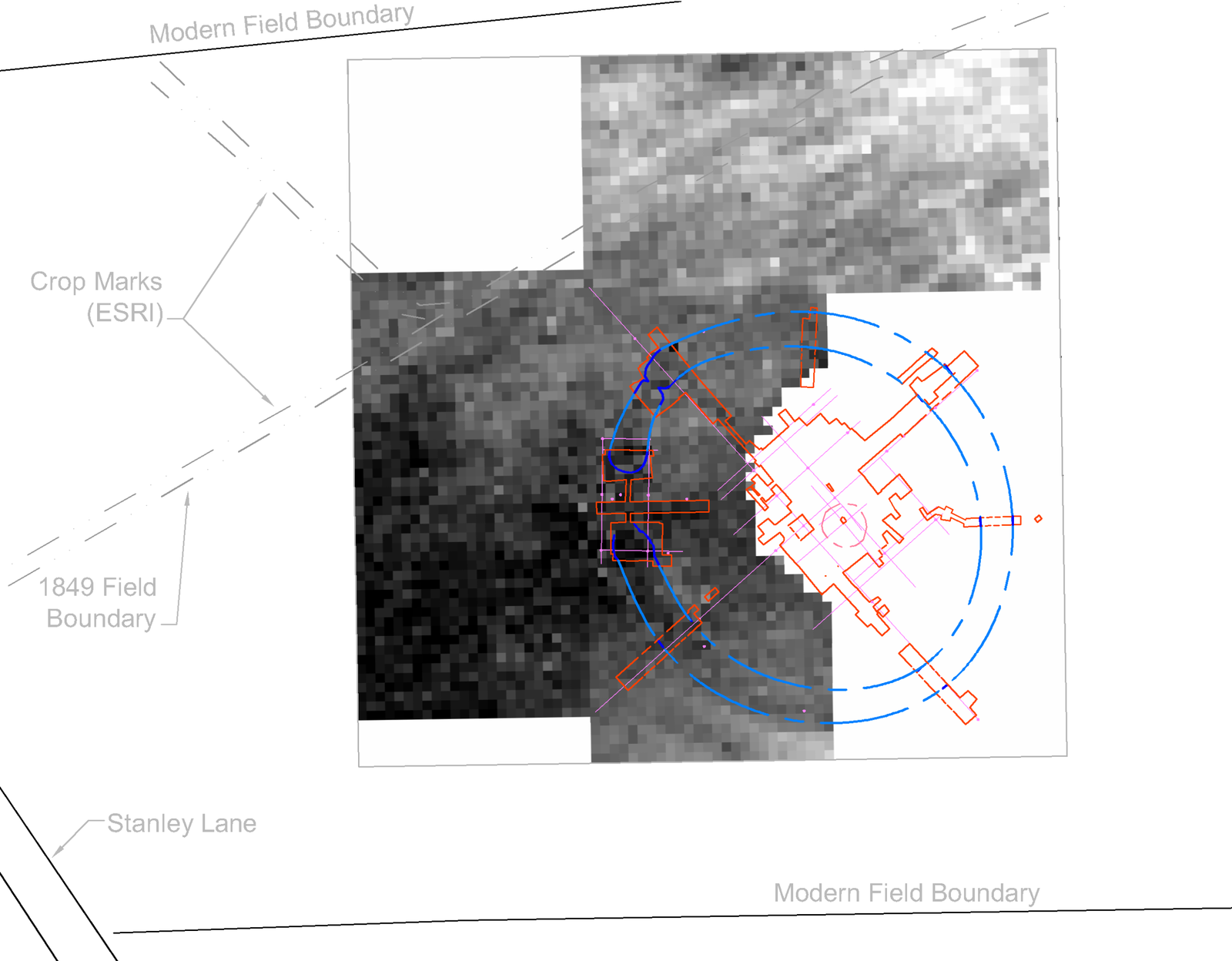
Having finished the survey, Bill and Andrew turned their attention to another issue which could be resolved by working outside the fenced area. There has been a long running question about the nature of the underlying soft sandy clay which covers the whole of the interior of the Ring Ditch and forms the major part of the mound. We have yet to discover any evidence for it being manmade, so against all expectations, it could it be natural. Test pitting outside the Ring Ditch could provide the answer i.e. if only compacted boulder clay is found lying under the plough soil, then it is highly likely the mound was created by the ancients. If however sandy clay is found outside the Ring Ditch then it would indicate that it is a natural formation, perhaps glacial outwash (something like a drumlin left behind by a retreating glacier).
The most likely location for sandy clay outside the Ring Ditch would be down slope of it, there Bill and Andrew marked out a 50 x 60cm test pit just a metre or so beyond Trench 10. This was the last trench we dug on the Ring Ditch to check for a possible entrance on the opposite side from the entrance discovered on the west side. It was noticed that the ditch here was dug into something resembling the underlying soft sandy clay. The test pit would therefore confirm this or otherwise.
Late in the afternoon Andrew started to remove the turf and top soil which turned out to be about 30cm deep. Despite the recent rain it was baked quite hard and cutting through it using the mattock reduced it to a sandy dust. This meant that it took longer than expected to reach the underlying layer. This hard stony layer was also very dry, but it did have the colour of the sandy clay similar to the lower layers within the Ring Ditch. 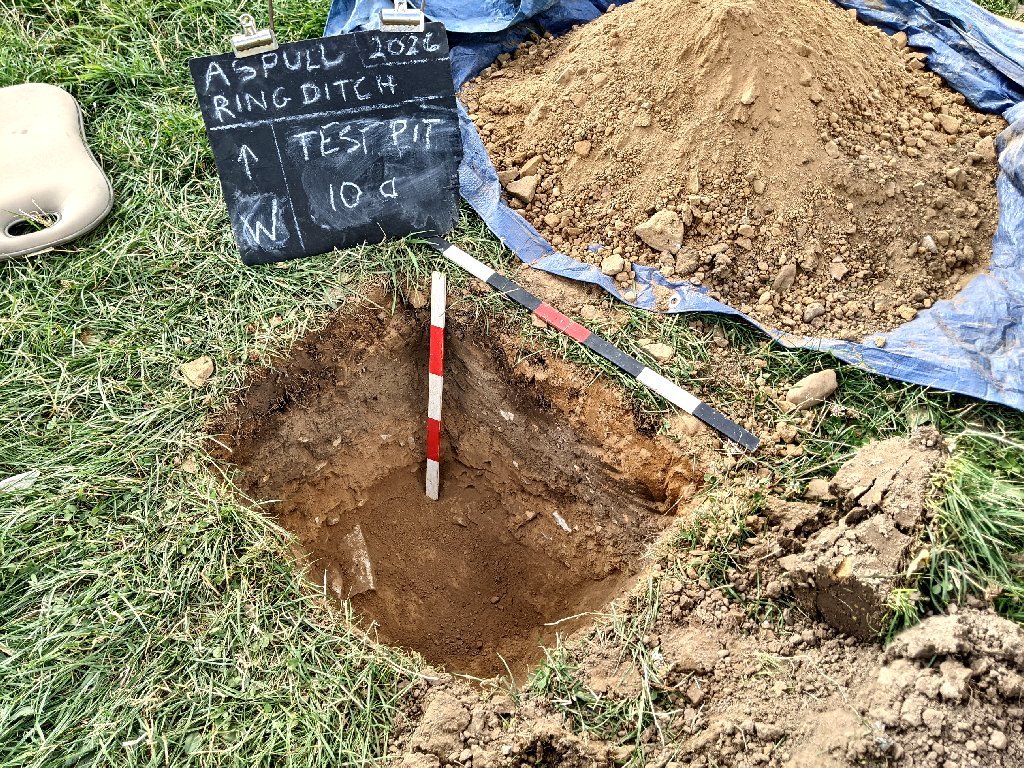 The Test Pit was labelled TP10a and Andrew took a sample for future comparison before having to backfill it (working out side the fence we had promised Nick the farmer we would not leave any trenches open). The result so far is not conclusive but does suggest sandy clay does occur outside the Ring Ditch.
Tuesday 18th August
Day 28
Joining Bill and Chris today were Andrew, Peter, Jen, Susan, Jon, Isabel and Dave North.
Jen carried on working on the (seemingly) circular feature she had started a few weeks ago on the northwest side of Trench 1b. In between time Colin had quarter sectioned it and now Bill asked her to open it up so that he could record its section.
Jon continued working and the area around our newly discovered burial (F9) trowelling down the area to the southeast of it to check for any further clues to its burial.
Susan meanwhile was asked to clean up and trowel down the patch of in Trench 1b we had first discovered in 2023 which was devoid of stone but still below the mottled clay and burning layers. She worked to the south of the cut Andrew had previously dug into the patch and as she continued south beyond the edge of the patch, a white-ish clay stated to appear (the stones in this area had already been removed).
The cut that Alison had been working to the southwest of Feature F2, had revealed large stones at depth. To investigate these further Peter was asked to widen cut and take in down to the level of the stones.
The field beyond the fence line bordering our excavations had had its grass cut but the horses had not yet been allowed in. Bill thought it a good opportunity therefore to do a resistivity survey of the area to west the Ring Ditch in front of the entrance where ancient activity might be expected. The recent very dry weather he though would also help perhaps to produce a good result in this area which had shown to be much wetter on our previous 2021 survey, blanking out any sign of the ditch. With the help of Andrew, Dave and Isabel he set about marking out a baseline along the western edge of the previous 2021 survey.
The first 25m x 47m scan was completed along this base line on the west side of it (it was meant to be 50m but unfortunately one of the remote probes got pulled our and its original position couldn’t be found). 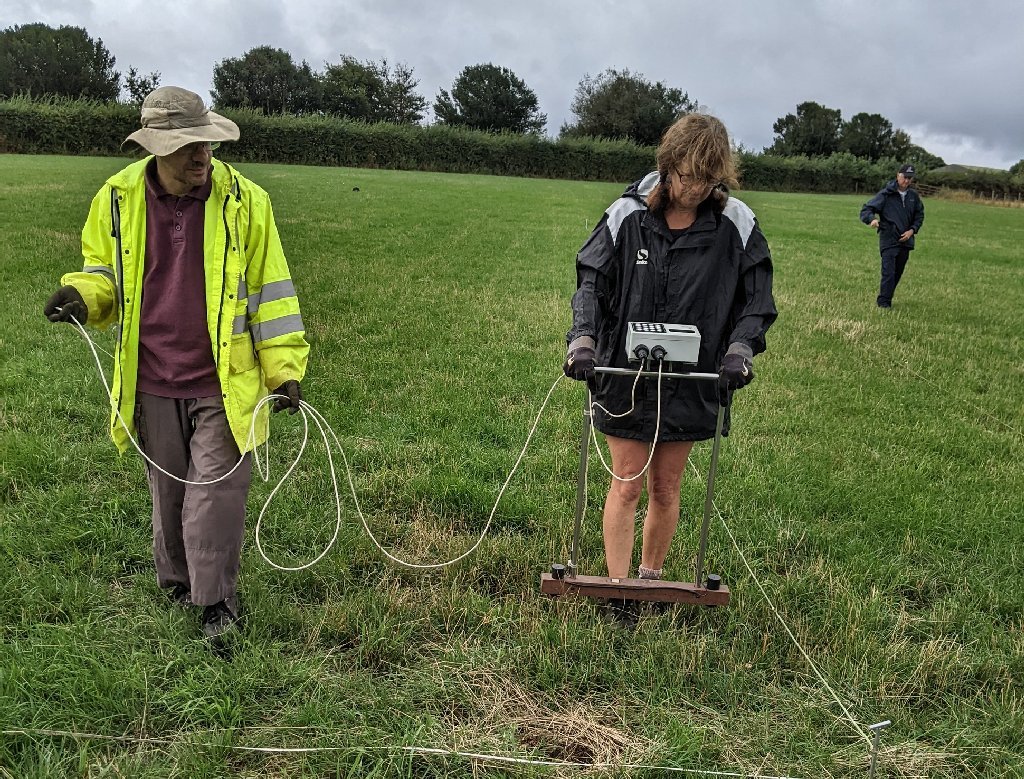 After lunch a second baseline was marked out at 90 degrees to the first 45m north along the first baseline and a second 25m x 49m scan complete facing north on the north side of the Ring Ditch (Bill didn’t have his laptop so the results would have to wait till he got home).
Just after lunch Bill had to leave Andrew temporarily in charge of the surveying as visitors arrived from the local area. Andy Vose who lives just around the corner had arranged with Bill for a tour and had brought some friends with him. Bill gave them the usual rundown on our work on the Ring Ditch (and including some history of the Society) before handing over to Chris to explain our excavations in the central area of the Ring Ditch (this enabled Bill to get back to the survey). Before leaving Andy Vose expressed their appreciation for the visit and how very impressed they were with our endeavours.
Saturday 15th August
This was our first open day and it turned out to be a great success with over 30 people in attendance (this was due the response from our displays at the recent History Festivals in St David’s Church Haigh and All Saints Parish Church in Wigan). Nick the farmer had okayed the day and his dad Frank had kindly opened the gate in the adjacent field for people to park. Assembling at 11.30 Chris gave everybody the required safety instructions before leading them onto the site. It was decide to split the audience into three to be lead around the site by Chris, Patrick and Bill (careful planning meant we were able to avoid each other in typical tour guide fashion). Everybody seemed to be thoroughly impressed with the site and our efforts to uncover its mysteries. There were apparently quite a few who’d expressed an interest in coming but couldn’t make the day so the intension is to hold another day in September.
Thursday 13th August
Day 27
Another hot one (over 30o ) so a few cry-offs today but Bill was back and refreshed from his hols. He was therefore able to join Chris and Patrick, Susan and Peter (Peter had to leave at lunch time). We also had a visit from GMAAS’ Ian Miller (this was instead of Ben Dyson who is currently suffering with a back problem).
Chris and Patrick continued with preparations for our planned open day on Saturday de-weeding and putting marker flags on our burials sites and features of special interest.
Bill and Susan meanwhile spent some time on the tent which had suffered a complete roof failure. The long hot summer sun had obviously weakened the fabric and large tears had opened up rendering it useless as a refuge against anything but the wind. Bill’s first thoughts were that the tent, having served us well all through this season, had now had its day. However he then remembered we still had the canopy from the gazebo (the frame had collapsed a while ago and its wreckage still on site in an abandoned ditch). With Susan’s help Bill managed to get the canopy on top of the tent and secured against the wind (though how long it will last is yet to be seen). 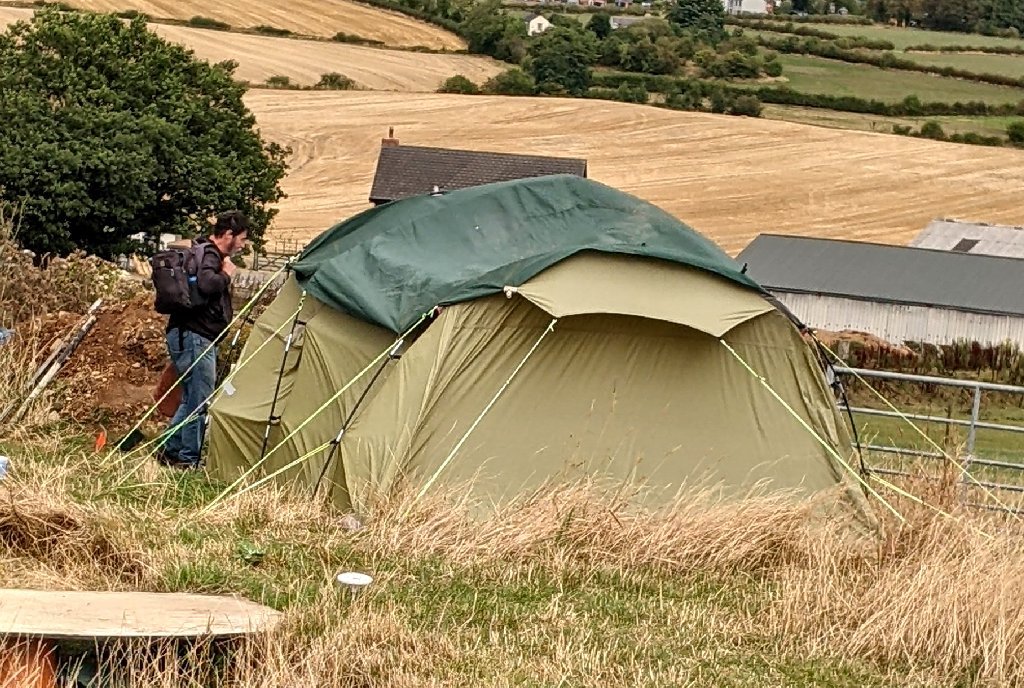
Ian arrived just before lunch and Bill gave him a quick tour to bring him up to speed with developments since his last visit. He was particularly intrigued by Feature F4 our clay-lined pit (as we all are) but couldn’t add anything more to our understanding of it. He was taken aback though by our latest cremation burial which is proving to be different again from our previous ones. 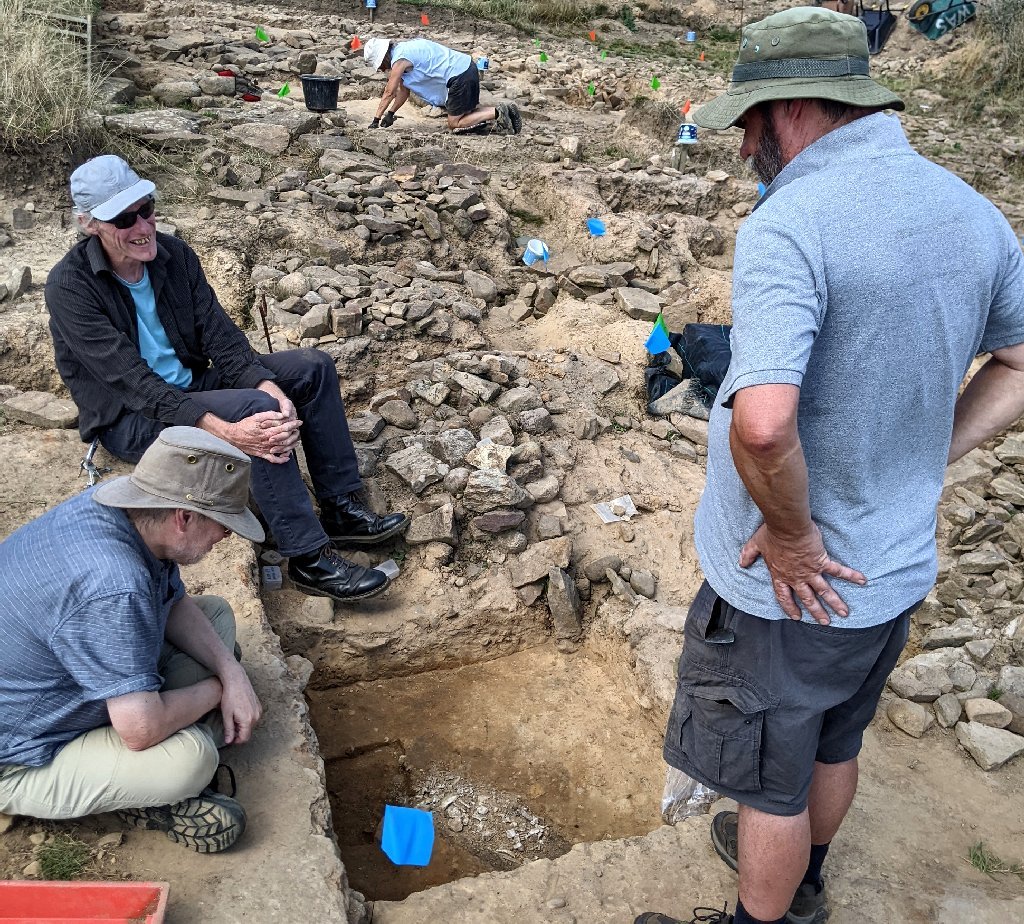 We can now see a pit in which the burial was placed – not seen cutting the through the level above the burial which suggests the sandy clay was deposited after the remains had been placed.
 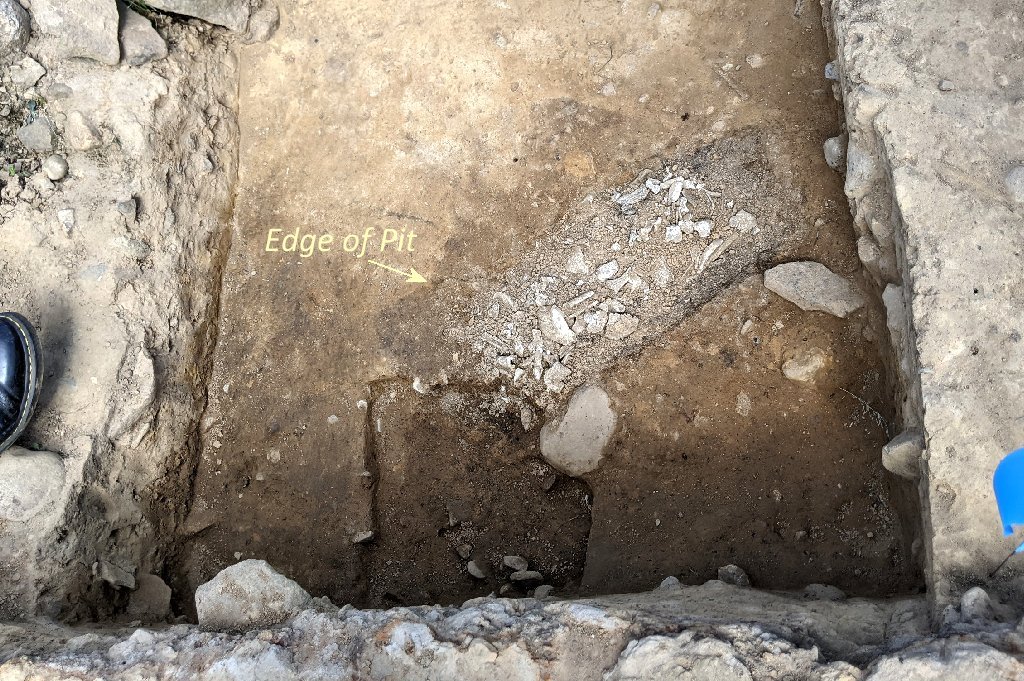 A blackish edge on the south side might suggest a leather bag or sack in which bones were placed (or is it a second cut) but there are no signs of any pyre material. The bones must therefore have been carefully separated out before being deposited (or cremated some other way).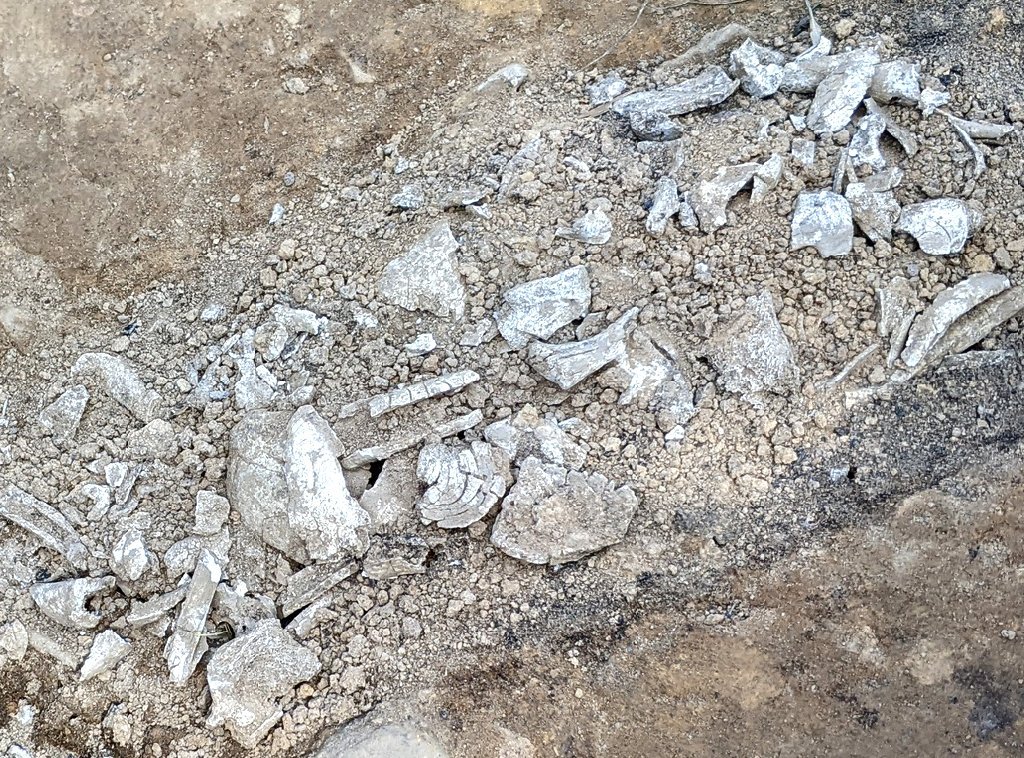
Early finish today because of the heat but before leaving Bill and Susan spent sometime cleaning up the section extending from Trench 1. This was to reveal the soft sandy clay which seems to form the main part of the central mound.
Tuesday 11th August
Day 26
Joining Chris and Patrick today were Peter, Alison and Susan.
Alison continued to investigate the northeast of the newly discovered large stone at the bottom of the rising sandy clay mound (southeast side) and got her first sighting of more large stones. 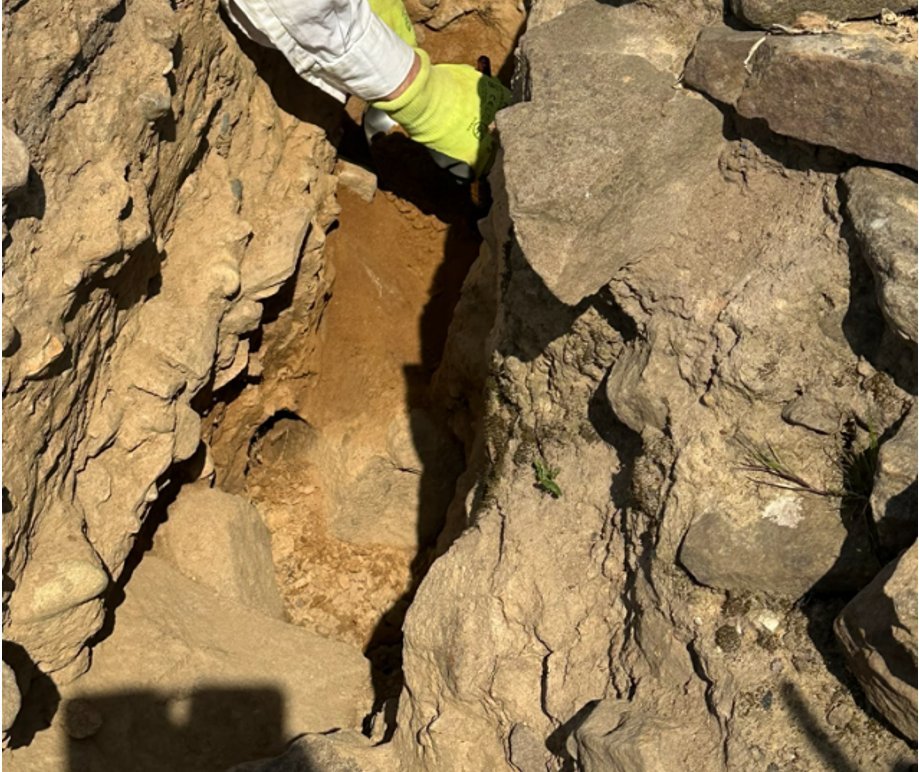
Susan meanwhile sent some time tidying up the small extension next to our latest burial (F9 – B27) trying to find the edge of pit it seems to have been put in. 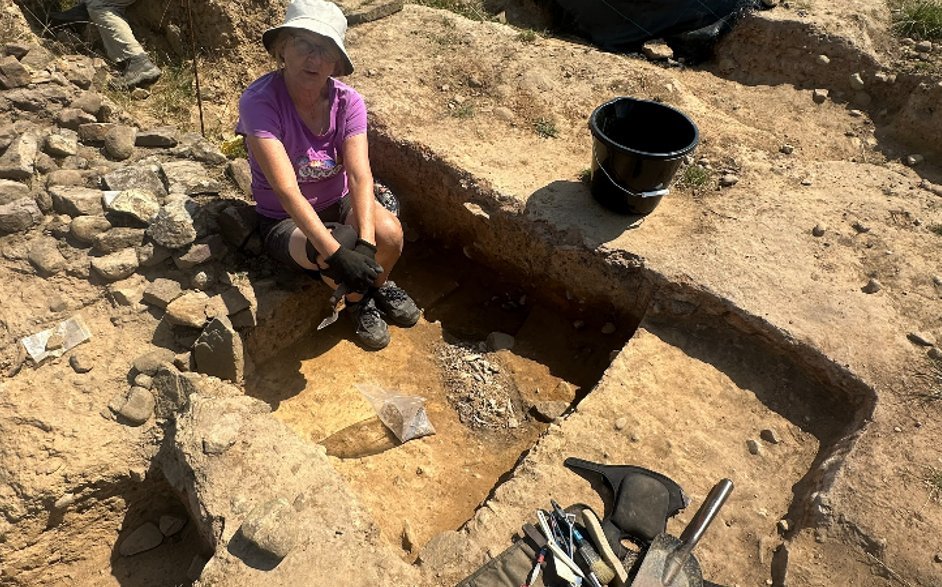 She later went on to improving the site by doing a bit of gardening in preparation for Saturday’s Open Day.
With this in mind Patrick cleaned the diagonal bands in the mottled layer on the southeast side of the central baulk, where Peg 3a in located (these seem to show that the mottled clay was constructed using upside down turfs).
After making some general site improvements with Susan (weeding), Peter cleaned between the large-ish stones located within the circular alignment of large stones on the west side of Feature F22. This was to defined their shape. 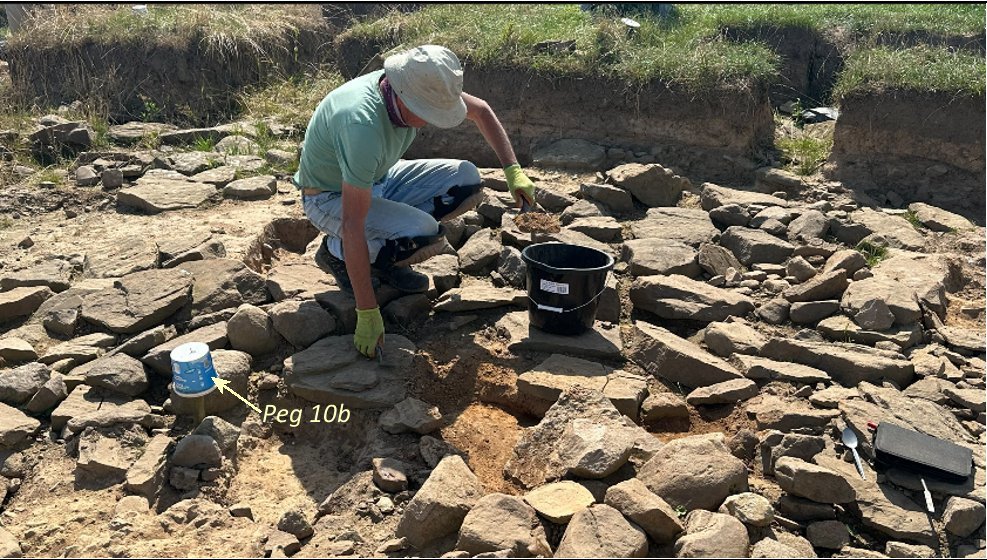
Isabel spend another day in Trench 1. Dave joined her in the afternoon and started to remove the old ‘steps’. 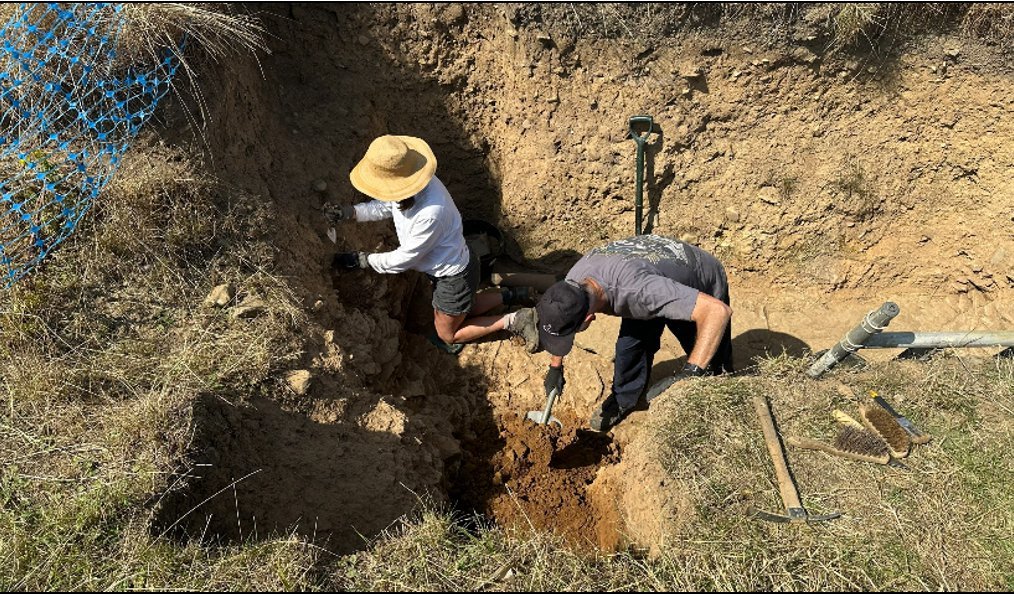 In the morning Dave worked on building visitor access to on the south side of the site by backfilling and building ramps.
Thursday 6th August
Day 25
Great turnout today with 12 on site, joining Chris and Patrick were Peter, Jon, Susan, Steve, Paul Langin, Colin, Alison, John Trippier, Gaby and Isabel.
Due to the recent extreme hot conditions of recent weeks, it was spotted that the pit around Feature F22 (at the centre of the kerbed circle of stones in Trench 1b), was much easier to see. Peter, with the assistance of Patrick, carefully cleaned all the sections round F22 so that we could 3D model the area of the pit . 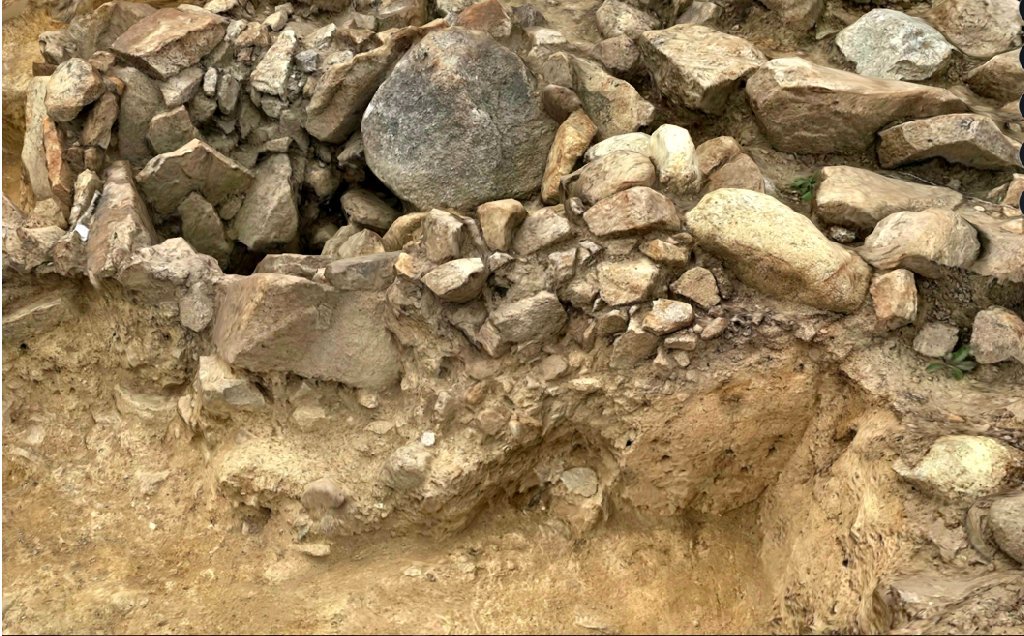 Later they moved to the unexcavated side of F22 to see if they could see the edge of the pit there.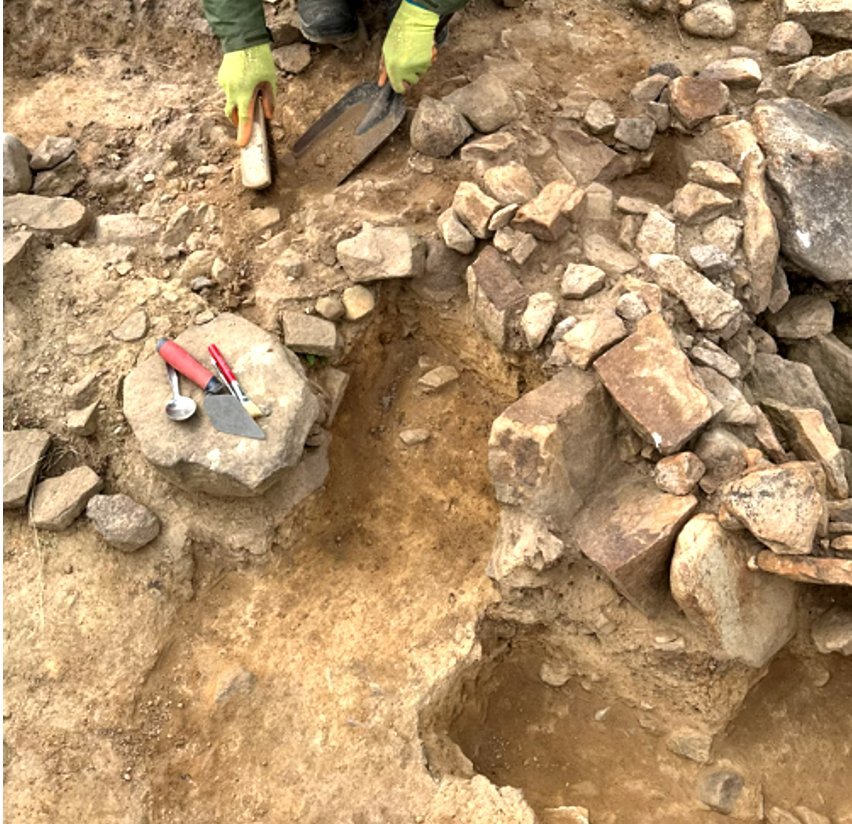
Colin and Steve worked on the newly exposed stones at the northwest end of Trench 1b. Steve observed many small circular patches of small stone which may be an indication of how the stones were carried and then laid on the site in baskets. 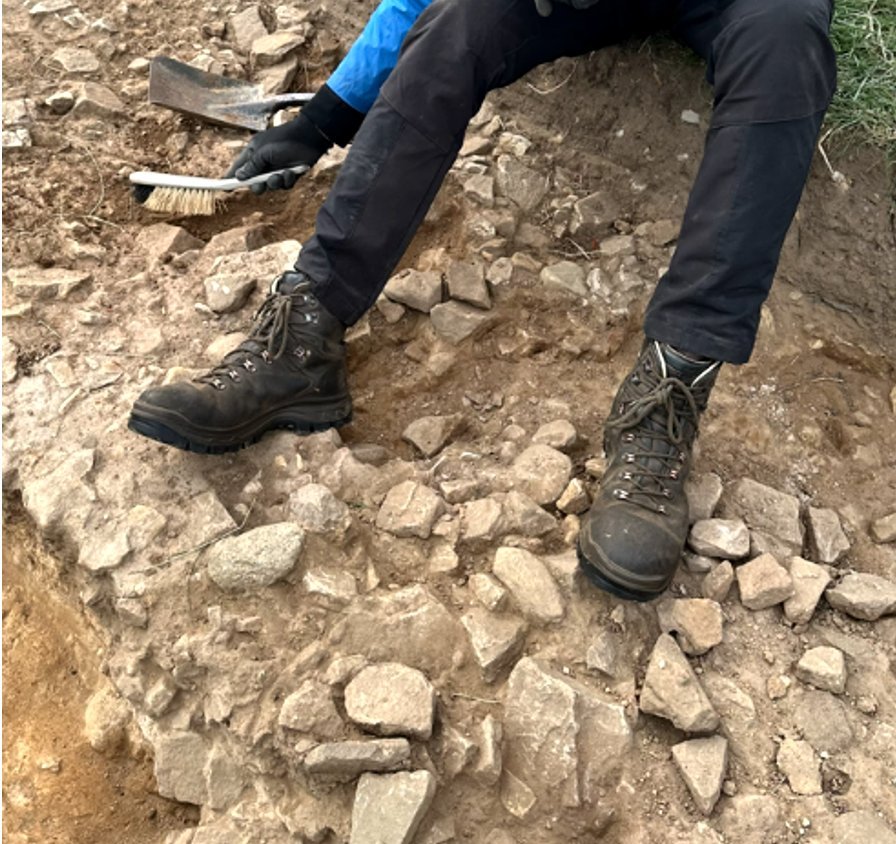 Colin worked on a (seemingly) circular feature Jen had started to half section last week. He quarter section the feature which showed the white clay interior ran outside the feature and may have been cut through.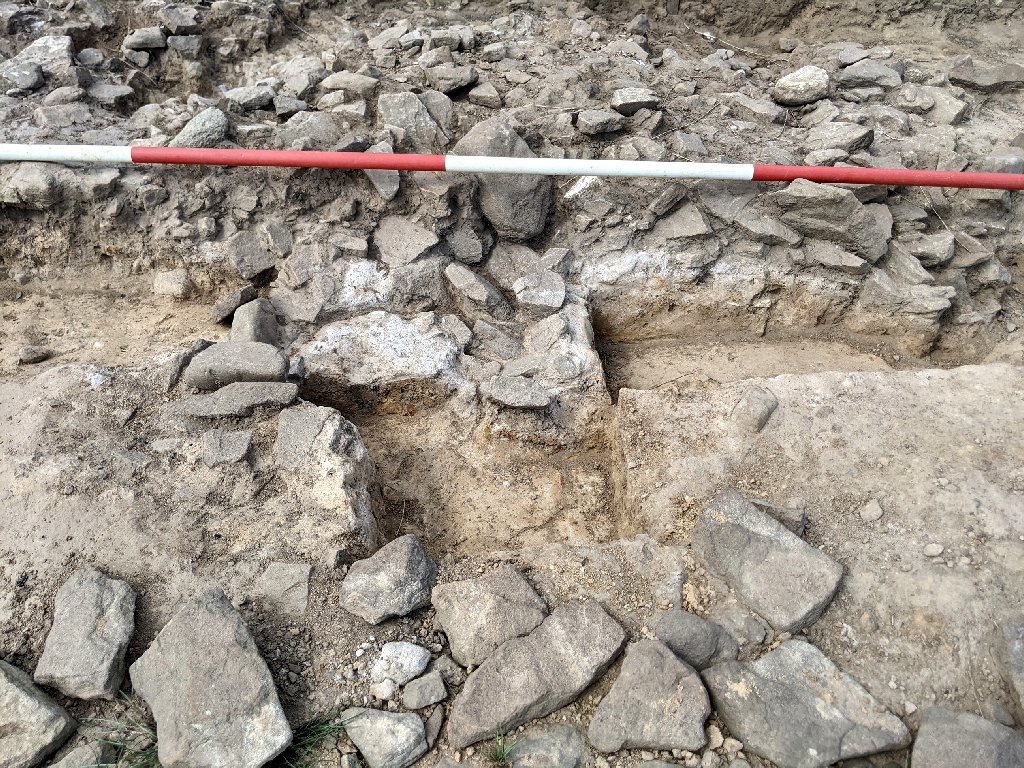
More to investigate next week.
Alison started working to the northeast of the newly discovered large stone to hopefully reveal more of it. There was not enough time to reach the required depth this week, but will be continued next week. 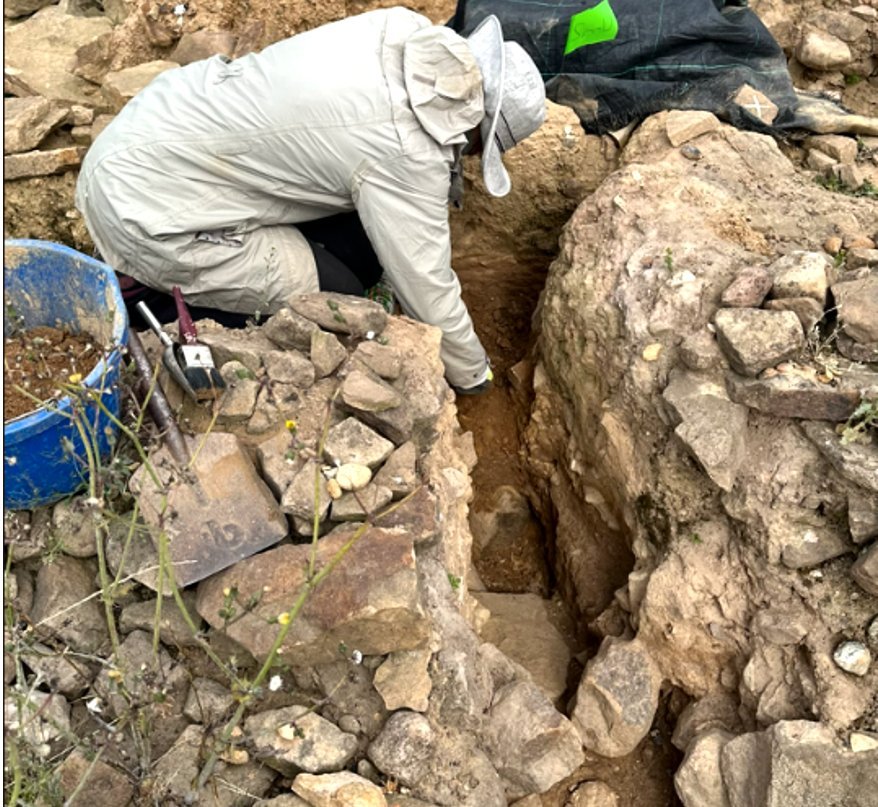
Susan continued working in the ‘token’ burial area (Features F15, F10, F21). 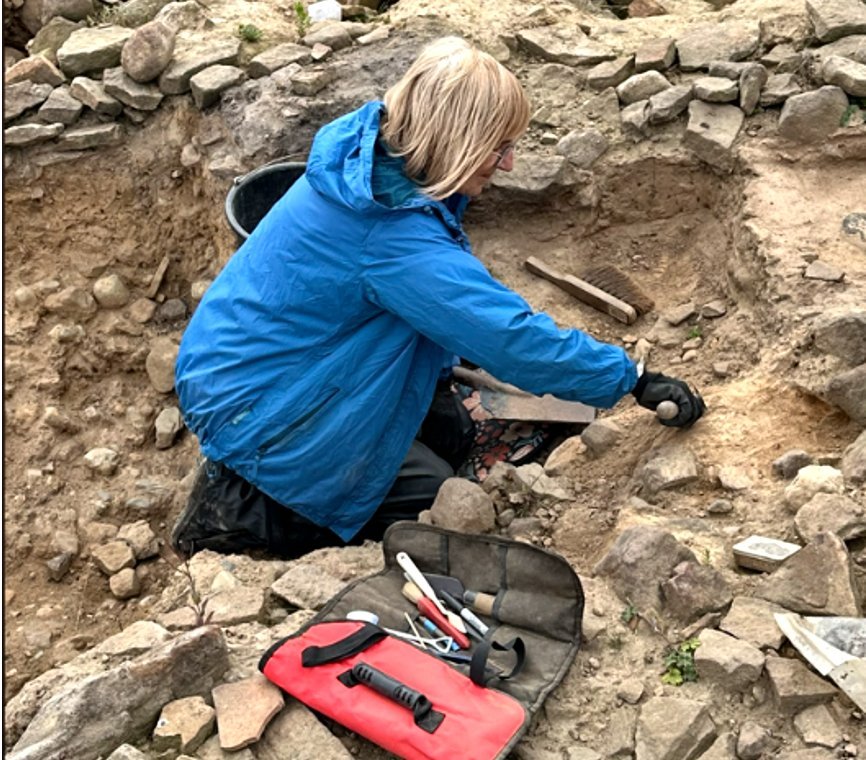 Then she moved over to the burial (B7) adjacent to where Urn 2 was lifted (Feature F2) and cleaned the sections showing the burial cut. During this cleaning she discovered a possible burnt acorn shell in the pyre material.
John continued to clean the section near where B10 (Feature F13) had been lifted and explored and interesting semi-circle of darker material. It did not show in the section but will be looked at again next week. 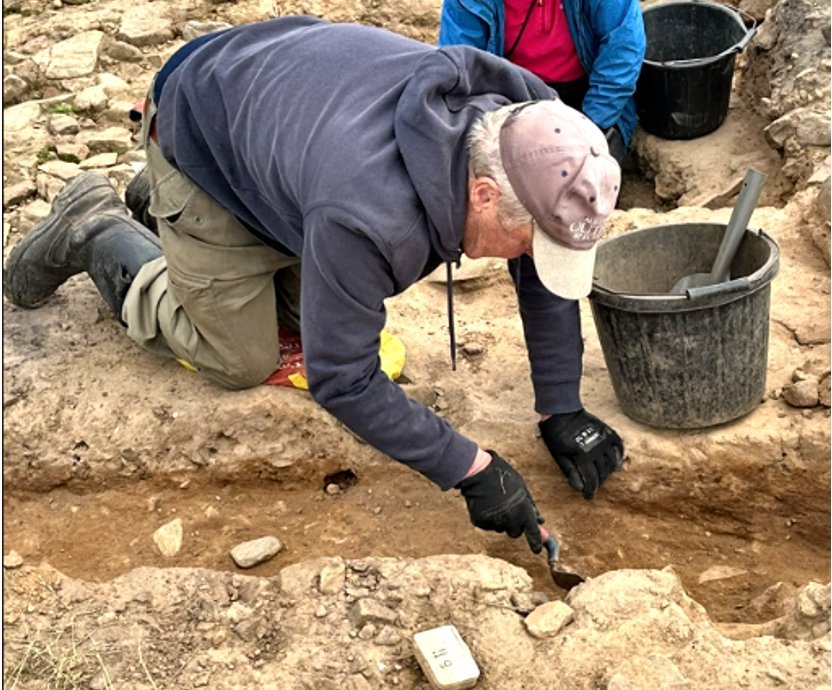
After lunch, with assistance from Paul, Isabel completed the clearance of the floor and side walls of Trench 1. 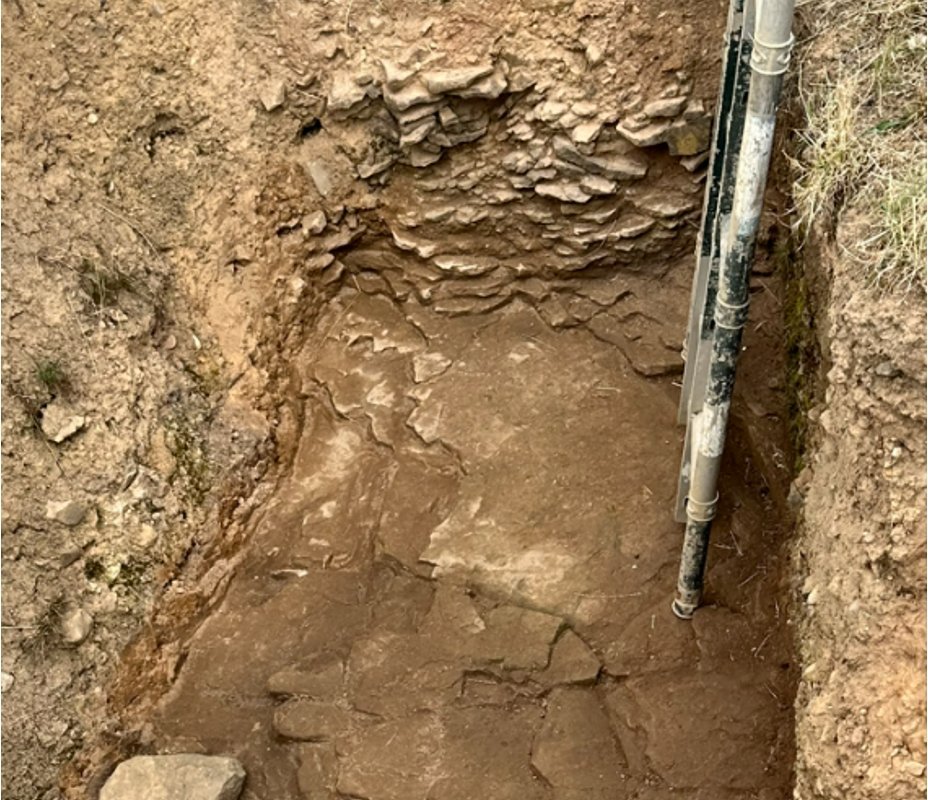
Jon was joined by Gaby who both carefully cleaned the sections around the newly discovered burial and the floor of the trench (B27 Feature F9). They are starting to suspect that there is another cut below the bones which may indicated another burial. 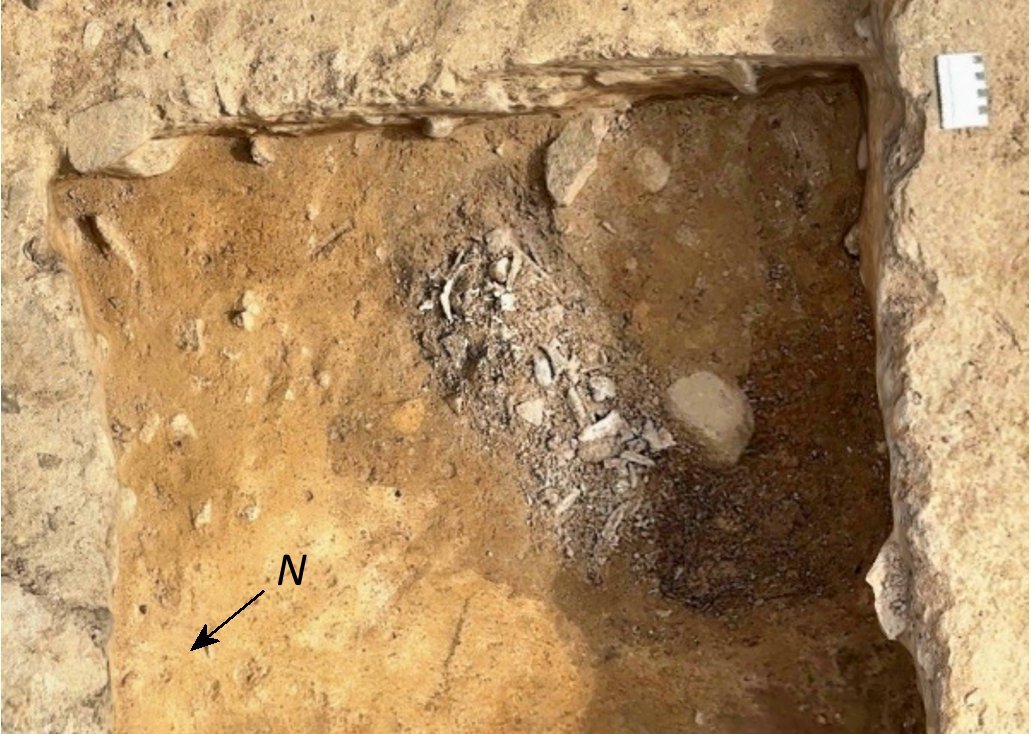
Tuesday 4th August
Day 24
With Bill on his hols again Chris was in charge. Joining him today were Peter, Isabel, Susan, Jon, Alison and Christine Morton.
Peter and Christine worked on cleaning the area that B10 (F13) was excavated from – i.e. the bones that John Trippier excavated and have been analysed Sam Walsh at at ULan. They then extended the section. Susan meanwhile worked on the adjacent area where we have the ‘token’ burials (Features F15, F10, F21) to see if we could find any more. 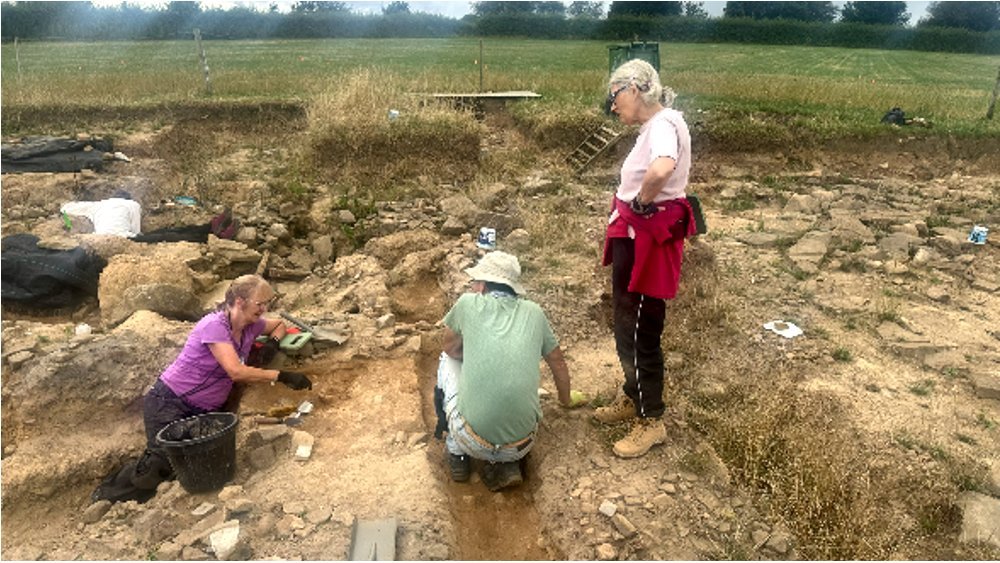
Isabel started work preparing Trench1, the only remaining section of ditch that is open, for the forthcoming series of visits by locals (open day planned for Saturday 15th August). It was great to see the stone cut and floor reappearing after a years’ worth of debris falling in. 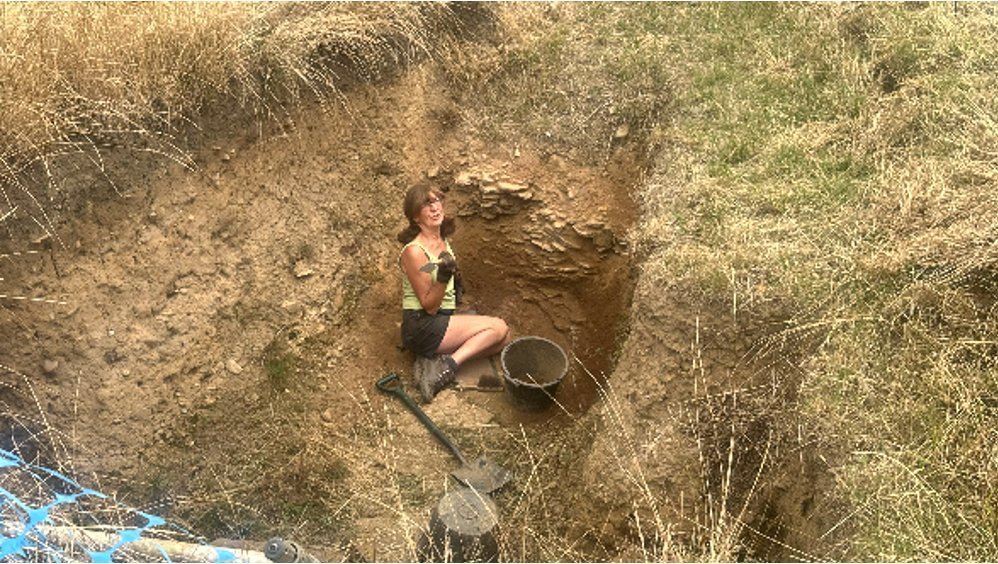
Jon continued his work on the newly discovered burial (F9 – B27) by lowering the section to the on the northeast so that we can see the full extent of the burial. Chris then produced a drawing from all the 3D models taken since the bones were first spotted to see if the burial and the pit cuts above correlated. It would see that the bones are at the bottom of the pit we observed higher up. 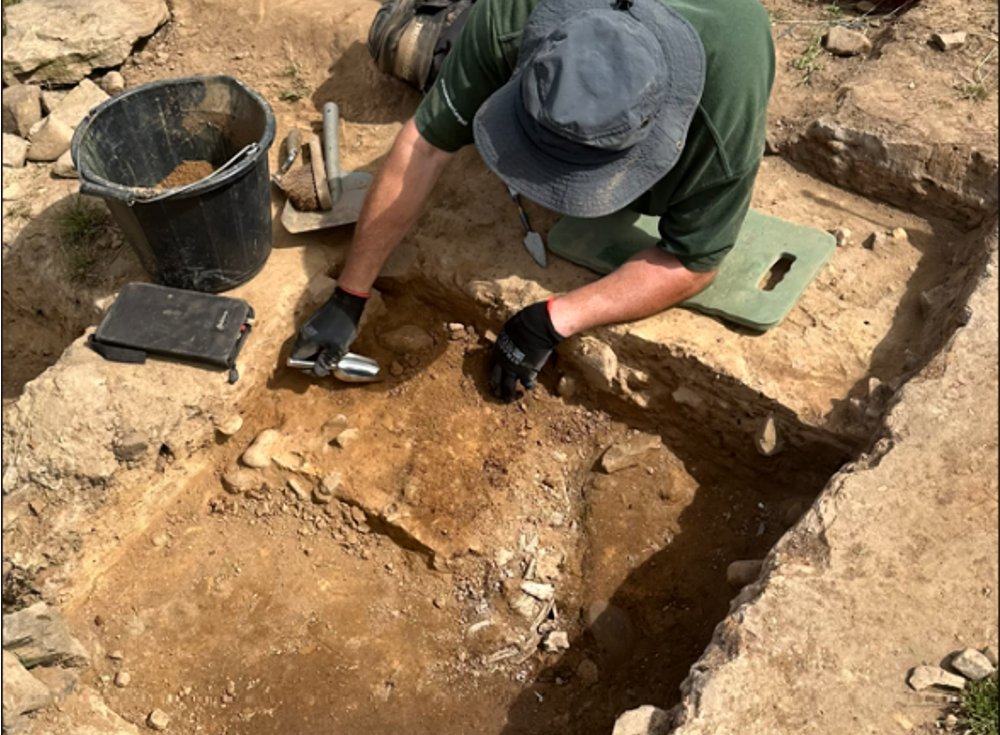
Alison continued working on the section through the stone revetment on the southwest side of the rising sandy clay mound. Another large stone was found at the deepest level yet. This stone is clearly under the sandy clay mound so could be an indication of earlier activity. 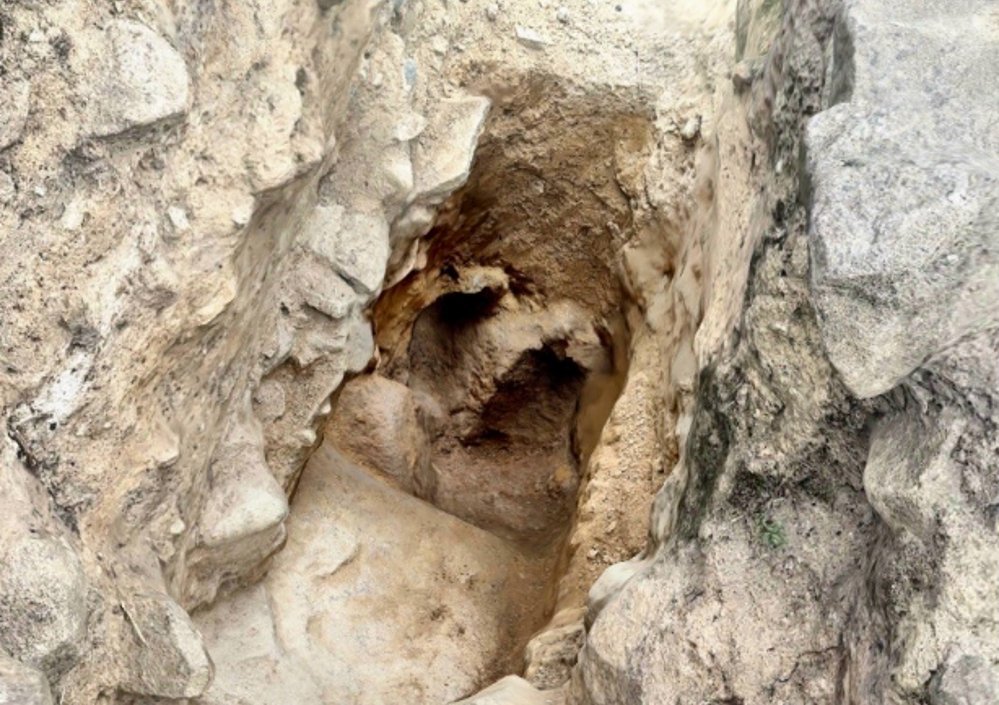
Thursday 30th July
Day 23
On site today were Bill, Chris, Patrick, Andrew, Peter, Jen, Steve, Susan, Alison and Gaby.
Today we split the team up with Andrew, Patrick, Steve and Gaby joining Bill to do some resistivity surveying in the field south of the track leading to the farm. The rest joined Chris to continue work on the Ring Ditch site. 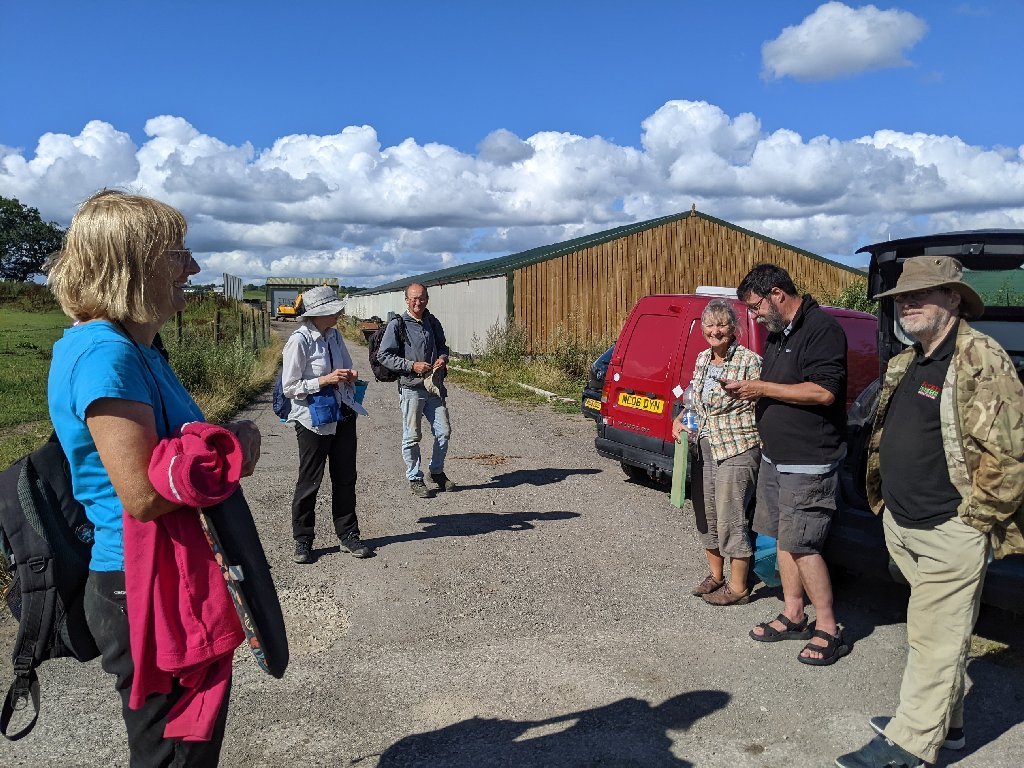
When we first looked at the LiDAR image of our site we were excited to find the mound in the middle of the crop mark ring. However we could also see a mound in the field south of the track leading to the farm but as it was much larger we have always assumed it to natural. 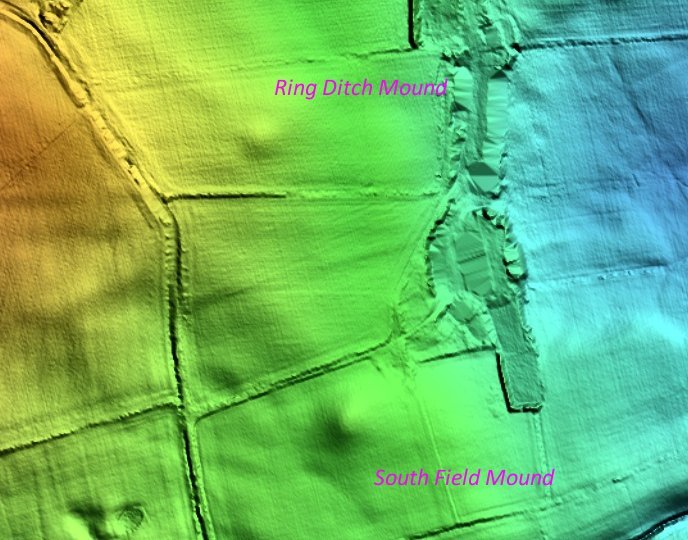 Excavating our Ring Ditch has shown it to be comprised mainly of soft sandy clay with only a relatively thin topping of stones and mottled clay. The last two have clearly be laid down by human activity but there is some doubt about the soft sandy clay as it has so far failed to produce any convincing evidence that it is manmade. Strange as it may seem, it could be a natural formation. To test this we intend carrying out test pitting out side the the Ring Ditch to see if the soft sandy clay occurs in other places near by, which could indicate the mound is natural. However we’ve always wanted to examine the larger mound in the south field. If this could be shown to be constructed of soft sandy clay, it would be a compelling reason to suggest that our mound is natural too. It could also perhaps dispel any thought that it is another monument (Chris had see some possible feature near the top on a more intense LiDAR image). Before digging into it though we need to do a resistivity survey and this week was our first opportunity to do this. As predicted the result showed little if any human activity (perhaps a field drain crossing at an angle) – certainly no indicative surrounding ring ditch.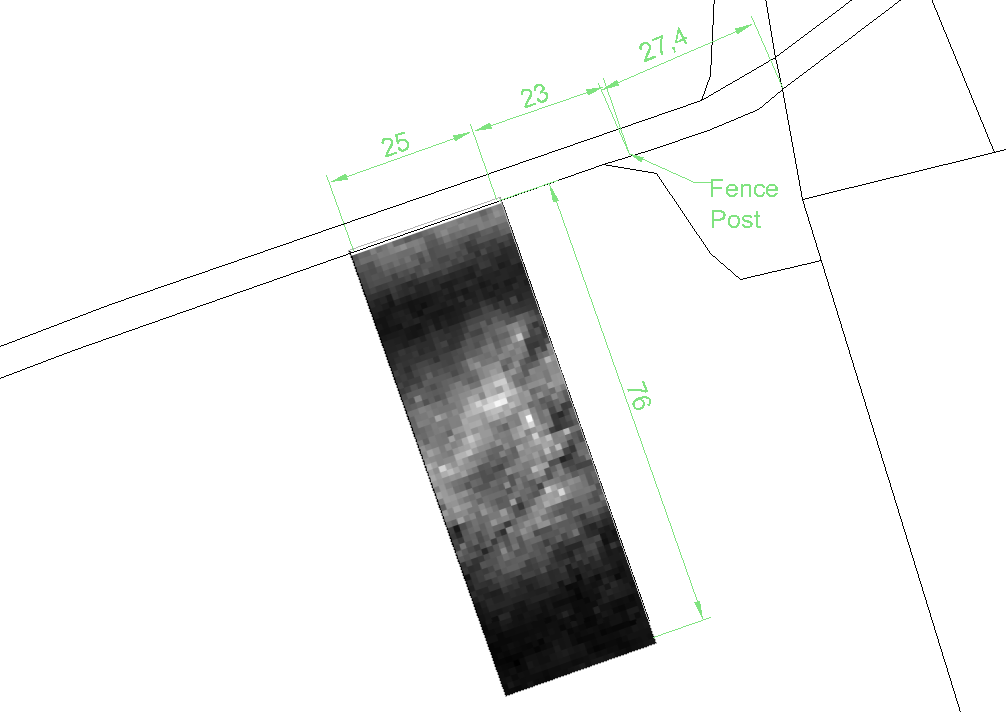
On our Ring Ditch site itself, Chris and Peter worked on the area around our newly discovered burial feature, while Susan continued working on Feature F4 cleaning the section on the northeast side. Bill had asked Jen to half-section the patch of white-ish sandy clay amongst a deep layer of stones in the section on the northwest side of Trench 1b that Colin had discovered last week. Meanwhile Alison continued working on the cut to the southwest of Feature F2. At some depth she was surprised to find a large stone instead of the usual harder stony sandy clay we have been finding in other trenches at that level. 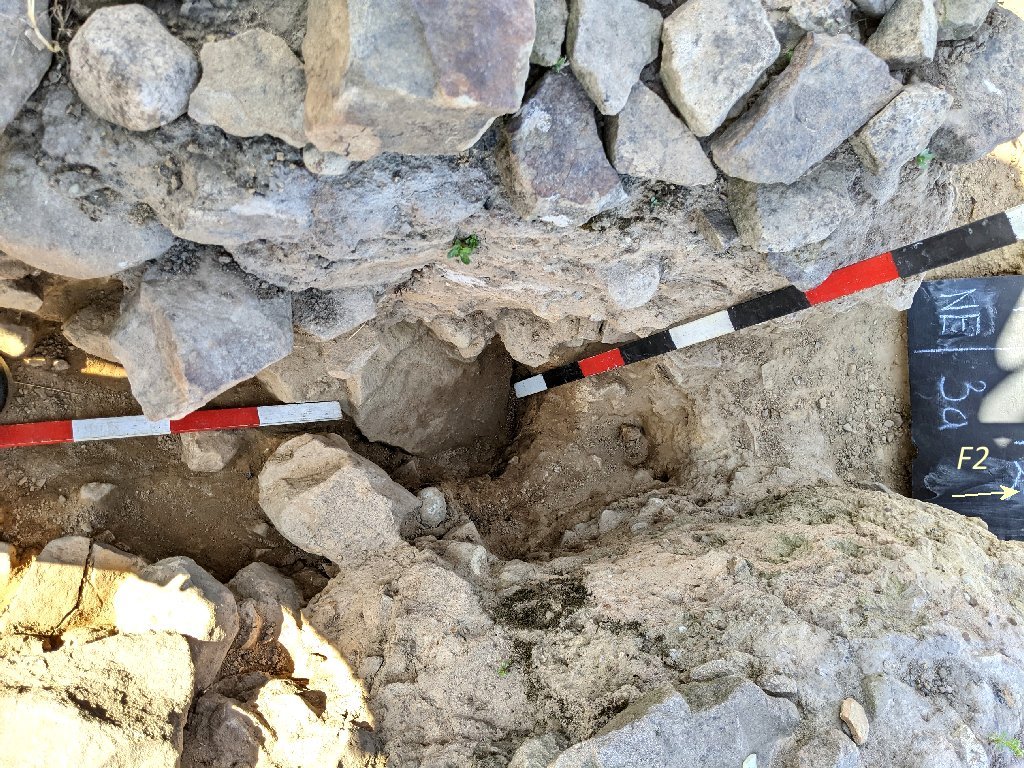
Tuesday 28th July
Day 22
Joining Bill, Chris and Patrick today were Peter, Andrew, Jon, Gaby, Susan and Dave North.
We also had a visit from Jane Williams and Paul Barnhill who are members of the Goofus Theatre Company base in Leigh. Strangely enough they are currently putting a production together based on the Bronze Age and where delighted to find out that we are currently digging a Bronze Age site in the Wigan area. Bill therefore spent much of the morning taking them around the site explaining what we had found over the last five years. It was good to meet up with them as they may be able to help us out with one of the issues we are having at the moment. Pretty soon we will be needing to find the money to pay for such things as bone analysis, carbon dating, preservation and reconstruction work on our urns. To this end we have been looking a applying for a Heritage Lottery Grant but it’s been difficult for us as it’s something we have never had to do before (we have had small grants in the past but nothing on the scale now required). The team at Goofus however are well versed in the process and have offered to collaborate with us an application which would be fantastic.
Work continued on site with Bill asking Andrew and Gaby to open some small pits along the section on the northwest side of Trench 1b. this was so that he could get an idea of the depth of the stony layer for his section drawing. It may also give some indication about the depth of the underlying soft sandy clay. 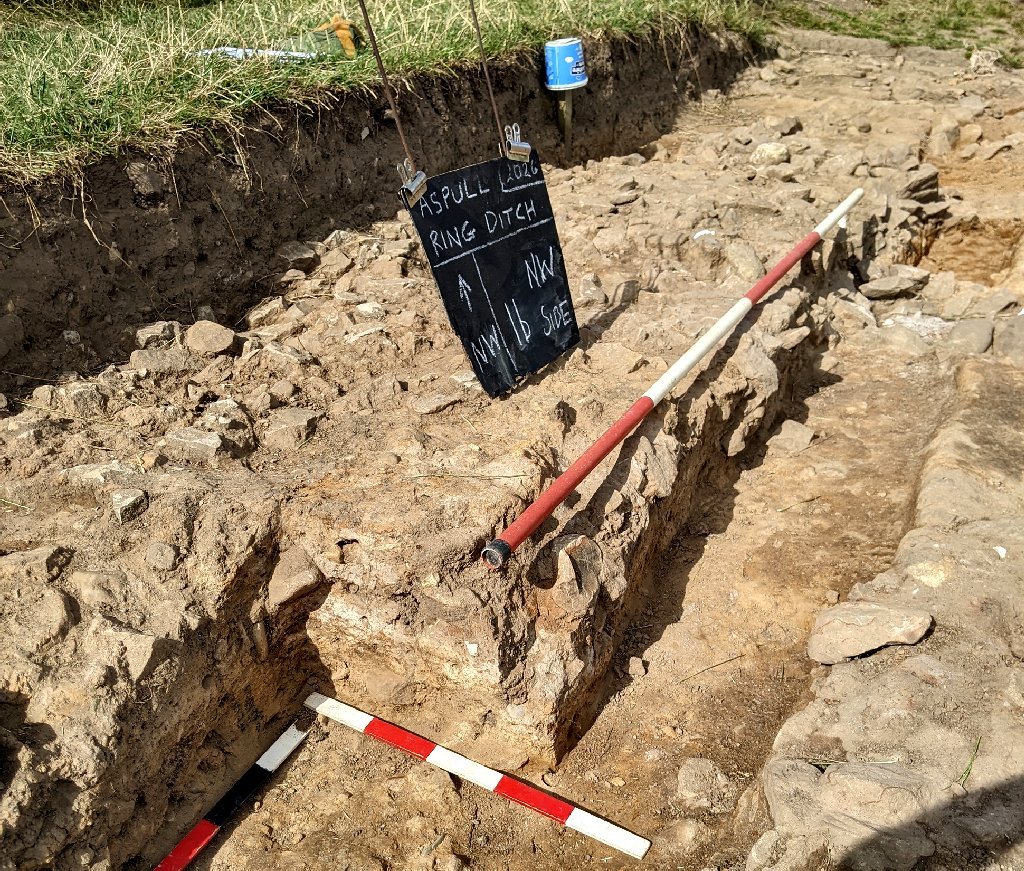
Susan meanwhile continued with her work on the southeast side of our clay-lined feature (F4). This would hopefully show more of the relationship between the burning layer and the side wall of the feature. However when she had finished we could see the burning layer in this area was patchy and it still wasn’t clear how it interacted with the feature. 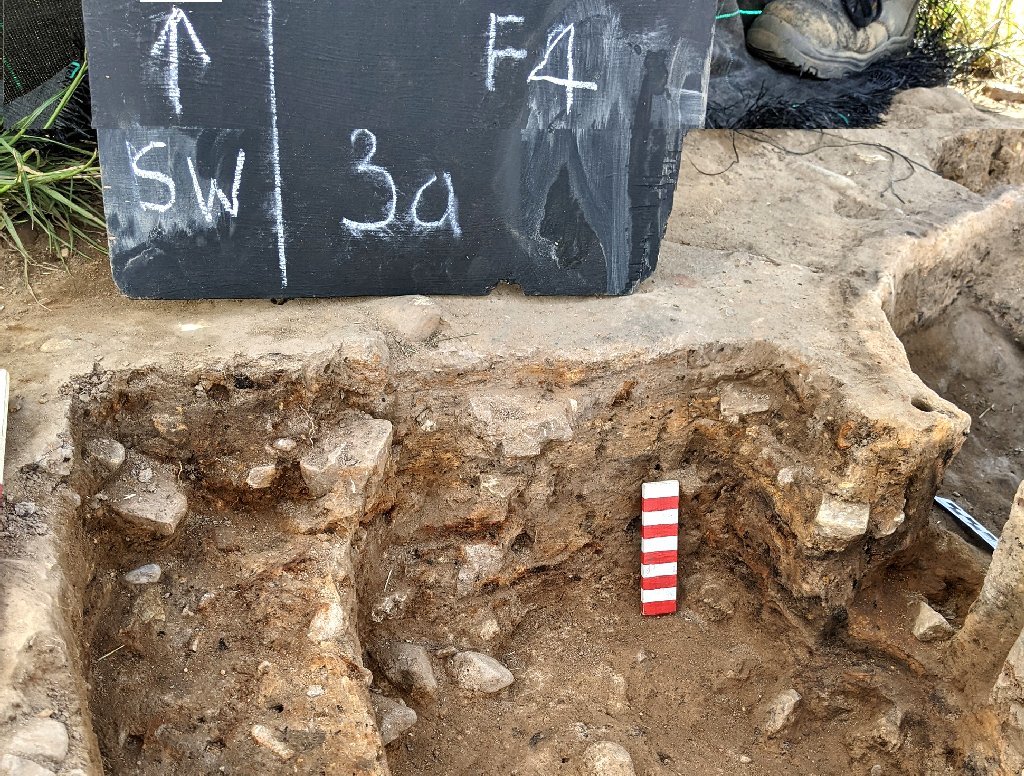
Peter was asked to look at the area on the northwest side of Feature F12 i.e. the burial under the two stone slabs. This area had produced some flecks of cremated bone and it wasn’t far from the pits we are assuming are token burials. Chris continued meanwhile to investigate the embedded stones on the east side of the rising central sandy clay mound.
Jon was delighted to be able to return to the collection of cremated bone he had found last week at the bottom of the cut Dave North had opened which was an extension from Jon’s original trench (Sondage 3a.S9). Dave was also happy to be able to join him clearing the area around the bone. Before starting though, there was some discussion about the lack of an obvious pit the bones where deposited in. As mentioned before John Needle had spotted a depression in the burning layer and Bill had reported soft material underneath (Feature F9). However there was no sign of anything now the burning layer having been removed. Remains of it in the form of a greyish clay could be seen on top of the yellowish clay covering the burial. It was though a rectangular cut in the grey layer could have had something to do with it but it was difficult to explain. 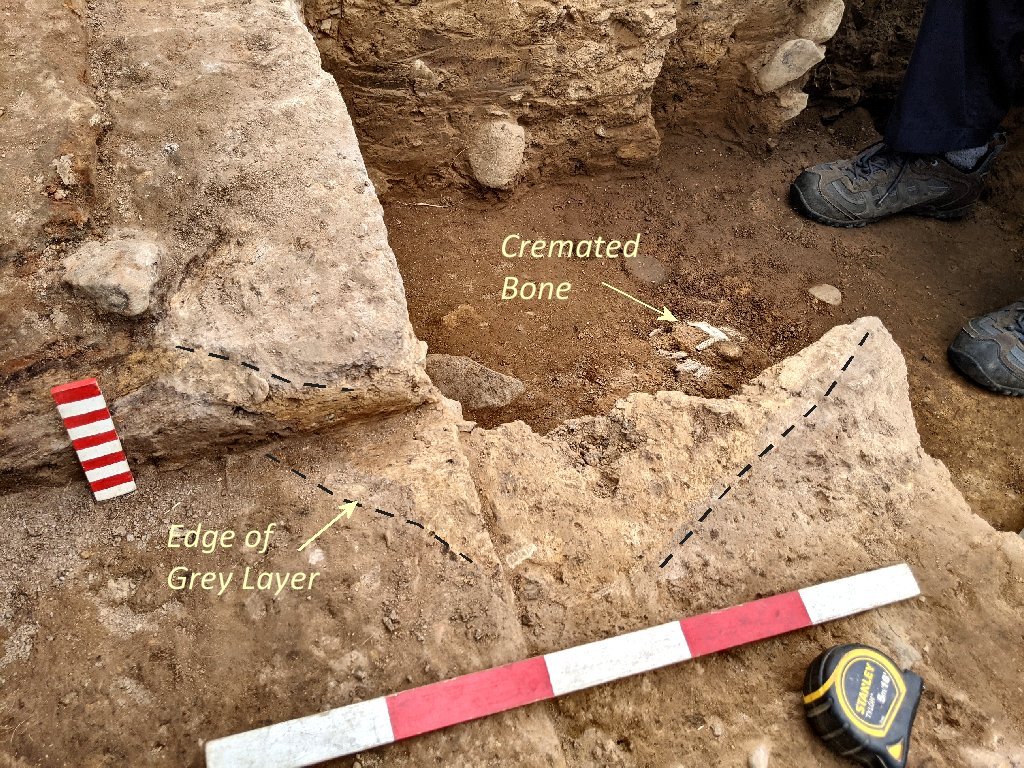 All day long Jon and Dave worked on clearing the clay from the bone deposit which just got bigger and bigger. Eventually quite a large cache was exposed containing some large pieces including what appeared to be sections of skull.
 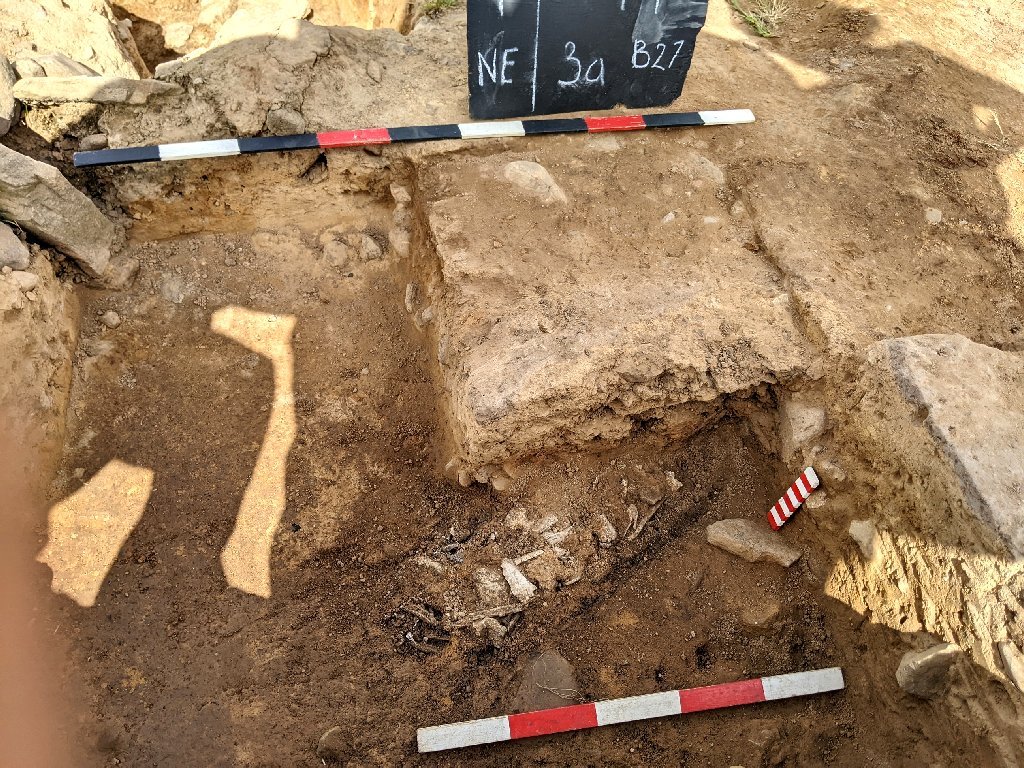 Bill joined in late in the day and was able to reveal the linear cut containing the bone and (for the first time) burnt material.
 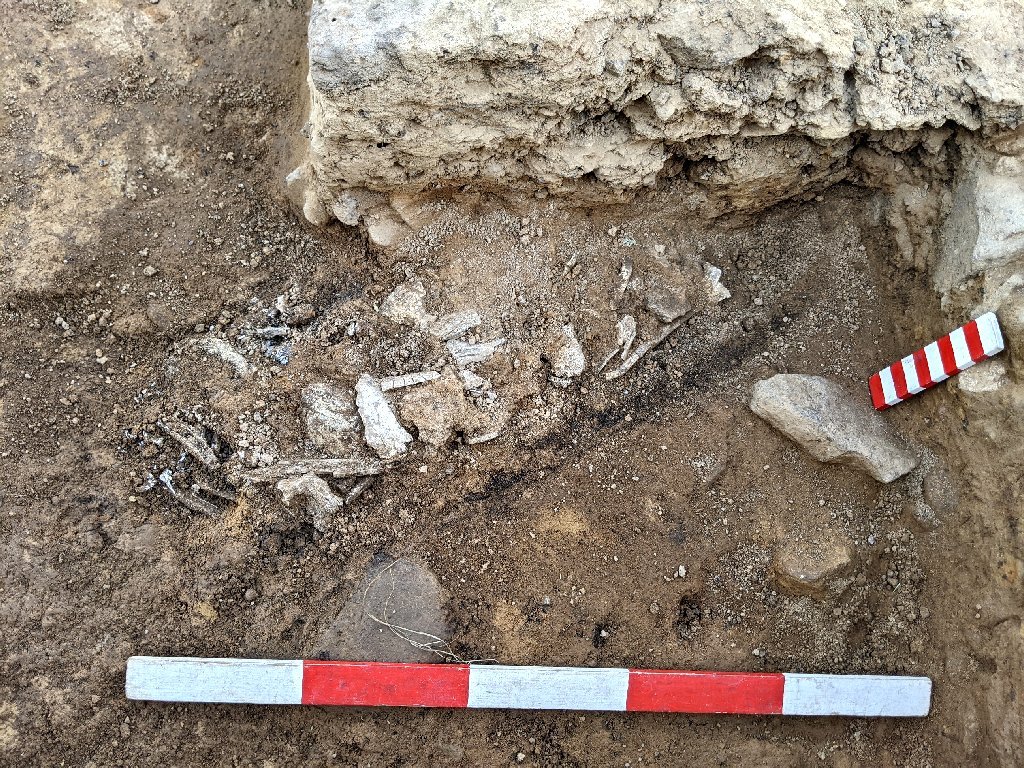 Chris suggested this could be what was left of the bag the remains we deposited in (the shape of the deposit was domed suggesting that was how they had been buried).
Thursday 22nd July
Day 21
Another great turnout with 11 on site today. Joining Bill, Chris and Patrick were Peter, Jon, Gaby, Isabel, Colin, Steve and John Needle with Alison joining after lunch.
Bill asked Isabel to continue cleaning up the bright stones in the area next to Trench 1c on the northwest side of Trench 1b – while Steve was asked to trowel the remaining soil from the other side of this newly exposed area around the datum peg (being careful not to disturb it). Colin was given the task of removing the seemingly deep layer of stones from the section in front of this newly exposed area so that Bill could finish his detailed drawing of this section. Steve found that there were little evidence of the stony layer next to the edge of the trench which seemed to confirm we have reached the extent of it on the northwest side. 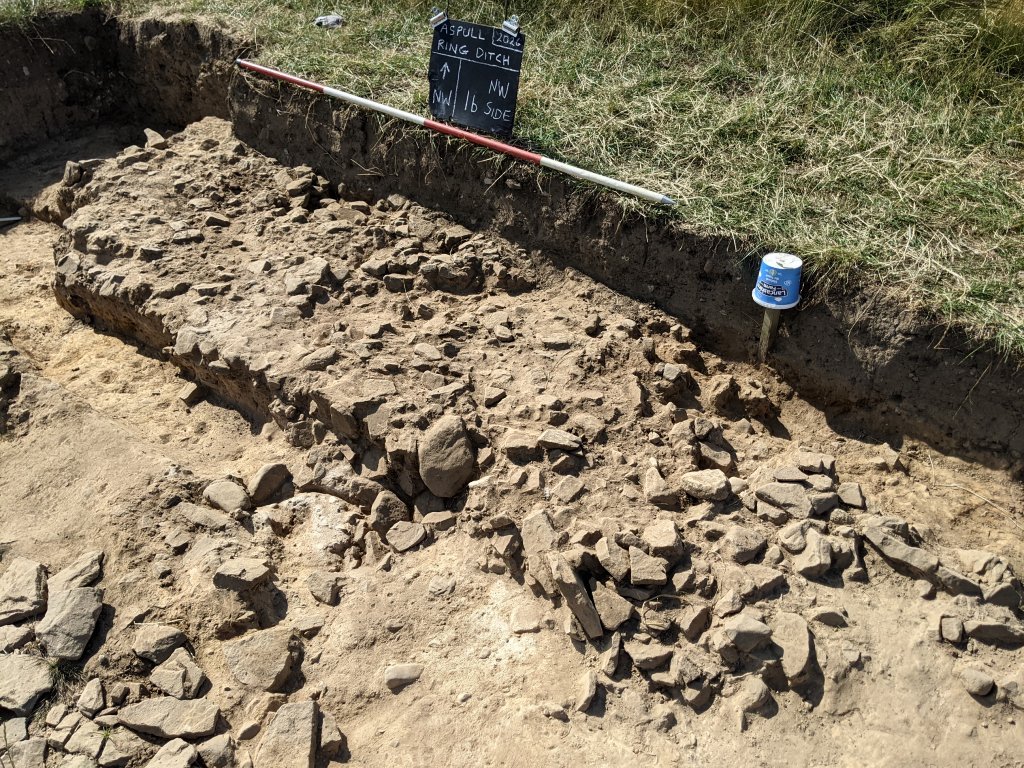 Bill wetted the bright stones to see if the green tinge would show up, which it did but not so obvious in the photo.
 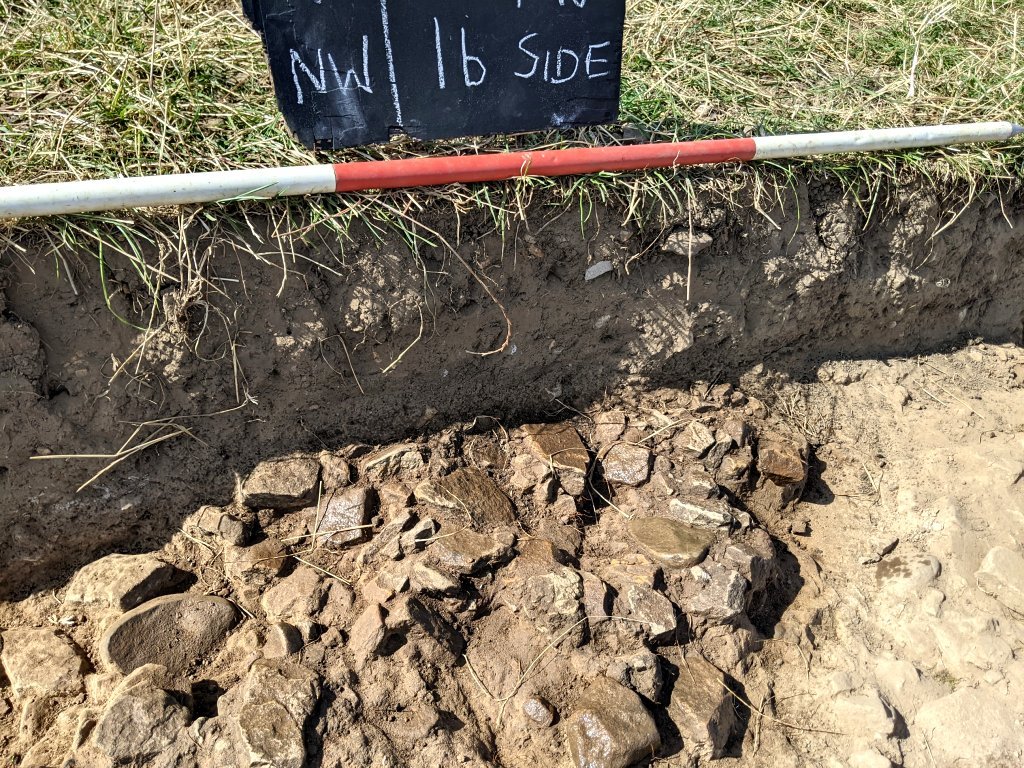 Colin surprisingly uncovered a patch of white-ish sandy clay amongst a deep layer of stones suggesting some sort of possible feature.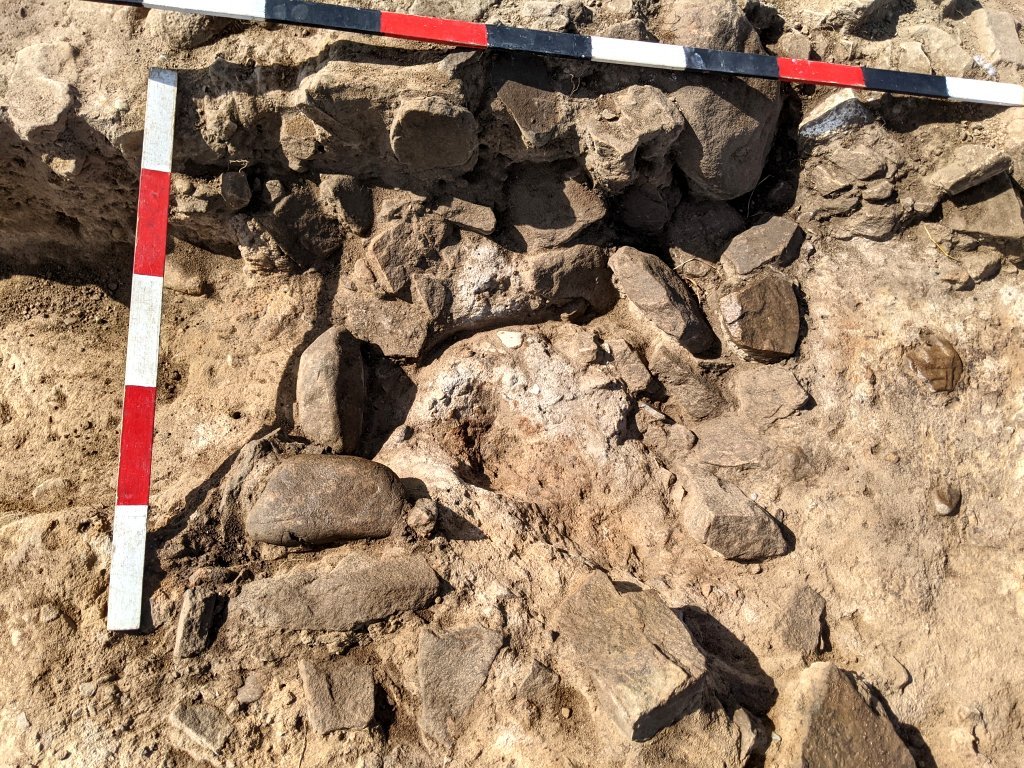
Gaby was asked to carry on working on the clay-lined feature (F4). On Tuesday it had been decided to investigate the southeast side of the feature, as it was away from the internal partition. The base also seemed to rise up towards the side wall on this side. Susan had previously expanded the cut on the outside to allow access to the side wall. Gaby was now tasked with cutting a section through the side wall. She carefully worked her way down through the wall taking samples as she went. Eventually she reached the point where the base came up to it. Bill could now see how the grey/blackish outer layer seemed to be going under the base as Chris had previously described. It was also significant that a layer of charcoal could be seen embedded in the sandy clay lining. 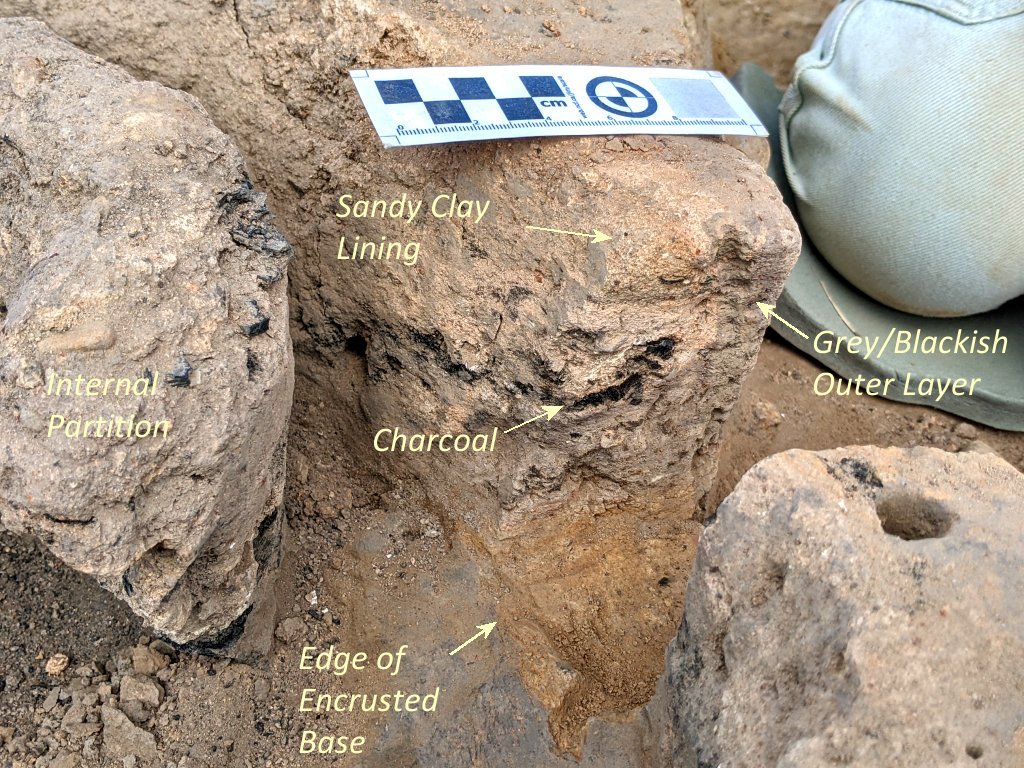 The charcoal continued on the opposite side of the cut.
 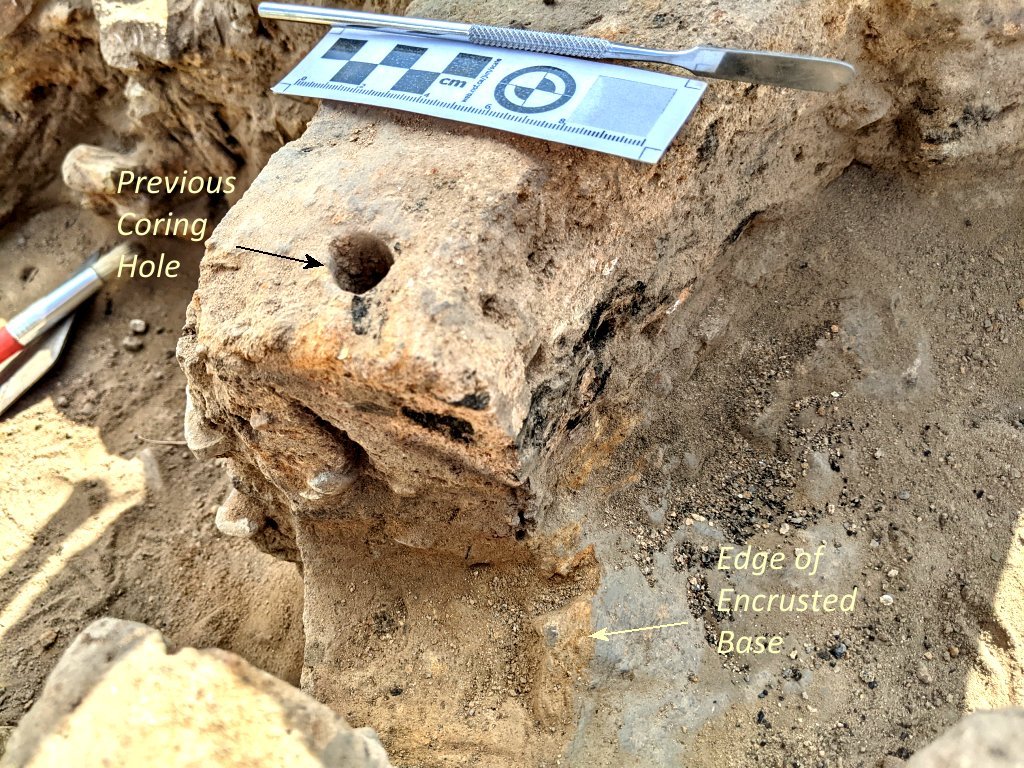 This embedding could only have occurred during the laying of the lining but how and why is a mystery.
Alison continued with her work on the section through the rising mound on the southwest side, while Chris and Peter carried on working on the embedded stones on the east side of Feature F2. Chris had previously had asked Bill if he could measure the difference in height between the base of the stones on north side and the base of the stones on the south side. Bill used the dumpy level to do this and, help by Gaby, showed that the base on the south side was 12cm higher than that on the north side. The base of the stones dipping on both sides seemed to dispel the theory that the stones were a kind of cairn, more likely a deposit of stones in a pit. 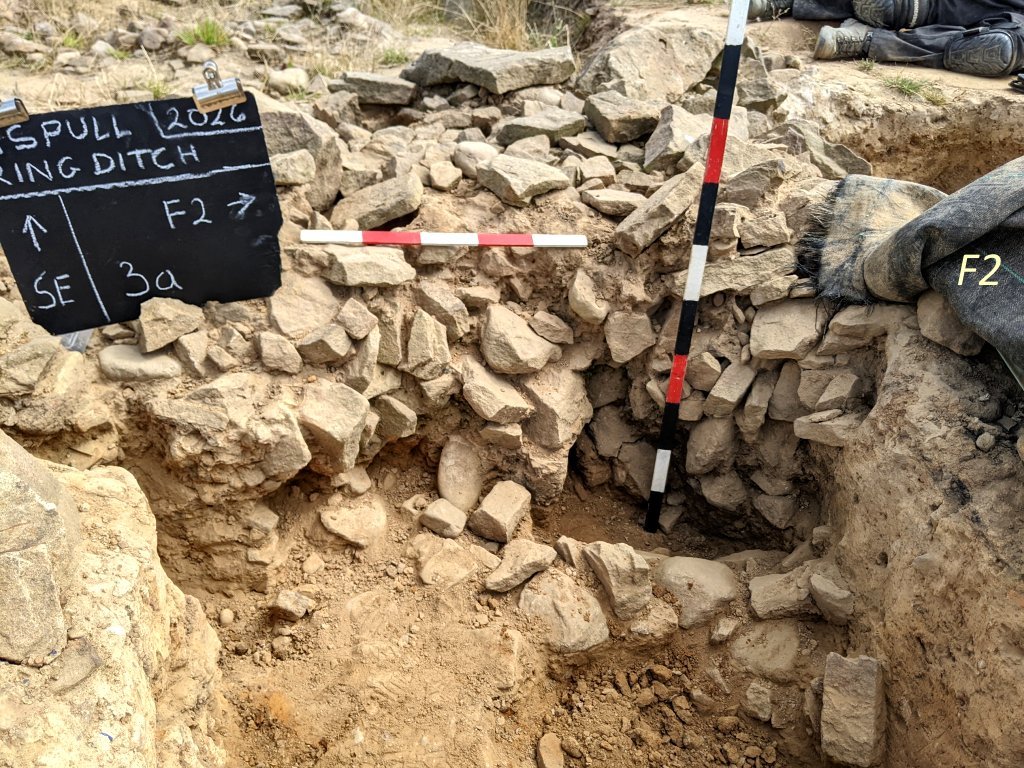 Peter meanwhile worked on the base in the north side trench taking it down as far as he could to see if its construction could be established. On the east side of the trench (as previously discovered) a dark brown layer can be clearly seen in the section proving at least the rising mound to be man-made.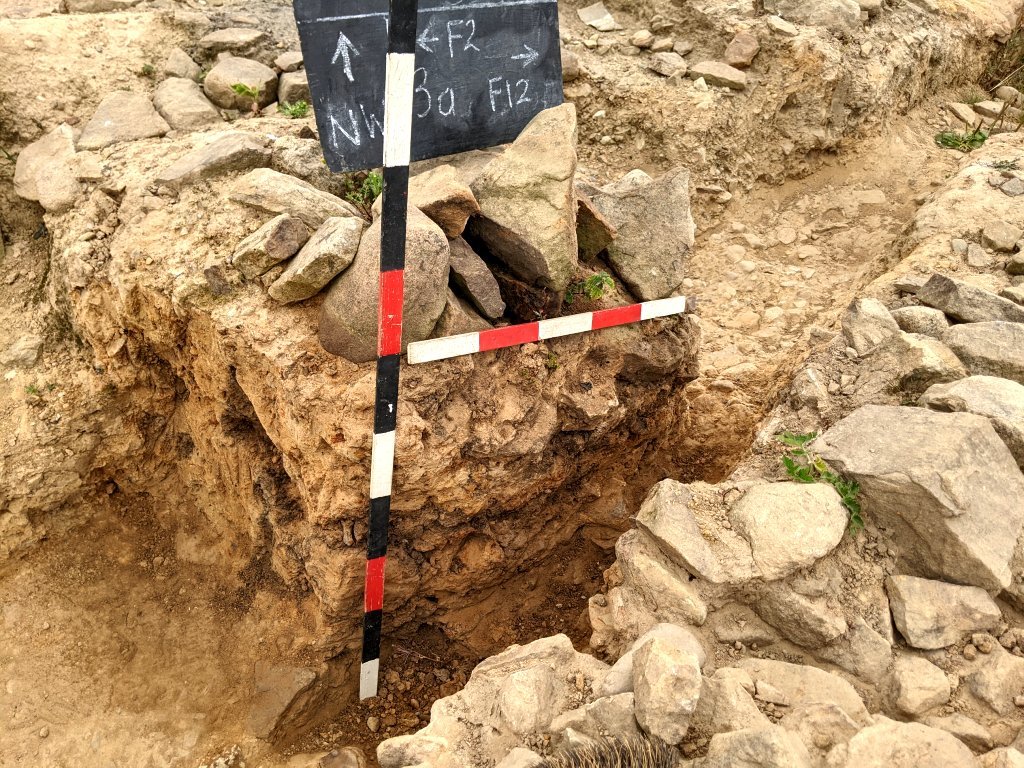
Jon was excited to get back to the trench he’d been working on a couple of weeks before i,e, Sondage 3a.S9. Dave North had already extended a section to the southeast by half a metre taking it down to just a few inches above the level Jon had reached. 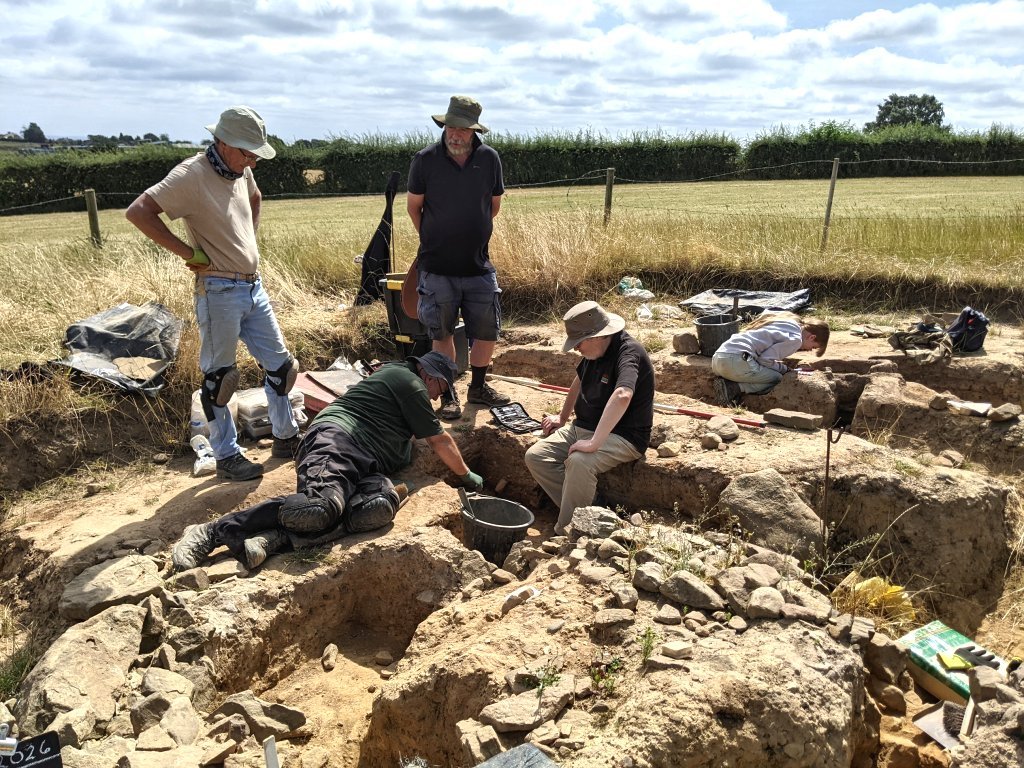 Jon carefully trowelled the rest of the way and slowly began to reveal more small pieces of cremated bone. Both Patrick and Chris had to leave early for various reasons so the missed the moment Jon uncovered more pieces this time much bigger.
 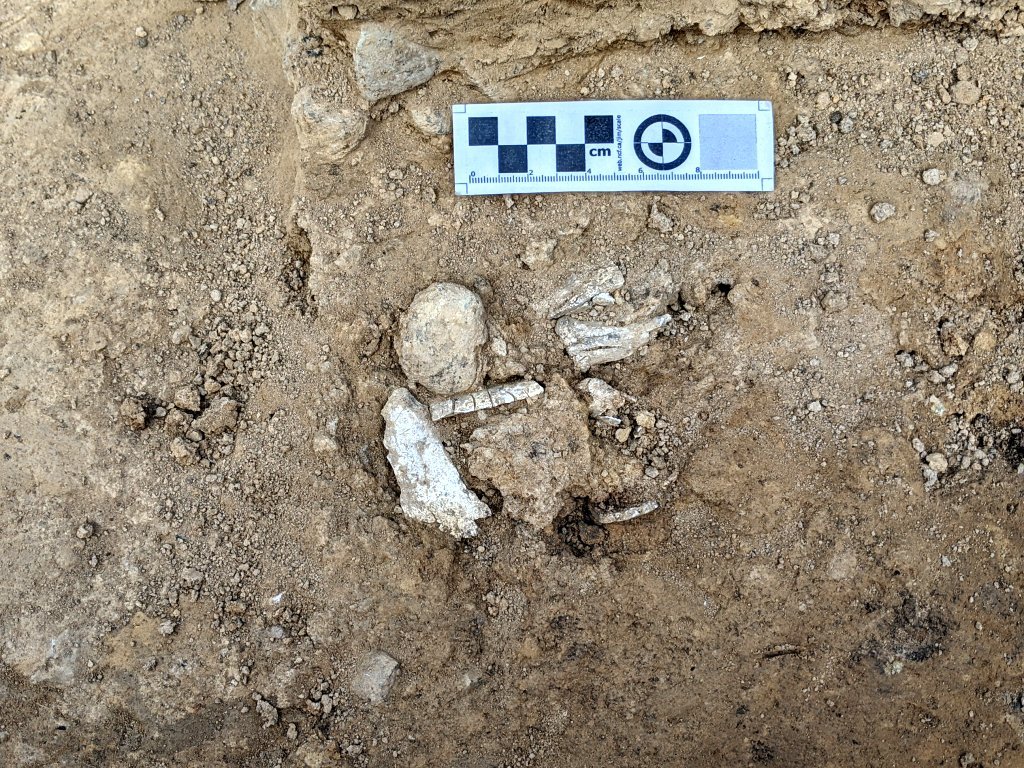 This now seems to be another significant burial, but strangely there does not seem to be an associating pit containing the pyre material (Dave though had noticed some disturbance in the layer above). Bill remembered a feature discovered in this area by John Needle in 2024 (later labelled F9). Later when Bill examined the drawings, drone shots and his diary entry for John’s discovery (Day 37 Tuesday 6th August 2024), it revealed it to be in the same place. It wasn’t drawn at the time as it wasn’t thought to be significant but Bill described the feature appearing in the section as “a dip in the burnt layer … directly under this was an area of very soft sandy clay”.
Tuesday 21st July
Day 20
Good turnout today (and Bill was back from his hols). Joining him, Chris and Patrick were Andrew, Jen, Susan, Isabel and Gaby – with Dave North joining later in the morning.
Looking at the work done last week by Colin, Steve and Paul on the northwest side of Trench 1b, Bill noted a distinct difference between the stones uncovered in the area next to Trench 1c, compared with the ones on the other side of the newly exposed area. The former were brighter than the latter, and Bill speculated that if wetted they would show the tinge of green he was expecting of the stones in this area. If it could be shown they were embedded in the soft brown sandy clay, it would confirm they were the same stones previously detected when Trench 1c was first excavated. Isabel and Andrew were given the task of cleaning off the remaining soil from these bright stones, while Jen cleaned up the rest. When finished there seemed to be a distinct edge between the two sets of stones and perhaps a northwest extent of the general stony layer. 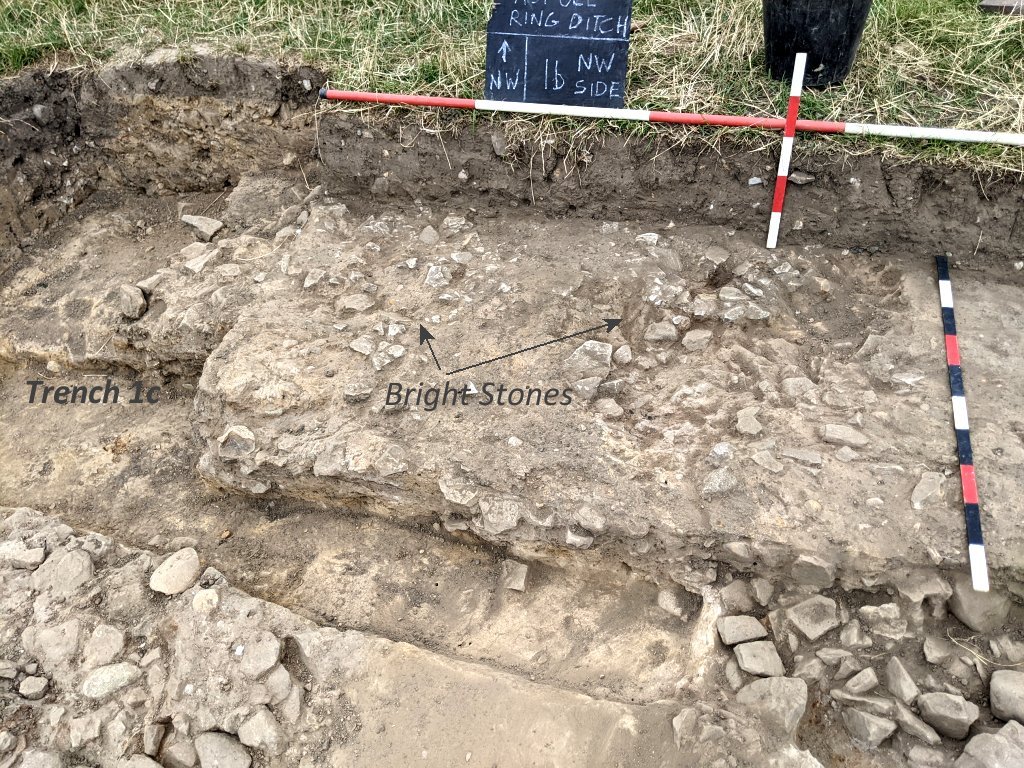
Particular attention was paid today to our clay-lined pit burial feature (F4). 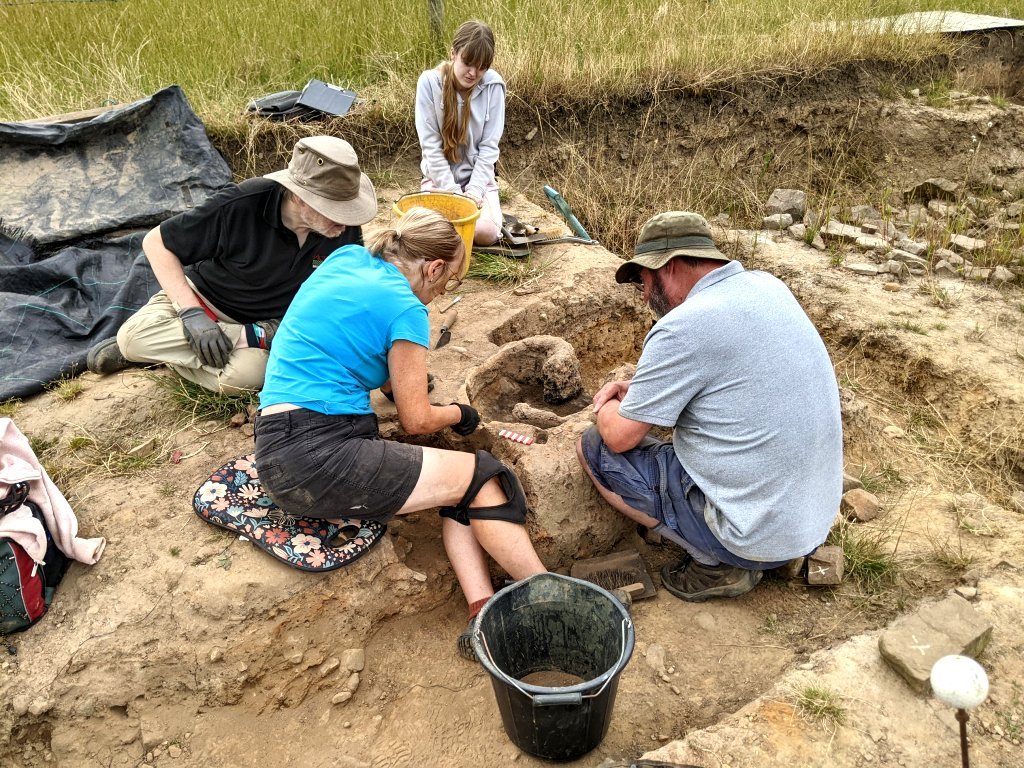 Bill had a good look at the section cut through the wall on the northwest side that Chris and Susan had been working on the previous week. The clay lining, with its grey/blackish outer layer can clearly be seen now but Bill could not necessarily see the outer layer going under the base as Chris had reported. However he could see a thin line of orange clay was coming in at an angle enclosing a triangle of greyish material, something he had noticed before on the surface in this area. The thin line of orange seemed to be connected to the orange clay going under the base of the feature.
 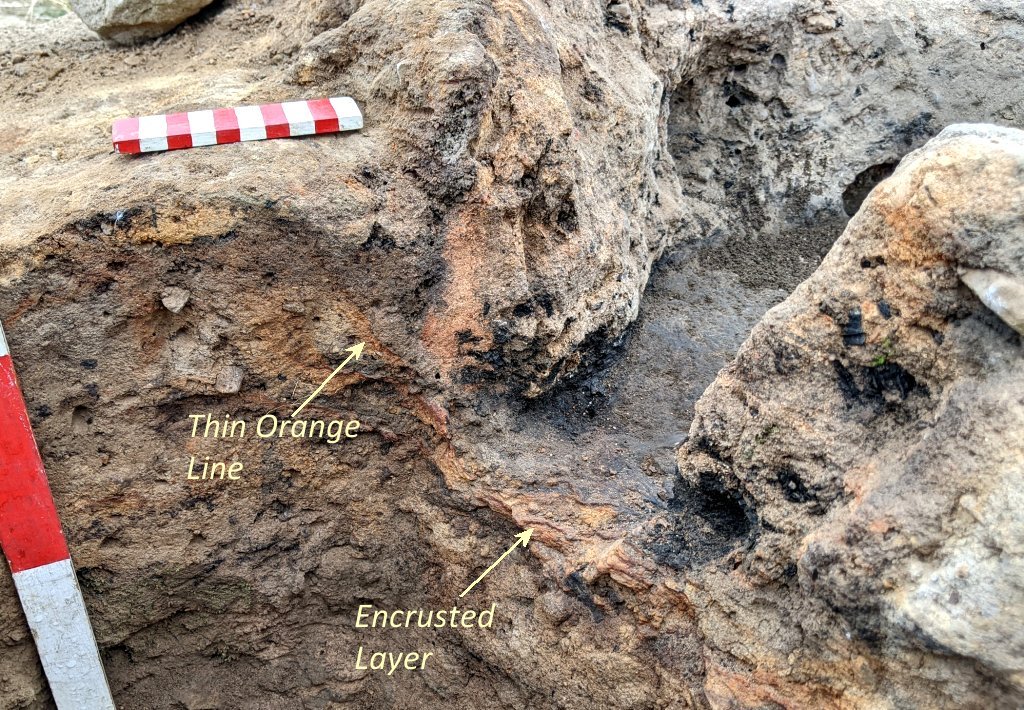 This clay going under the base was hard i.e. encrusted similar to an iron-rich hardpan which is normal produced by something called podsolisation (i.e. the precipitation of mineral rich water when it interreacts with different layer). In fact Bill speculated that the redish orange line we associate with the burning layer is very similar and may be the result of podsol action producing a hardpan of iron oxide.
 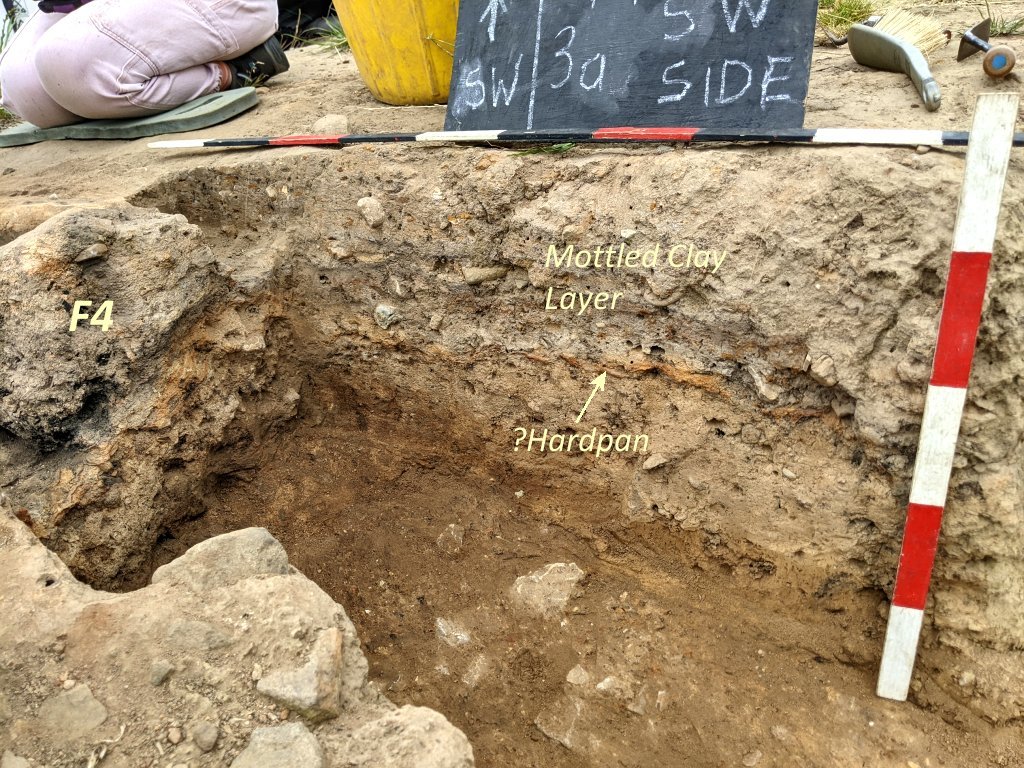 This area of Feature F4 is complicated by it being where the internal partition terminates. Chris therefore suggested a cut through the opposite wall which was clear of the internal partition. Patrick had already opened up a small cut outside the feature on that side and Susan was tasked with opening up this area to allow for greater access to the proposed section. Meanwhile Gaby was tasked with cleaning off the top edge of the feature so that the blackish outer layer could be clearly seen. As she was doing this Bill turned his attention to the base of the feature cleaning off as much of the back charcoal and loose material as he could. This revealed a very uneven surface seemingly constructed of compacted small stones embedded in a dark orange encrustation.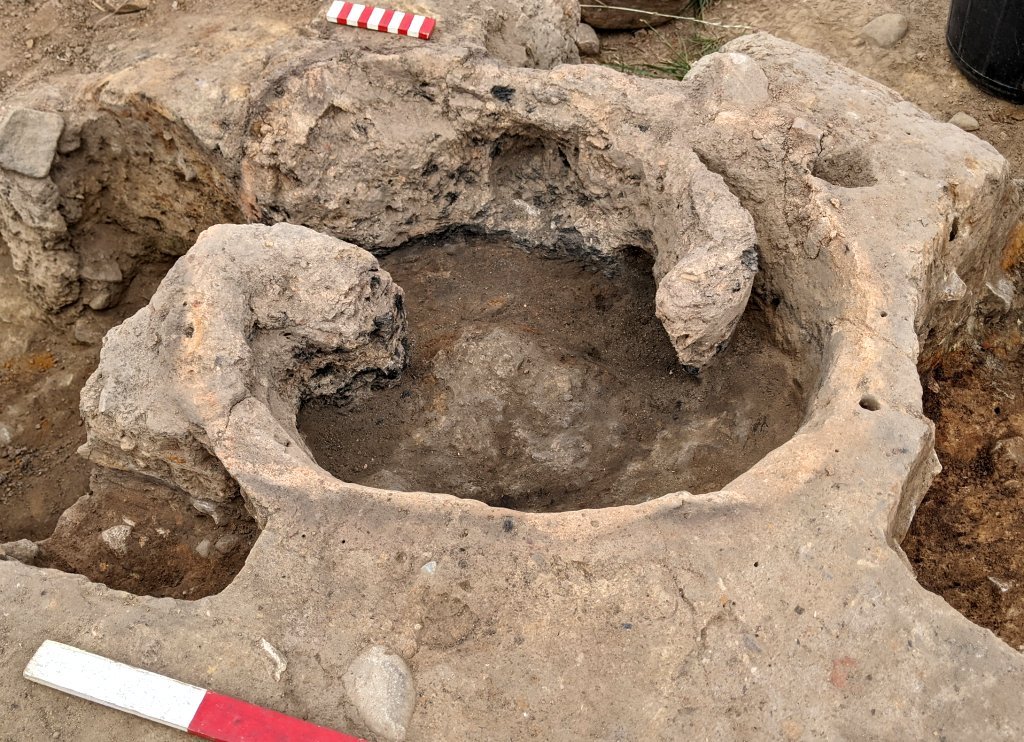
Meanwhile work continued on the sondage Jon had been working on a couple of weeks ago (Sondage 3a.S9). Chris said Jon had been so excited to find some cremated bone in the bottom of the trench, he wanted to leave further work on it for him to complete when he returned on Thursday. However, as the discovered pieces where on the southeast edge of the cut, Chris asked Dave to open up a small half metre square area on that side and trowel down to just above the layer ready for when Jon returns to finish it off. Dave’s trowelling revealed some mottling and promising flecks of charcoal suggesting man-made disturbance in the general soft sandy clay. 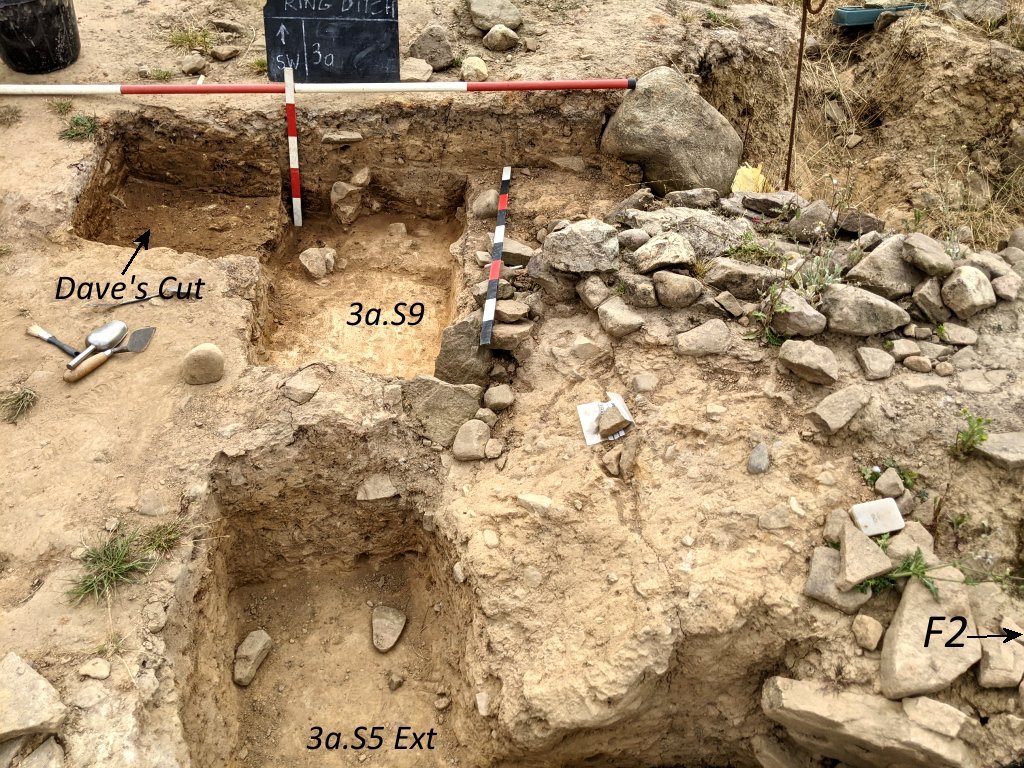
Thursday 16th July
Day 19
Much better turnout today with Jon, Susan, Steve, Paul Langin, Colin and Alison joining Chris (Bill not back till next week).
Colin, Steve and Paul continued to de-turf more of the northwest edge of Trench 1b. Upon cleaning they found stones (which still need a final clean) lying directly under the plough soil. It seems clear though that we have not yet reached the edge of the overlaying stone layer. 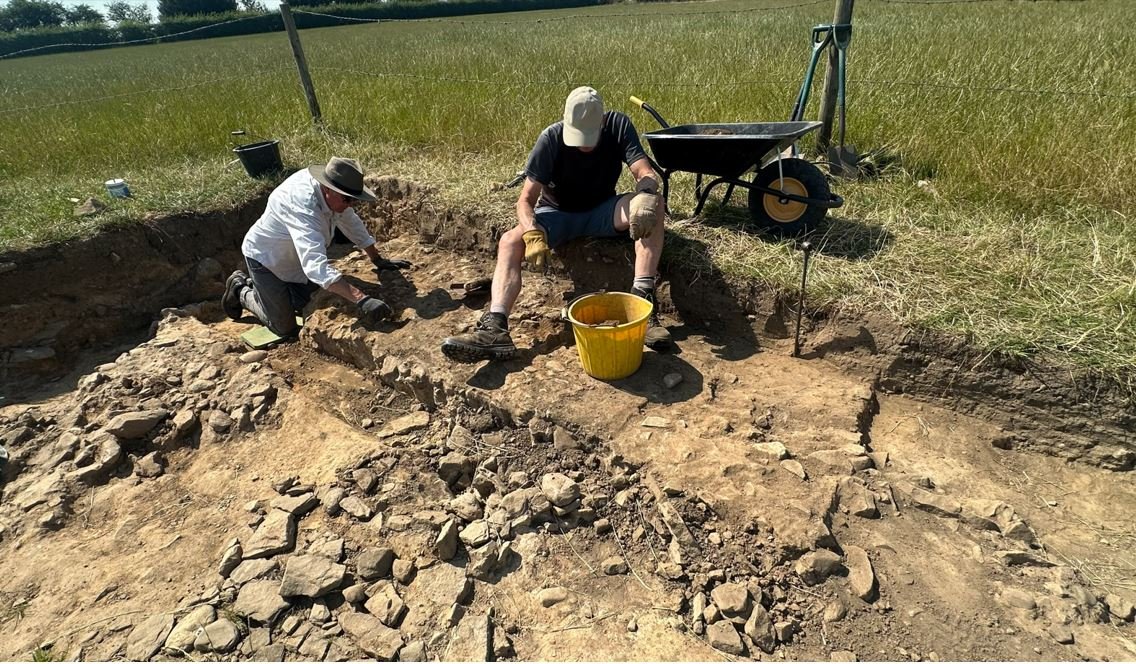
Jon continued working in the area on the south side of the rising sandy clay mound he had begun to clean last week. This area was never completed when it was first excavated in 2024, having found a scatter of a few cremated bones (B1). After proving that a pit like shape was in fact just from previous years, Jon continued trowelling down and was very pleased to eventually find a small selection of cremated bone within a darker clay. Early days, but this is looking very promising (Bill later labelled this cut a Sondage 3a.S9). 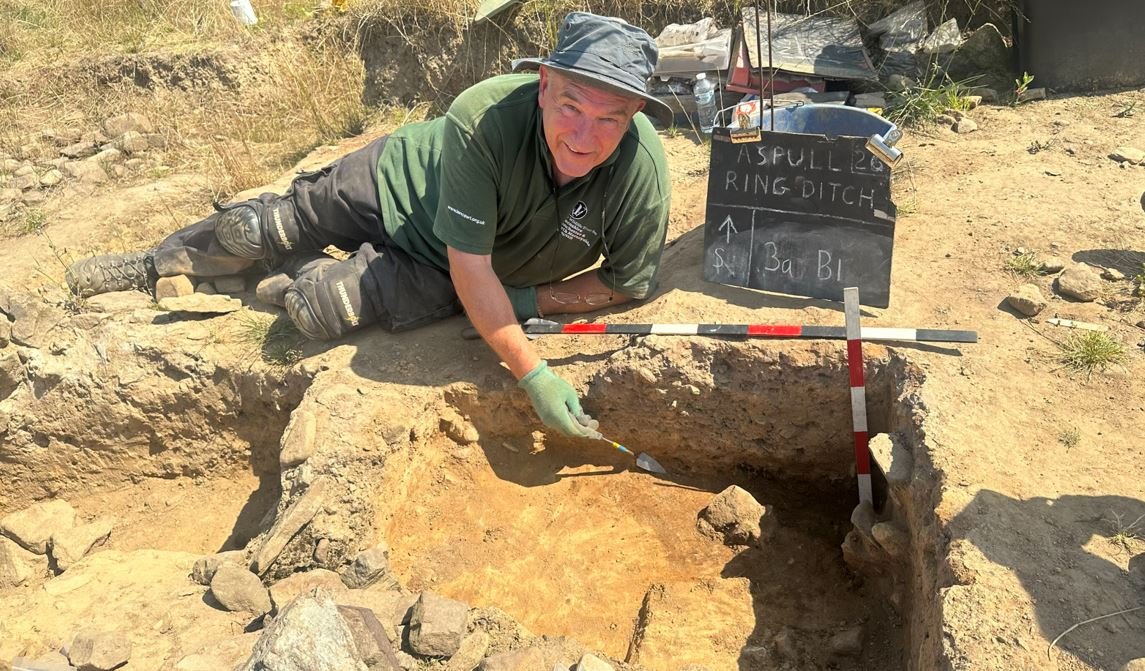
Chris continued to explore the embedded stones on the east side of F2 (Urn 2) to define the lower stone area. Susan continued working this area later in the day. A deep stone layer is possibly starting to emerge.
Alison continued working on the southwest cut southwest of Feature F2 through the ‘revetment’ of the rising sandy clay mound. Some larger stones were recorded, and then removed from the revetment. Last week she discovered some potential larger stones at a deep level, which she is working towards and improving the section. 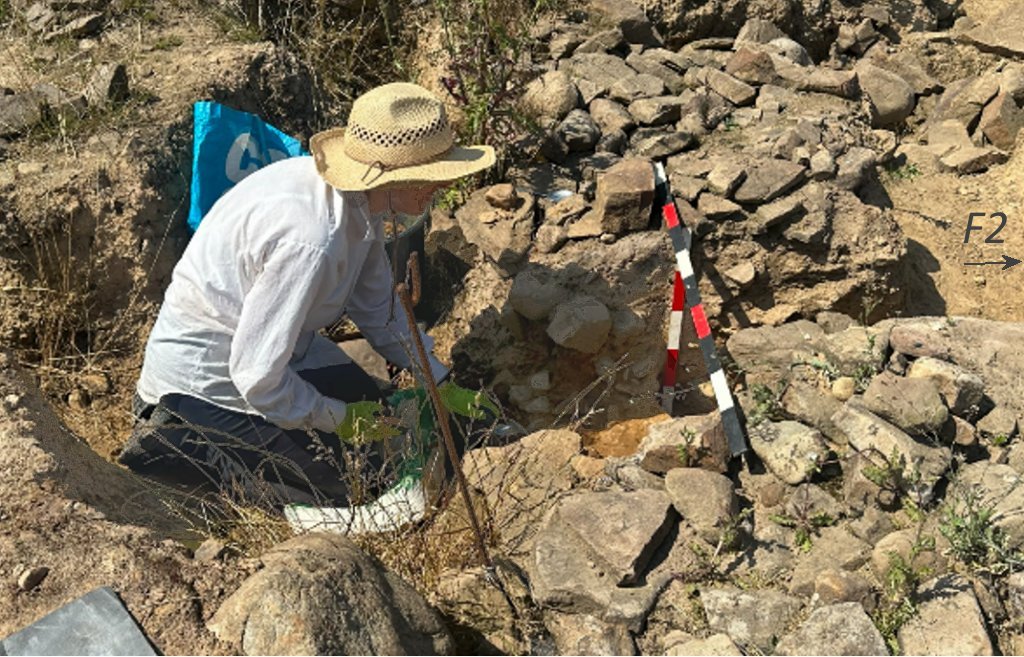
Susan working on the cut in the wall of Feature F4 (clay lined burial pit) which Chris then recorded on video and in 3D. The more we see of this section through the wall, the less we understand how this feature was constructed. To get a better understanding, after lunch Susan slightly open the section up to get a clearer view. 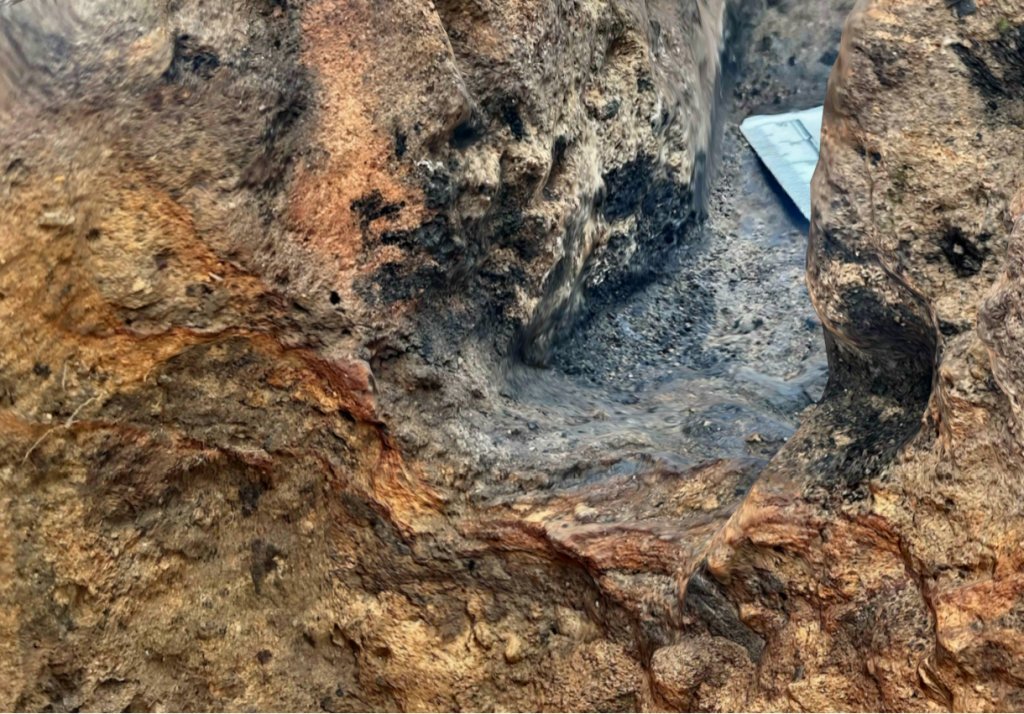 We can now see clearly the orange clay side wall. However the grey (blackish) outer layer (which we saw clearly when the feature was discovered) seems to run under the orange clay wall above the stone base. More 3D models, videos and photos were recorded.
Tuesday 14th July
Day 18
Not a great turnout today, with Bill on his hols (again) Chris was in charge. Joining him were Gaby and Peter.
Chris and Peter started the day by removing an area of turfs on the northwest edge of Trench 1b. 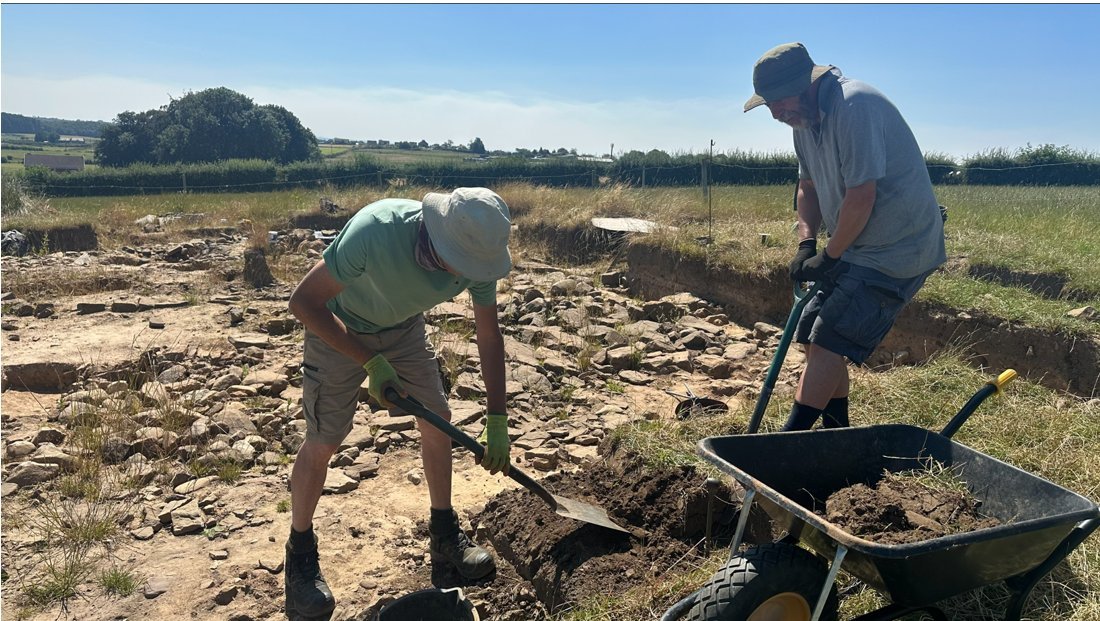
Later in the day Gaby began the process of cleaning of the remains of the topsoil from the area exposed down to the next level. 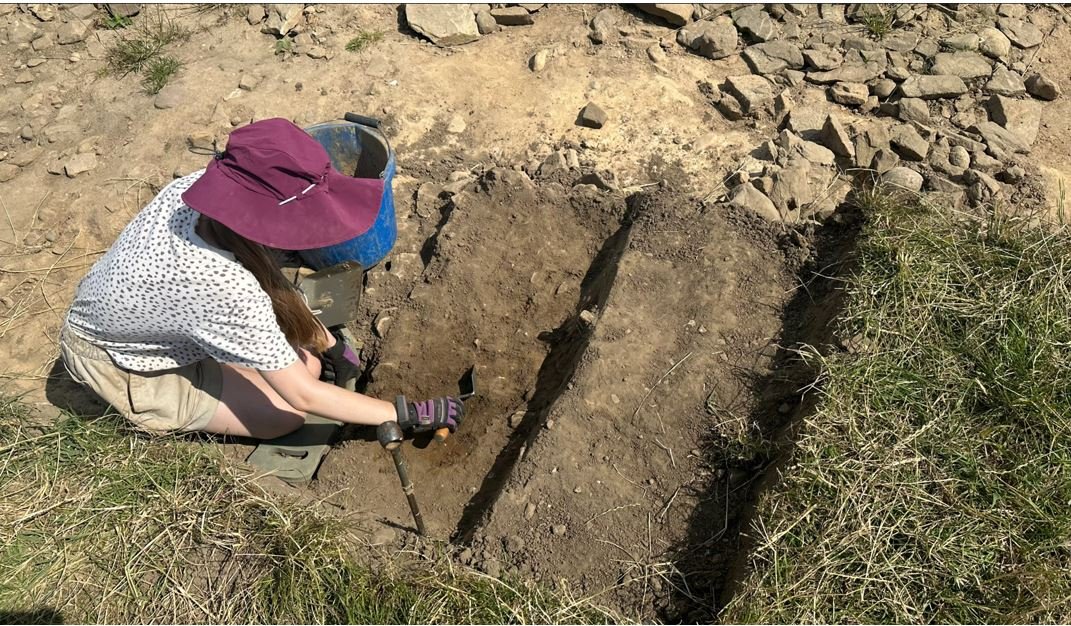
Chris and Peter continued to work on the area at the base of the embedded (layered) stones on the east side of F2 (Urn 2). At first it looked like there could be a large stone at the base of this feature, but this turned out to be a couple of stones, one of which had split. However, it soon became clear that on the north side of the feature the stones are much deeper (0.7m). 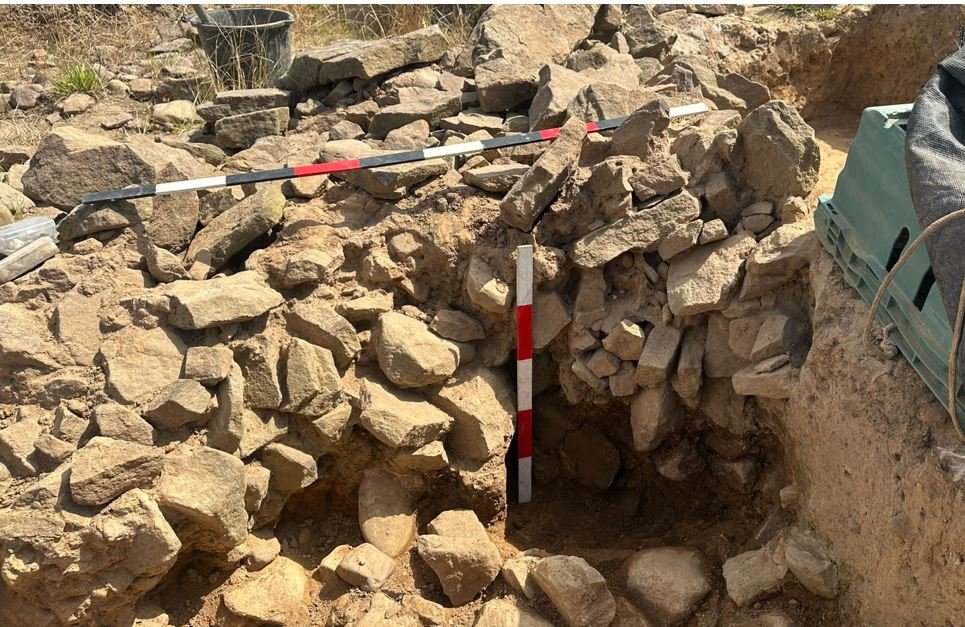
Gaby cleaned up the small section on Feature F4 where the clay wall had been exposed in previous years, which now had deteriorated. The section is very confusing and will need further investigation before we understand how this feature was constructed. We can see the edge of the base now and the clay wall is outside of it but it is not yet clear the interface between the two. 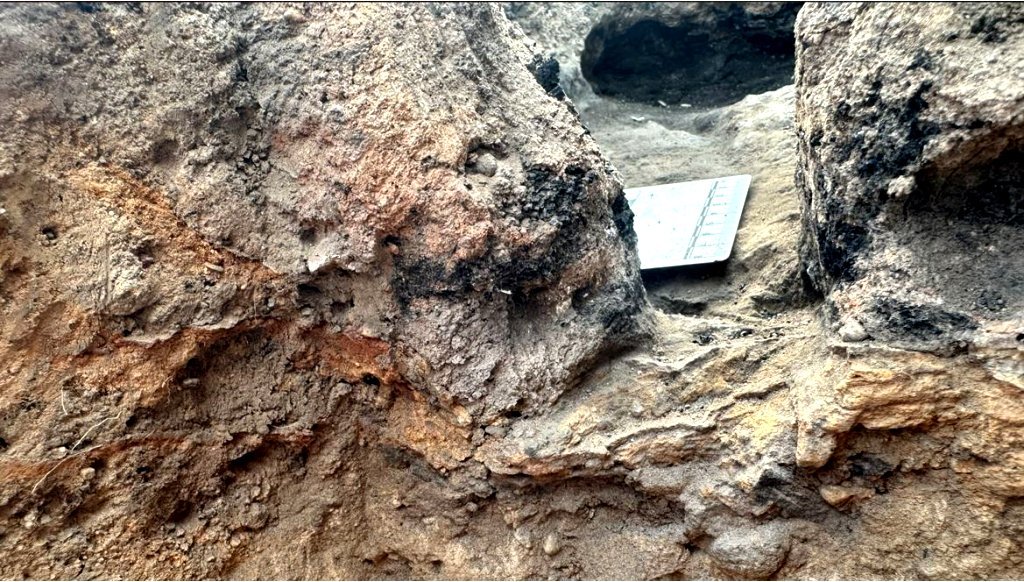
Thursday 9th July
Day 17
It was forecast to be hotter today but the breeze kept the perceived temperature to an acceptable level. Joining Bill and Chris today were Andrew, Peter, Gaby, Susan, Isabel, Colin, Jen and Paul Langin.
Bill asked Paul and Colin to remove another metre of the fill from Trench 1c. Bill’s drawing was showing the original trench narrowing so his thoughts were that traces of the embedded stones he was looking for should turn up in the undisturbed section. 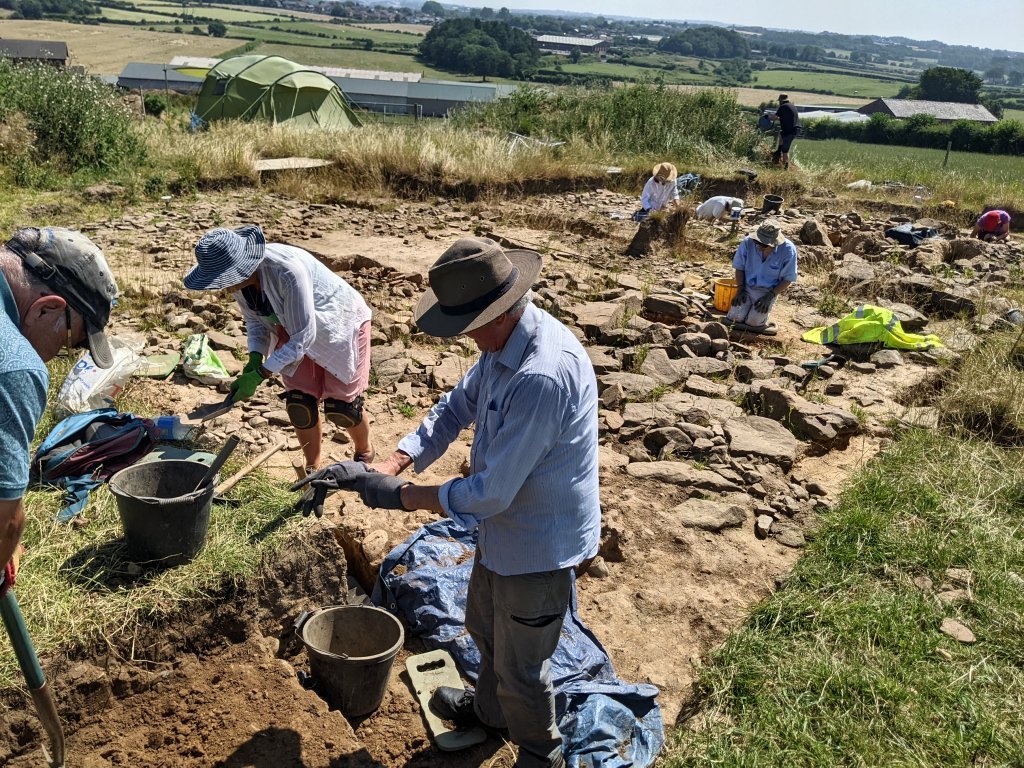 In the afternoon Colin was tasked with cutting the turf from around Peg 10c and replacing it with the auger in preparation for the whole of the side of Trench 1b to be extended. Paul continued working in Trench 1c and was able to uncover a concentration of stones. Early days but they seem to be the stones Bill had been looking for, lying as they seem to, above the burning layer.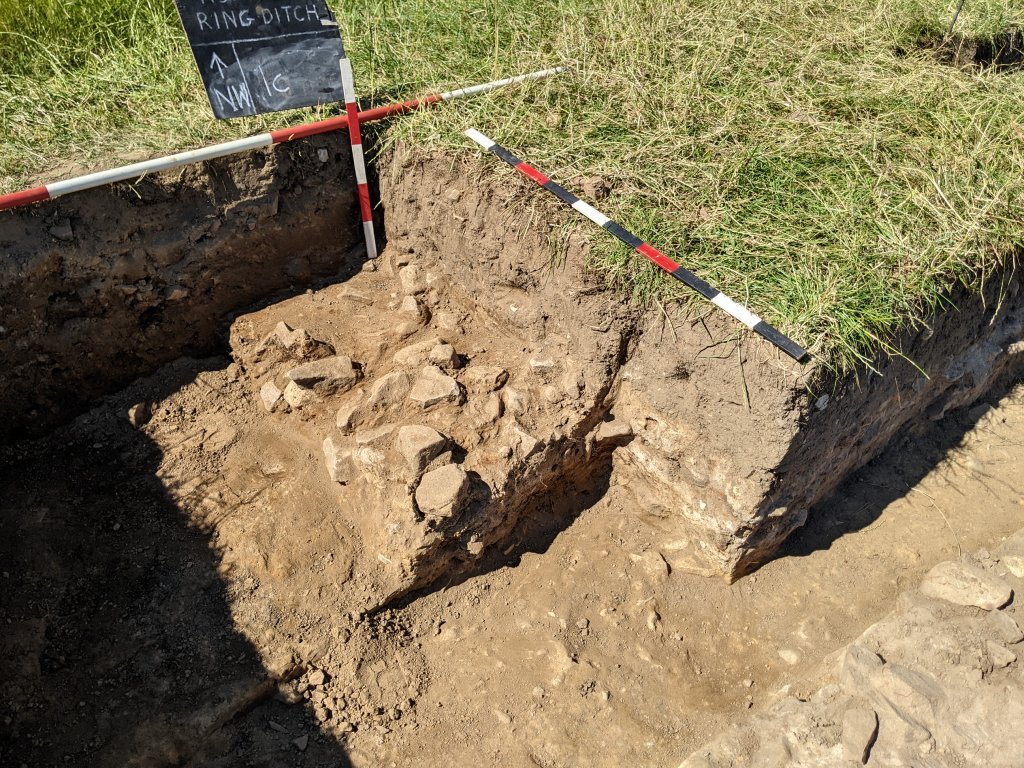
Bill asked Jen meanwhile to remove the stones from the northwest section of Trench 1b. This revealed quite a depth of stones in the central area of the section. In the afternoon Paul helped Bill to record the section so that next week the trench can be extended in search of the end of the stony layer (and maybe reveal an interface between it and the embedded stones in Trench 1c). 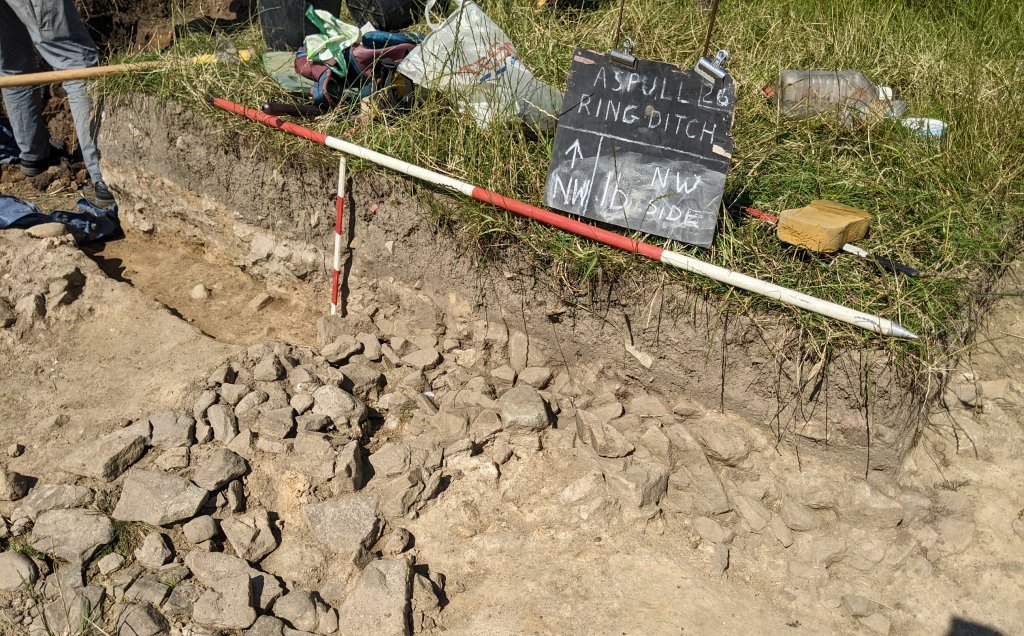
Andrew continued to trowel the new cut outside the southwest edge of the circular kerbed feature – while Chris carefully examined the area where Gaby had found the tooth on the south side of the rising sandy clay mound.
Peter and Isabel continued working on the northeast side of the rising sandy clay mound breaking through from the outer trench into the trench next to F2. This revealed a section very similar to the section Alison had exposed on the opposite side of the rising mound – i.e. stony layer resting on sandy clay, a band of dark soft material, then more sandy clay before reaching the stones embedded in the base of the trench. The dark soft material seemed to expand around the corner of the cut, something Chris had previously come across. 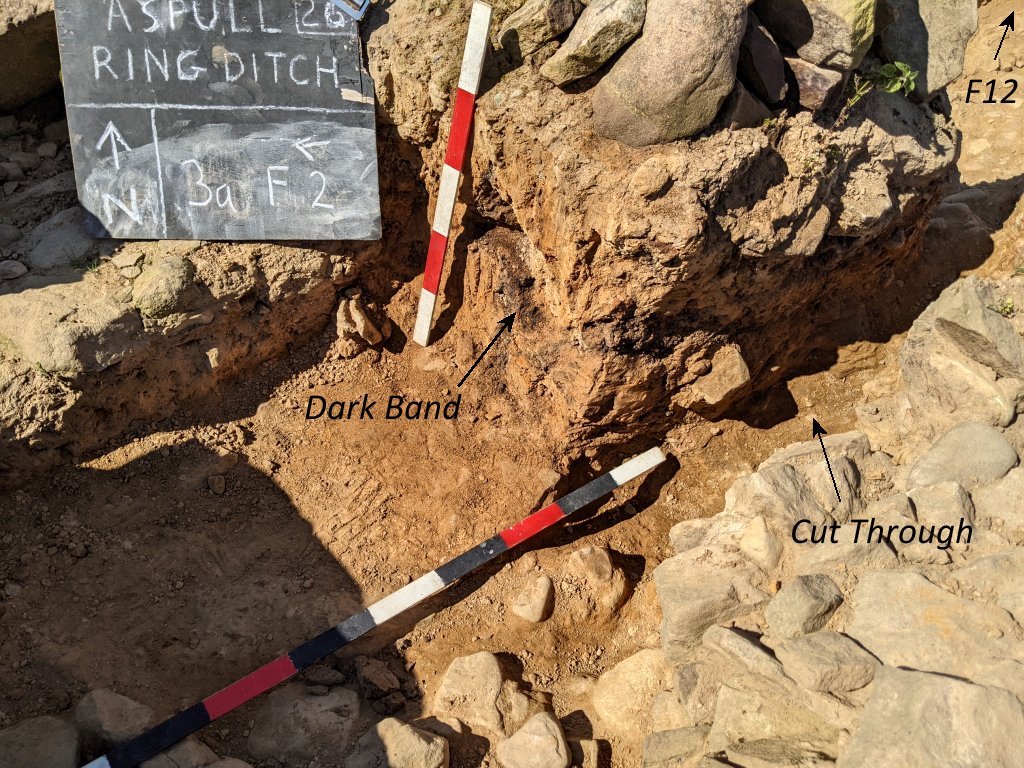 The stone base here rises as it approaches this point then falls away as it enters the trench next to F2.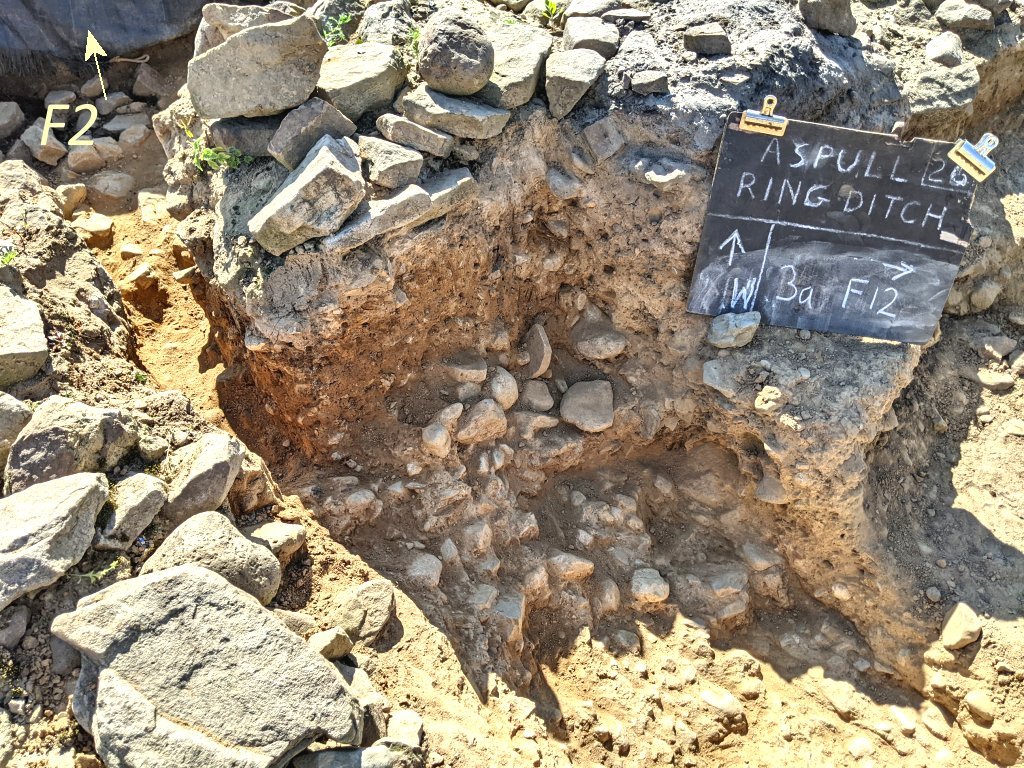
Gaby continued with her work on the cut on the northwest side of the clay-lined feature (F4) and was able to expose the well defined burning layer in the southwest section which disappeared just before reaching the feature. Chris asked her to continue down the southwest side of the feature to see if an original pit could be detected. When none appeared it is assumed the clay lining was put up against the original pit (Patrick had come to the same conclusion when he’d excavated the section on the southeast side). 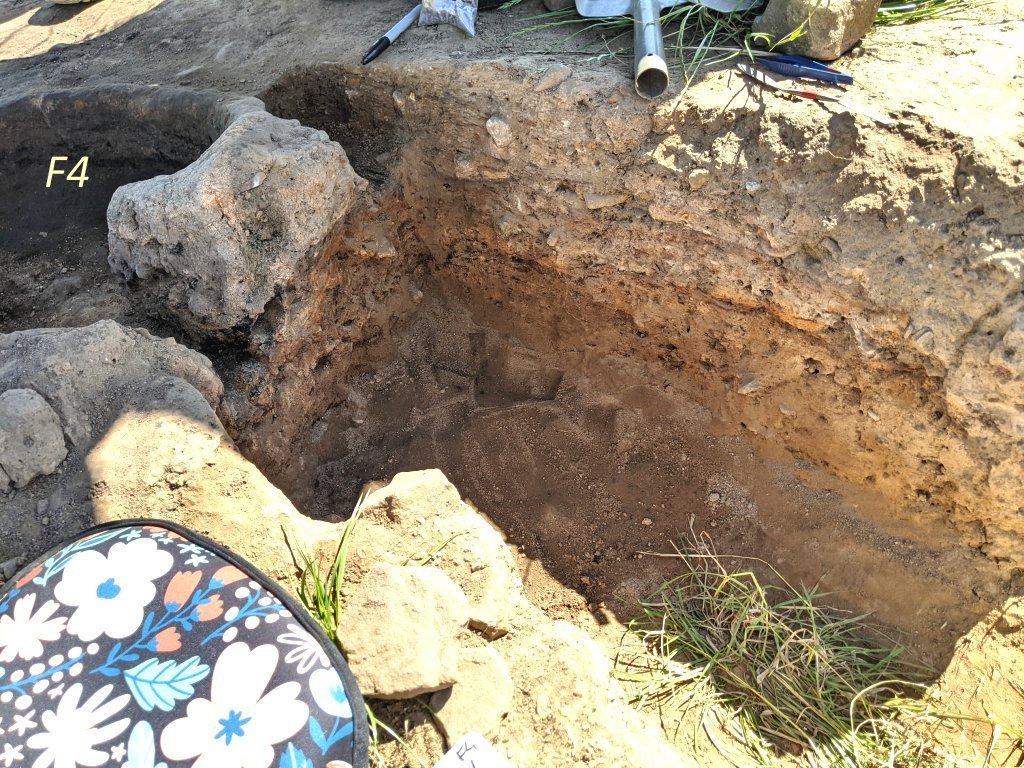 The exposed clay lining on the northside has suffered from the heat, drying out and crumbling to the extent where large pieces were falling off. It was decided to take the section down to the base of the feature which would give us the opportunity to examine the interface between the base and the clay lining. This revealed quite clearly that the clay lining went beyond the base. In fact the base seemed strangely to end in a lip suggesting it could actually be ceramic (more work obviously needed here but the mystery continues).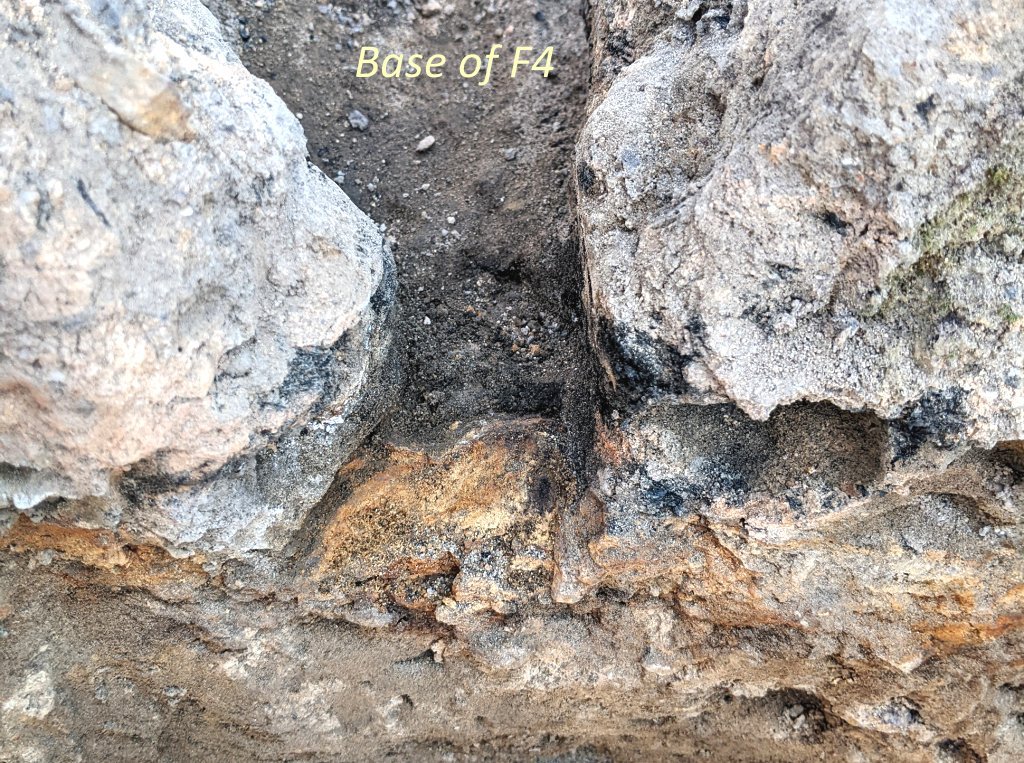
Wednesday 8th July
Day 16
Good turnout despite the return of the heatwave. With Bill not back till tomorrow Chris was in charge. Joining him were Patrick, Peter, Jon, Alison, Susan, Gaby and Jen.
Chris continued looking at the perceived stone cairn on the east side of the rising central sandy clay mound.
Meanwhile Jon was asked to reopened 2 year old area just to the south of the mound. This area was one of the first areas opened when we moved towards the centre. It was never completed as we found a scatter of a few cremated bones (B1).
Peter continued with cleaning the stones on the north side of the supposed ‘cairn’.
Alison returned to the slot she’d been working on – the cut going through the revetment on the southwest side of the rising central sandy clay mound cleaning up the stony layer she found at the bottom of it.
Patrick continued looking at the area on the southwest side of the stone box-like feature (F22) in kerbed circle.
Susan was tasked with removing the last bone from under what was left of central the partition (hopefully without destroying it). Meanwhile Gaby was asked to clean up the section Patrick originally cut last year on the northwest side of the clay-lined feature (F4)
Jen continued with the task of cleaning up Trench 1c ready for Bill to record.
Proceedings finished early today due to the heat.
Thursday 2nd July
Day 15
Another great turnout with Andrew, Peter, Jen, Isabel, Gaby, Alison, Jon Shelley and John Needle joining Bill and Chris. We also had Gabriel and his mum Denise joining us for the second day of his two-day work experience placement.
Jen, Gabriel and Denise continue with their work on the northwest section on Trench 1b and Trench 1c. It now seems clear that we are beyond the stony later in Trench 1c but not in Trench 1b (stones seen at the edge of Trench 1c seemingly at the mottled clay level turned out to be part of the backfill btw). In the afternoon Andrew showed Gabriel and Denise how to set up the dumpy level and they heled him to take more readings for Bill.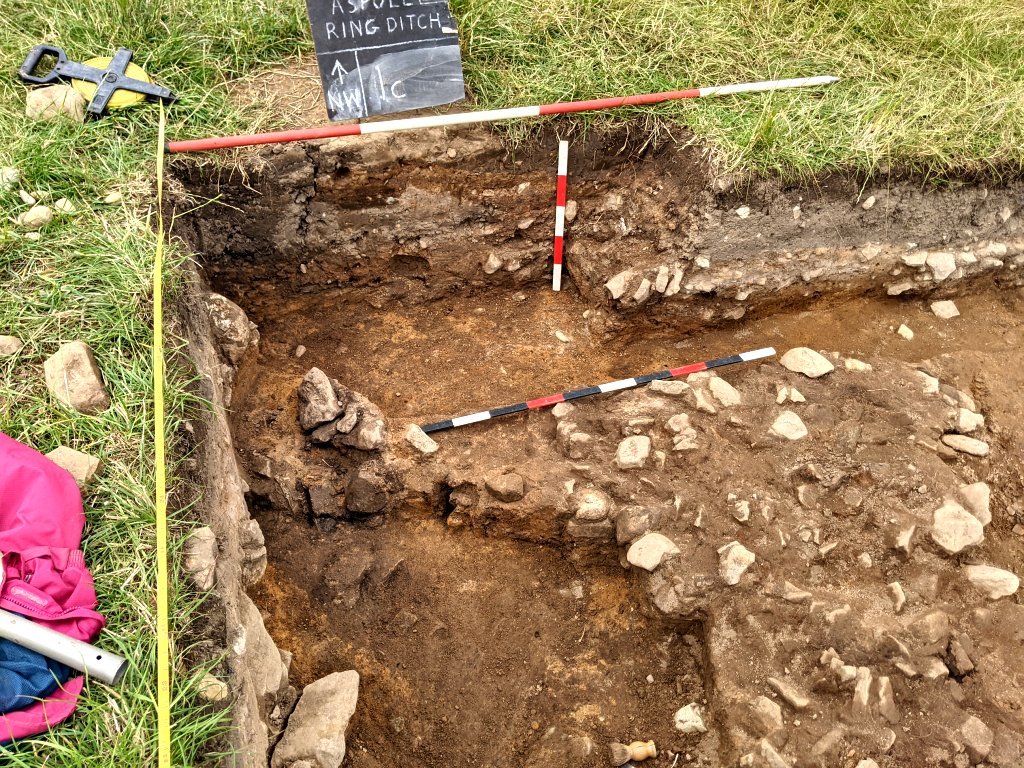
John Needle was tasked with clean the stony layer revealed on Tuesday in the extension of Trench 1b on the southwest side. This confirmed the edge of this layer was going off in a northly direction. 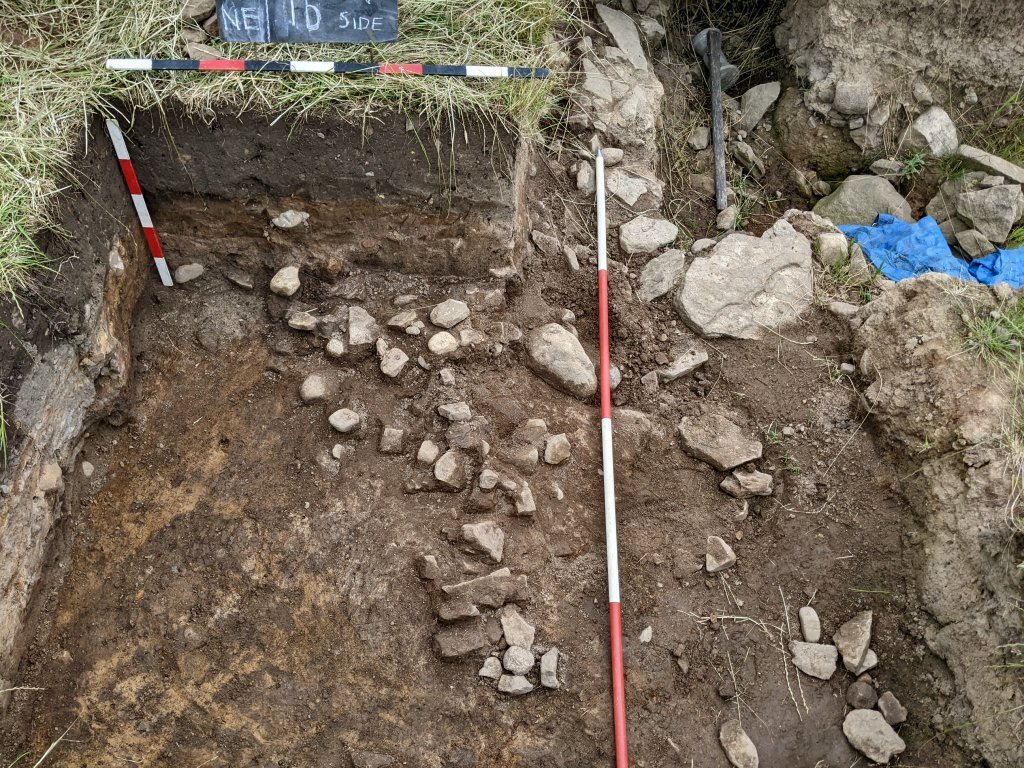
Before lunch Andrew was tasked with opening up a new section In Trench 1b starting from the outside edge of the curved alignment of large stones and going through the sandy clay patch devoid of stones (first discovered in 2023). The idea was to line it up (although on a dog leg) with the sondages either side of our stone box-like feature (F22) so that Bill could record a full section across this area. 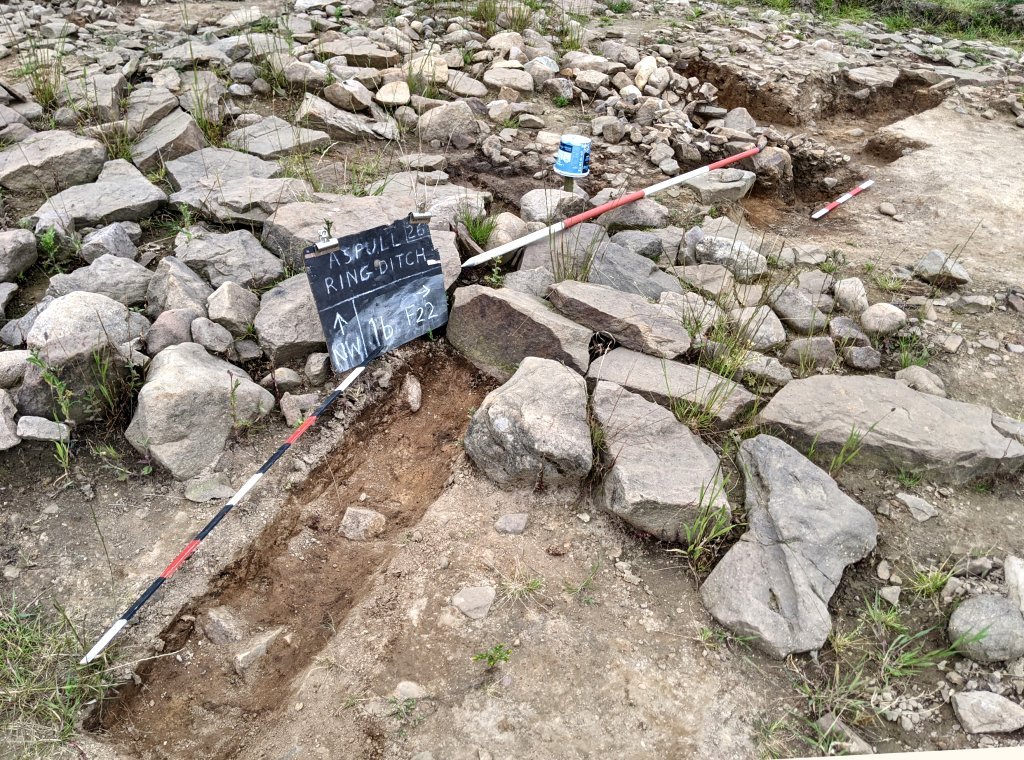 It has always been a mystery why this patch exists devoid of stones but still sealed below the burnt and mottled clay layers.
Much attention was given today on the rising sandy clay mound trying to understand it relationship with original ground surface and the general mound of sandy clay that covers the whole of the interior of the ring ditch. 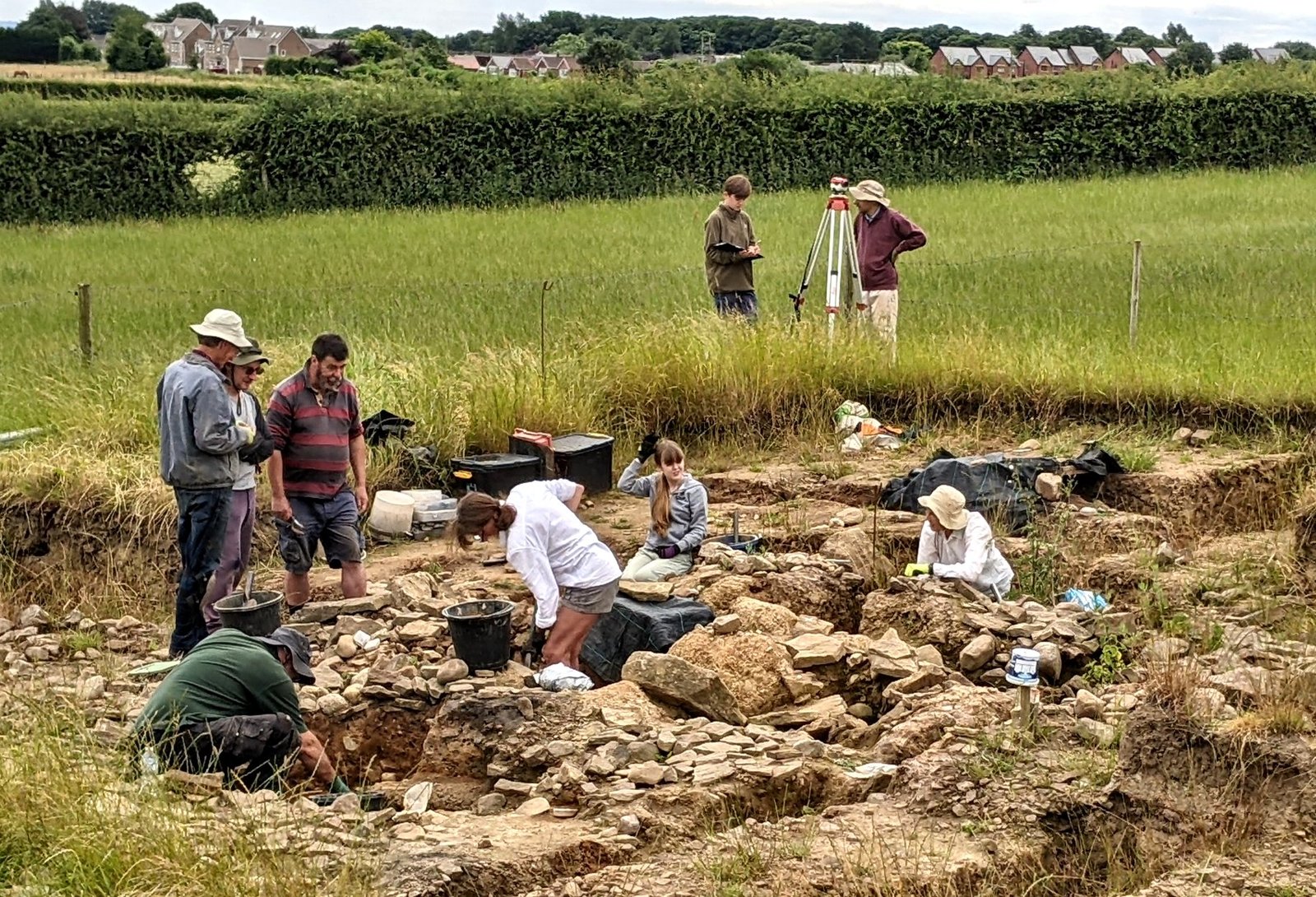 Gaby worked on an area on the south side of the rising mound where flecks of cremated bone had previously been collected (B2). Although not finding much more she did manage to retrieve a tiny fragment of what appears to be a tooth.
Alison continued her work cleaning out and taking down the cut on the southwest side of Feature F2 clearly revealing how a stony layer on this side is acting as a revetment to the rising mound (lying outside it rather than embedded in it). At the bottom she came across a layer of harder sandy clay embedded with stones. 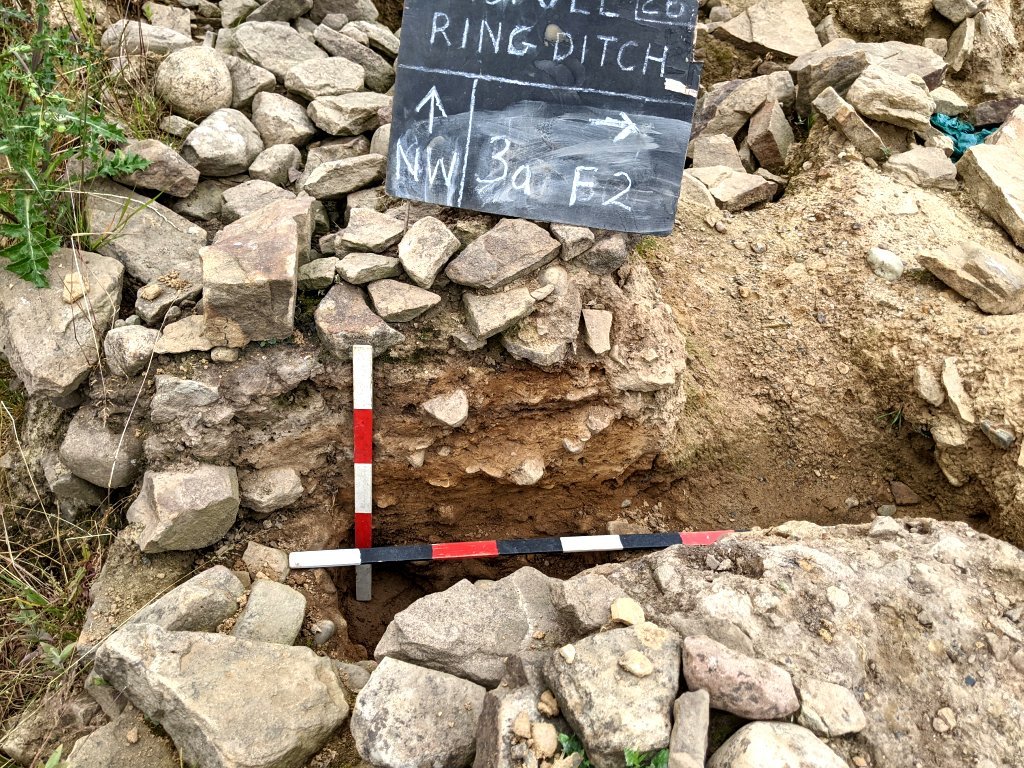 This was turning out to be a theme a Peter, tasked with continuing the work of cleaning out the bottom of sondage on the southeast side of the mound (3a.S5 Ext), also came across a layer of harder sandy clay embedded with stones.
 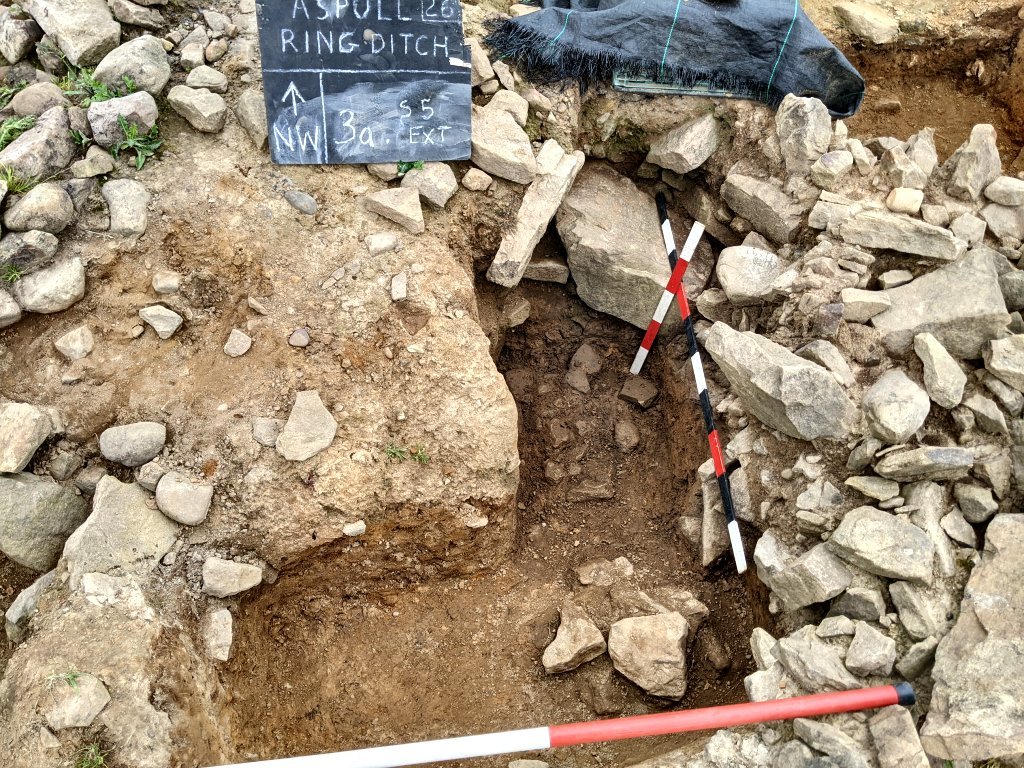 Similarly Isabel, continuing her work on the embedded stones on the northeast side of the mound, also came stones at the very bottom of the trench.
 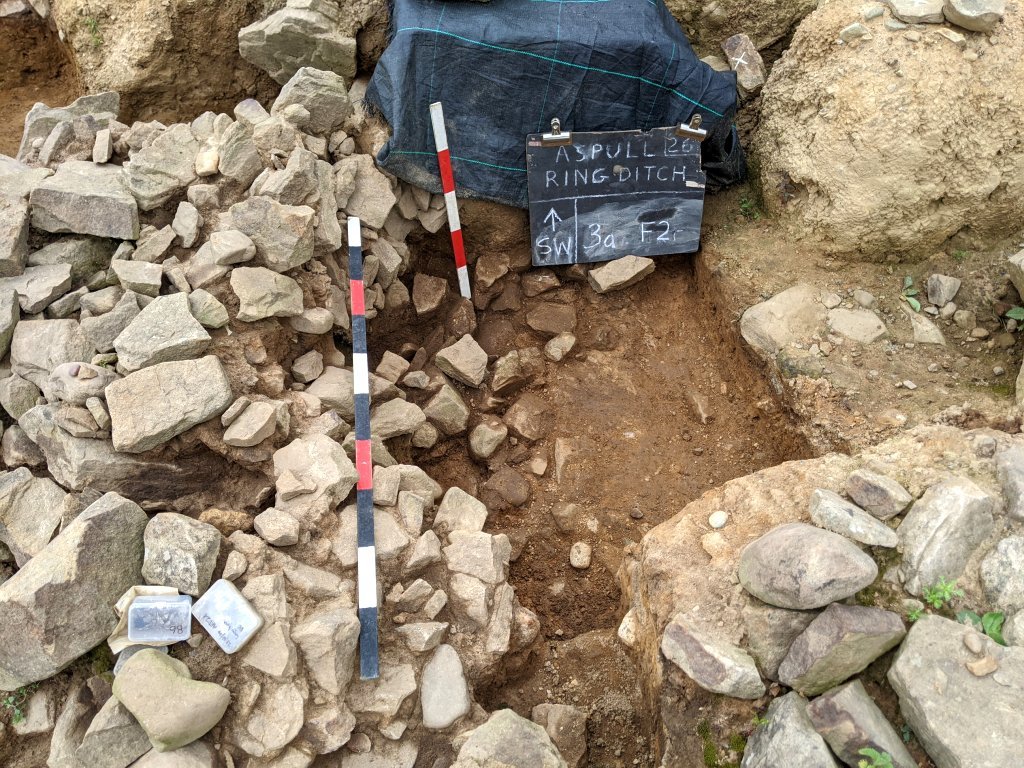 Jon also, working further out to the northeast on edge of the rising mound (before it reaches the cremation burial found under the two slabs – F12), revealed stones at the bottom of his trench. As with Alison’s trench we a clear section revealing the stony layer (even remnants of the burnt layer) acting as a revetment on to of the rising sandy clay mound.
 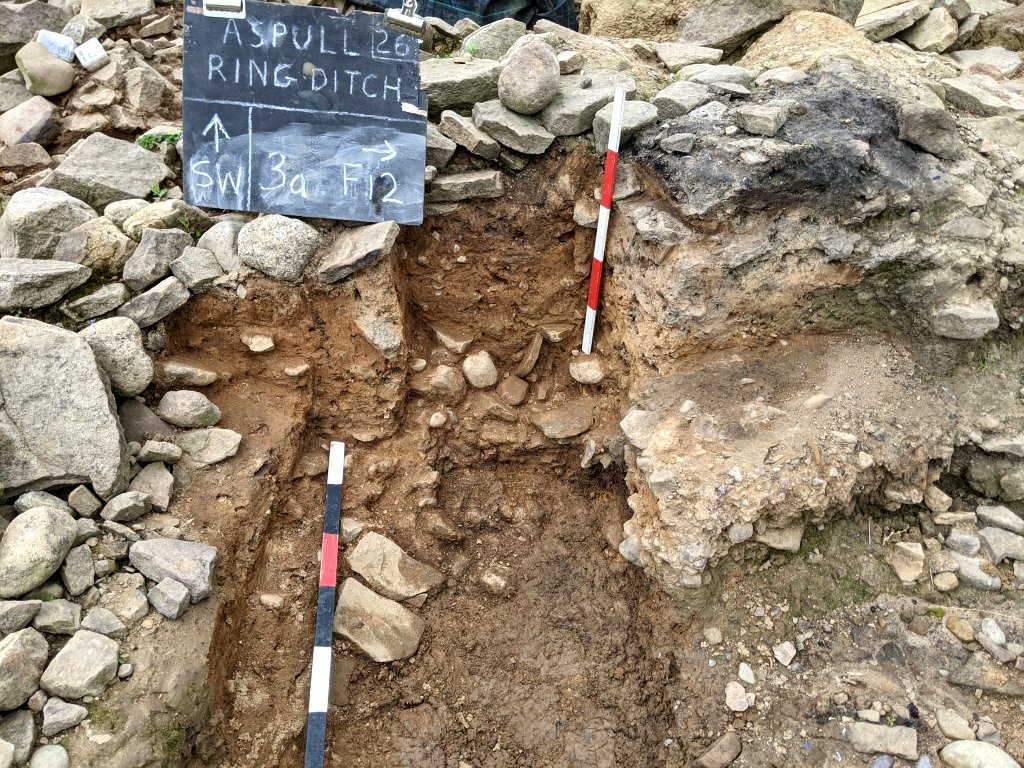 What this all means at this stage is unclear. Chris’s thoughts were that the embedded stones on the southeast side of the rising mound could originally have been a separate small cairn. However the arrangement of the stones in it didn’t seem to be supporting this theory as they seemed to be more randomly placed.
Tuesday 30th June
Day 14
With the weather back to normal our volunteer turn out was great today with 11 on site. Joining Bill, Chris and Patrick were Andrew, Steve, Isabel, Jen, Rachael Tynan (joining for the first time this year) and Peter (back from his hols). We also had Gabriel Morgan and his mum Denise – Gabriel is on a two-day work experience placement from St Bede’s High School Blackburn.
Bill spent much of the morning take Denise and Gabriel around the side explaining our site and giving them some insight into its Prehistoric context particularly with its association other sites around the region. He then set them to work with Rachael next to Trench 1c trowelling off the remaining soil from the stony layer. Rachael next to them in Trench 1c itself cleaning the floor of it looking for the arc of dark material first detected on Day10 earlier in the month. 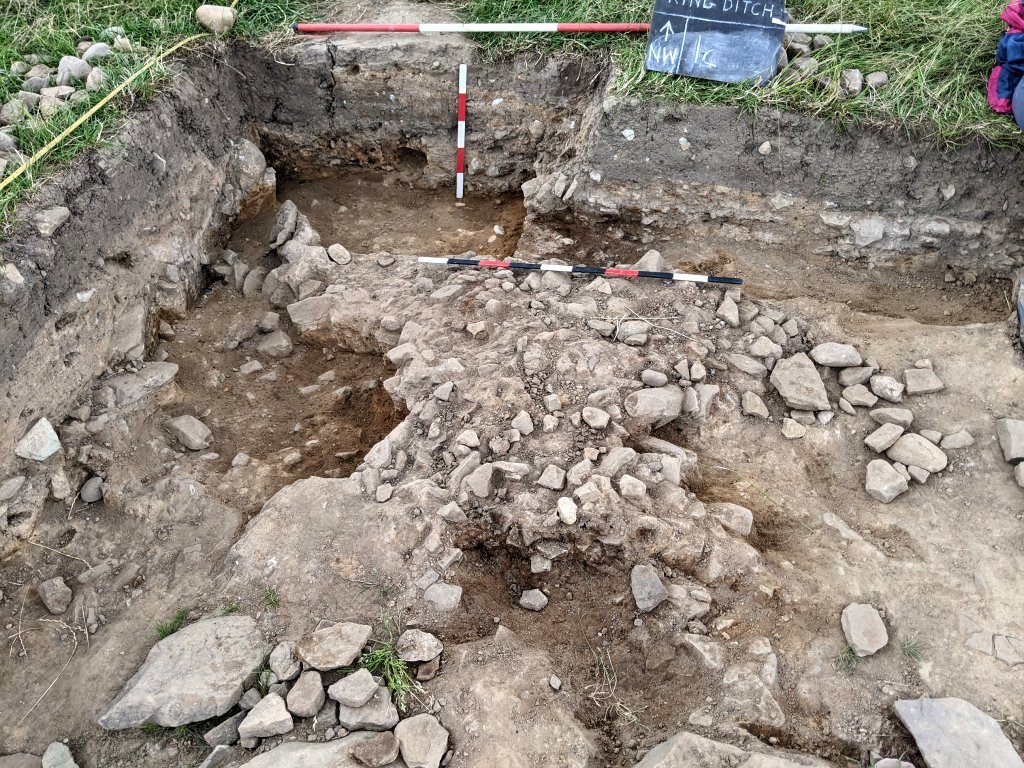 Jen meanwhile continued with her work on the cut along the northwest section particularly where it reaches Trench 1c. She had discovered a curious gap in the stony layer and Bill wondered if the stones reappearing next to Trench 1c were the embedded ones he had been looking for.
 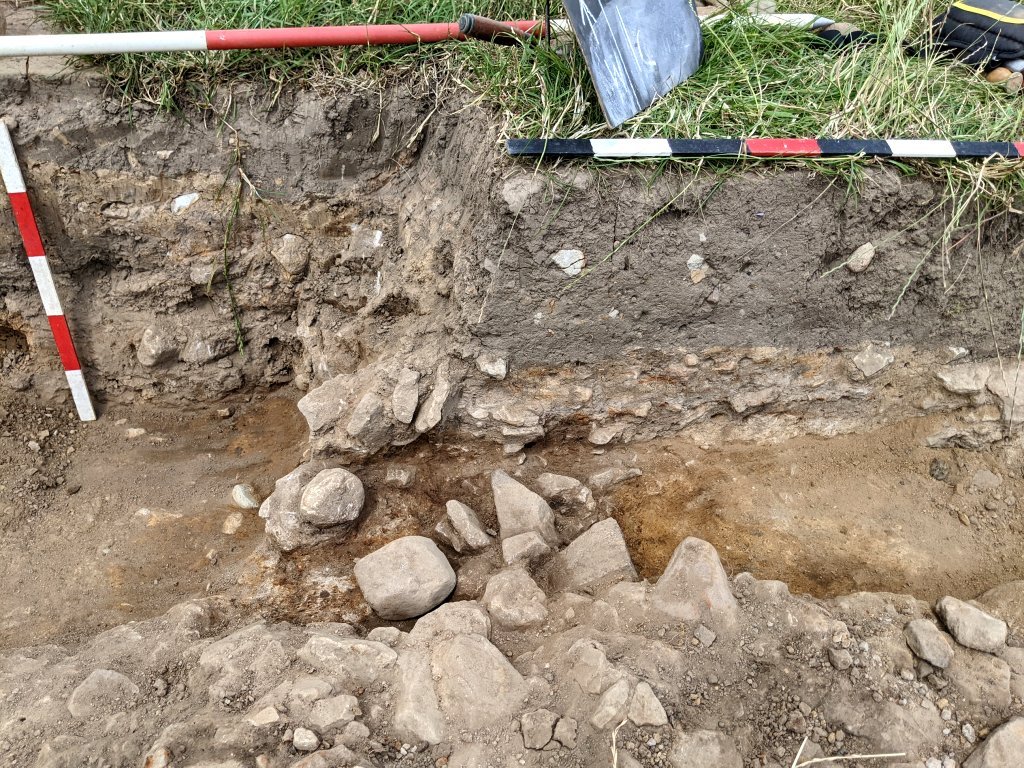 After carefully removing them it was obvious they weren’t, just part of the usual stony layer lying under the burning and mottled clay layers.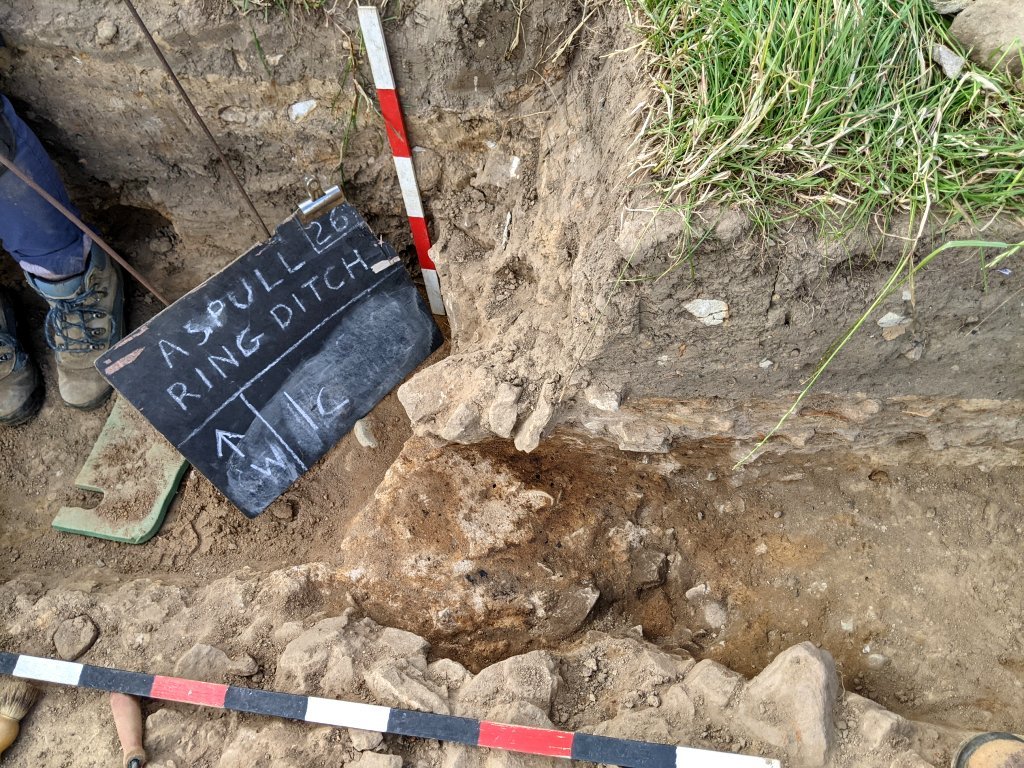
Steve meanwhile continued his work in Trench 1b on the southwest side. Having established the stony layer did not continue to the northwest we needed to find out how far to northeast it went so Bill asked Steve to extend the cut in that direction be another half metre. It would also be useful to find out why there was a gap in the burnt layer. Helped by Andrew, the mottled layer was soon revealed but there was no sign of a pit which would have explained the gap in the burnt layer. By the end of the day Steve had managed to get down to the stony layer. It was early days but the stony layer seemed to continue in that direction (albeit at an angle towards the north). 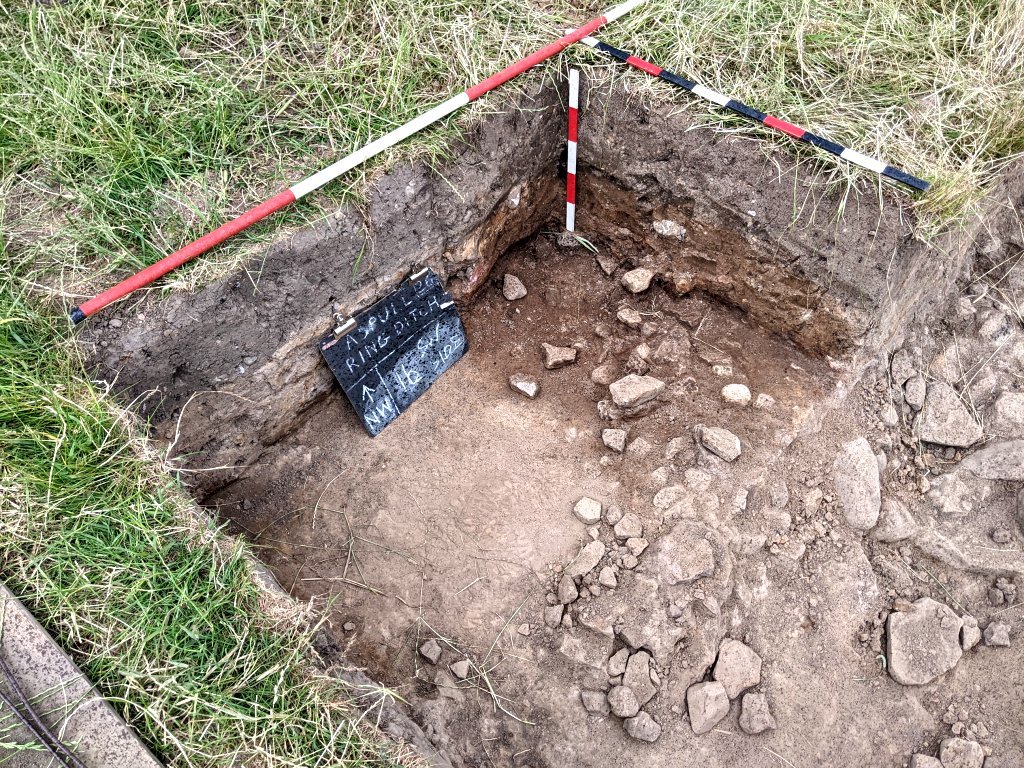
Chris spent some time cleaning the base of the clay-lined pit removing as much as he could of the blackish material from the bottom without damaging the base itself. Hopefully the dry weather will dry out the surface so that we’ll be able to understand what the base consists of. He later continued with the work on the embedded stones in the rising sandy clay mound. With this task he got help from Peter and Isabel. Andrew and Patrick meanwhile continued their work on the trenches (Sondage 1d.S1) either side of the box-like feature (F22) at the centre of curved large stone alignment. 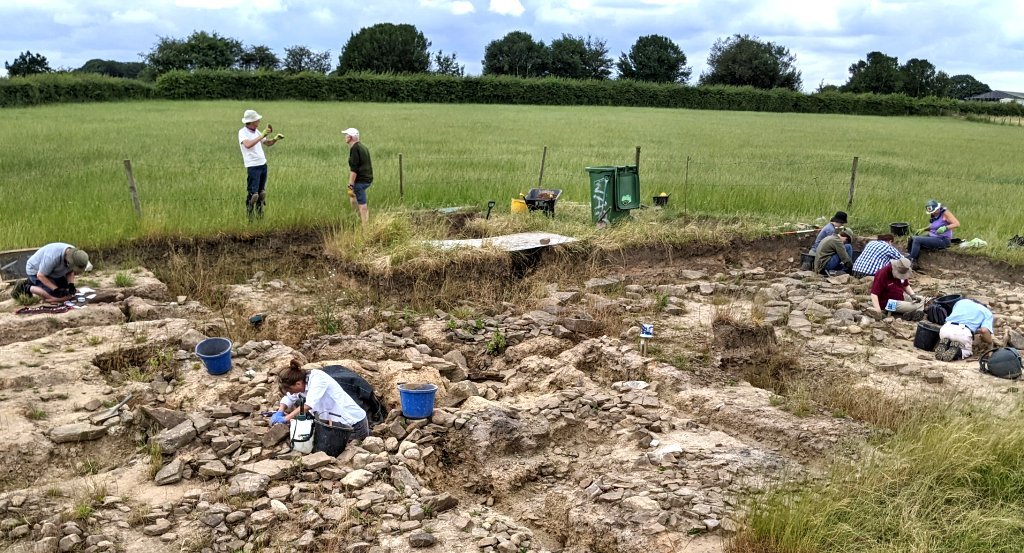
Thursday 25th June
Day 13
It was forecast to be hotter to day but a constant breeze blowing over the crest of the hill meant it wasn’t as bad as Tuesday. Still we only managed a small turnout with just Paul Langin and Alison joining Bill and Chris.
Bill explained to Paul the issues we were having re-digging Trench 1c. On Tuesday Bill had realised we hadn’t over cut the trench on the southwest side. Colin had taken out another 40cm of the fill but had left the soil in on that side just in case. When he left though he was confident it was part of the backfill. Bill asked Paul therefore to take it out and take the trench down until he reached an unexcavated level. This he achieved after lunch reaching the pure sandy clay we’d discovered when this trench was first dug. Looking at the section Bill realised something else – last year, to prove that the stones embedded in the brown sandy clay in the southeast end of Trench 3a, he had cut a small test pit in this trench to retrieve some of the stones for comparison (see 2025 Day 30). He recorded it as being about 4m from Peg 10a which is exactly where we were now, confirming the soil being the filled in test pit. 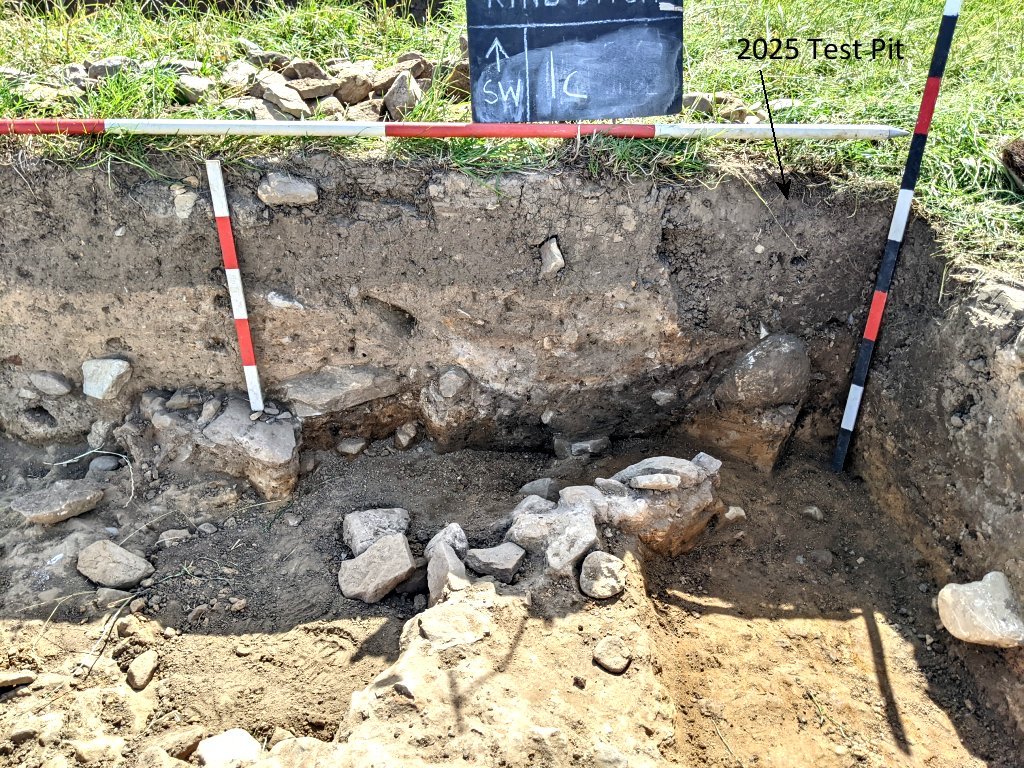
Chris meanwhile continued with the work Susan had been doing on the embedded stones in the rising central sandy clay mound on the northeast side of Feature F2. As he extended a cut on the northeast side he observed mottling in the soft sandy. 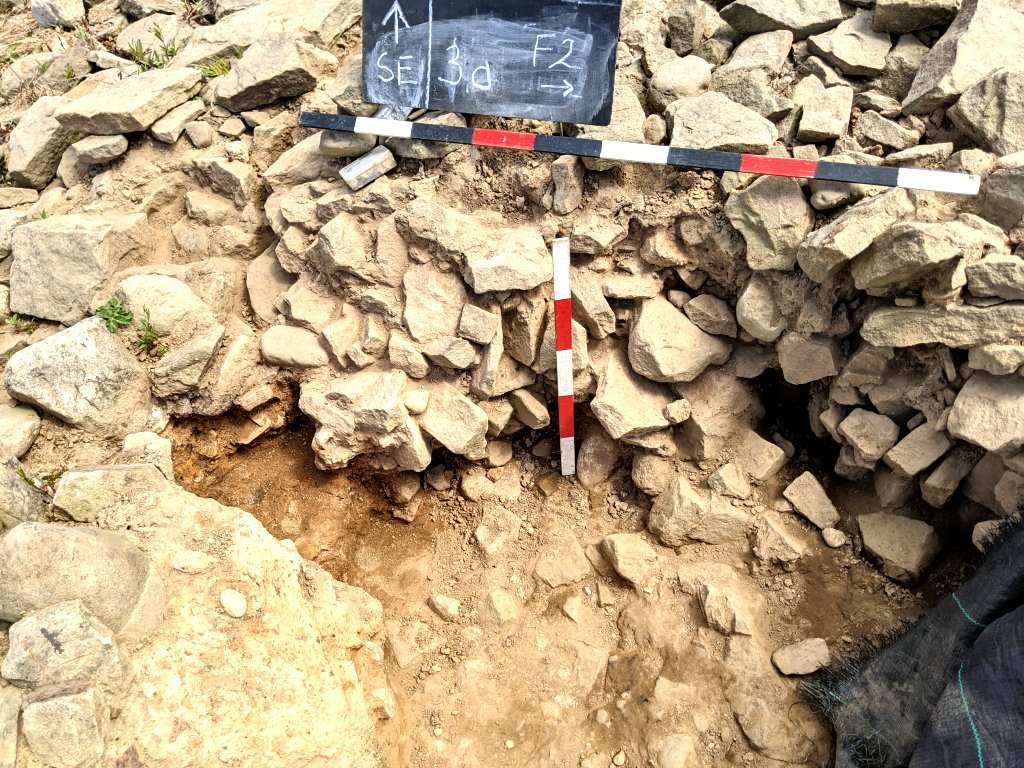
Chris had to leave soon after lunch but was able to carry out his drone survey before he left.
When Alison arrived Bill got her to help him take some more height readings with the dumpy level – this time along the line of the sondages either side of Feature F22 so that he could draw this section when it is finally excavated. Later Bill asked Alison to recut the section through the rising central sandy clay mound on the southwest side of Feature F2. 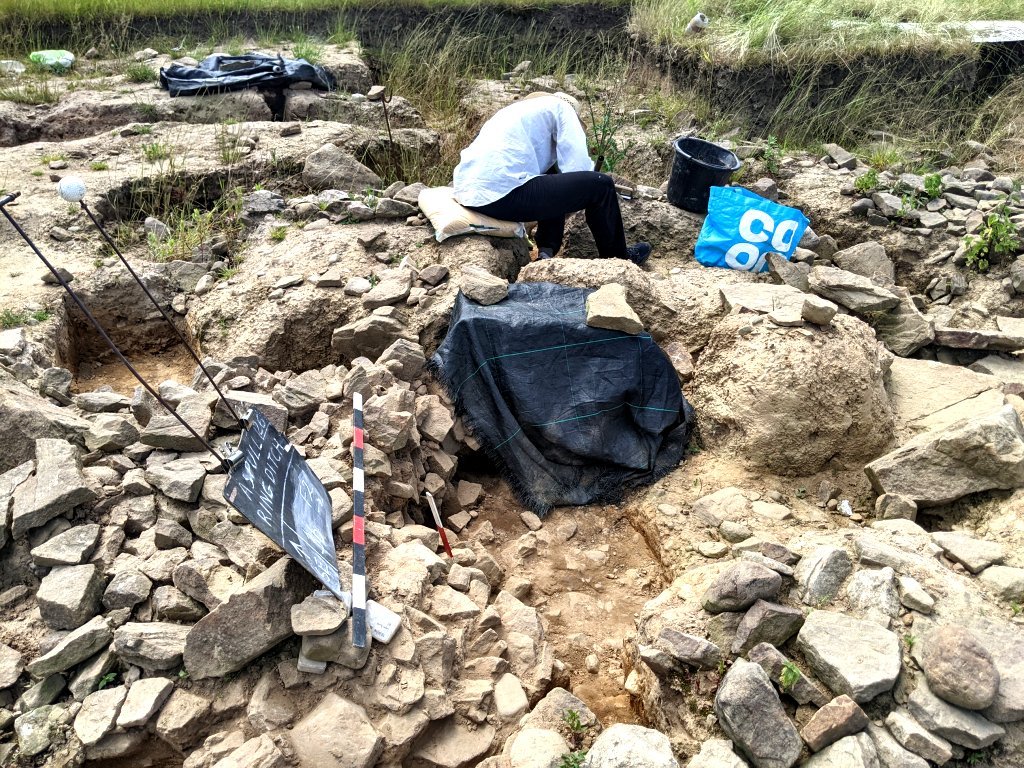
Tuesday 23rd June
Day 12
From the cold and wet to the hot and sticky, this week is going to be a challenge with temperatures reaching the mid 30s. Braving the conditions today with Bill and Chris were Andrew, Colin, Steve, Susan and for the first time this year Dave North.
Bill explained to Colin the problems we were having trying to resolve the complex layering in the previously dug Trench 1C. Both Bill and Chris had been checking the original recording of this trench when it was first dug (see 2023 blog Day 30) to see if it related to what we were now seeing. We both had detected a seemingly isolated dark patch. Also Bill had been assuming the re-digging of this trench had overcut the southwest section by 25cm. A check on his drawing however made him realise that it hadn’t been. What seem like the edge of the original trench exposed in the northwest section was just were a large sod had been inserted. To check this out Bill asked Colin to dig out another 40cm of backfill initially following the apparent edge just in case it was the edge. Colin had to leave soon after lunch but he was confident it wasn’t the edge, as the apparent plough soil was much deeper and softer than the plough soil in the ‘known to be true’ plough soil in the southwest section. 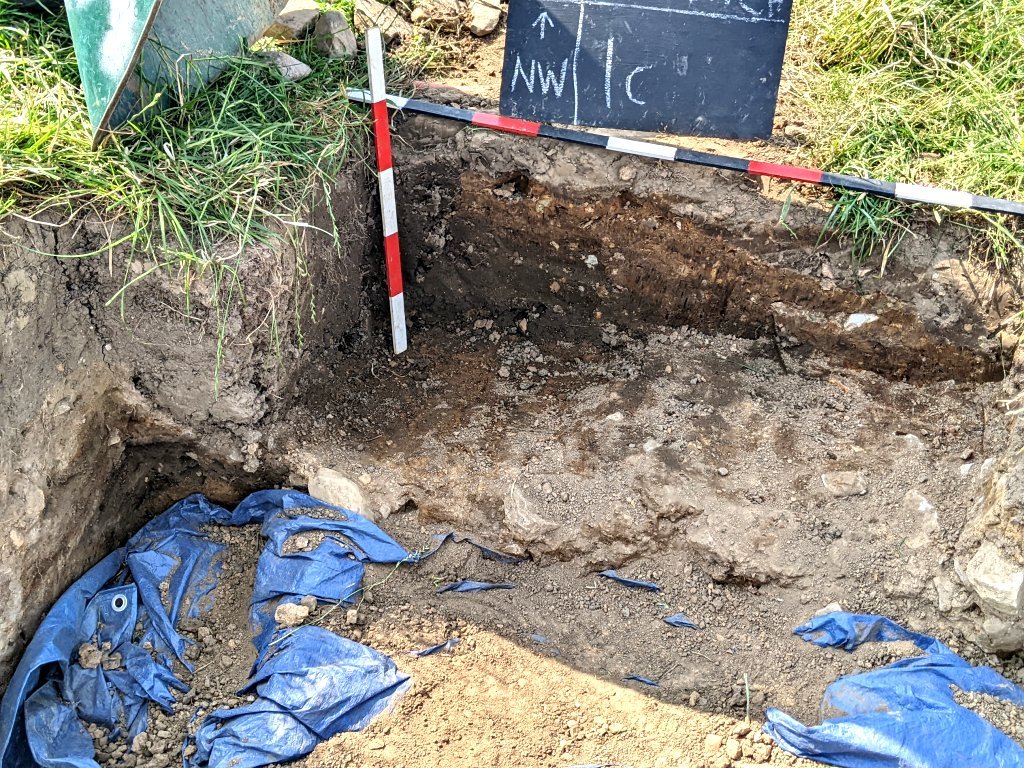
Steve meanwhile was given the task of cleaning up the extension to Trench 1b on the SW side that Chris Haws and Paul Wale opened up last week. This confirmed the extent of the stony layer stopping half way along the extension. It also showed the burning layer continued but there was a gap at which point the mottled clay layer stopped. On the other side of the gap the layer above the burning was more homogenous, similar to the extension in Trench 1e. 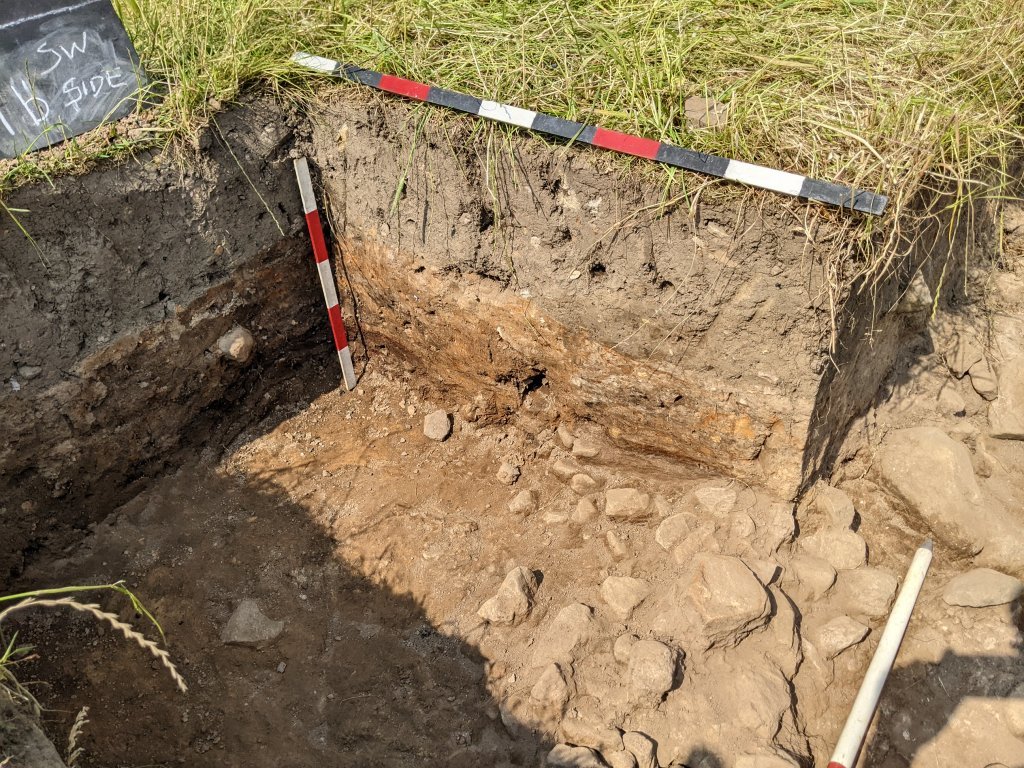
Andrew continued working on the sondage on the northeast side of F22 (Sondage 1d.S1). He was able to take it down about 5cm into the underlying soft sandy clay. 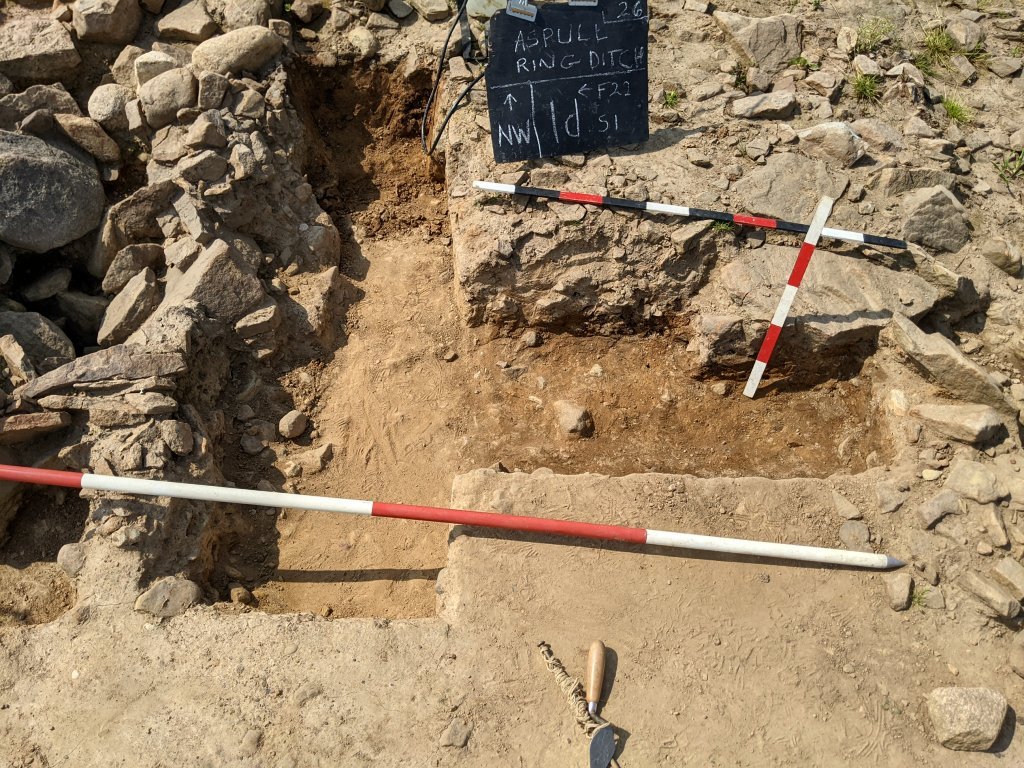
Chris, Susan and Dave worked on the area around F2 (where our second urn was). Chris worked on the section Patrick looked on Day 4 (Sondage 3a.S5 Ext) removing the fill from the previously dug section. 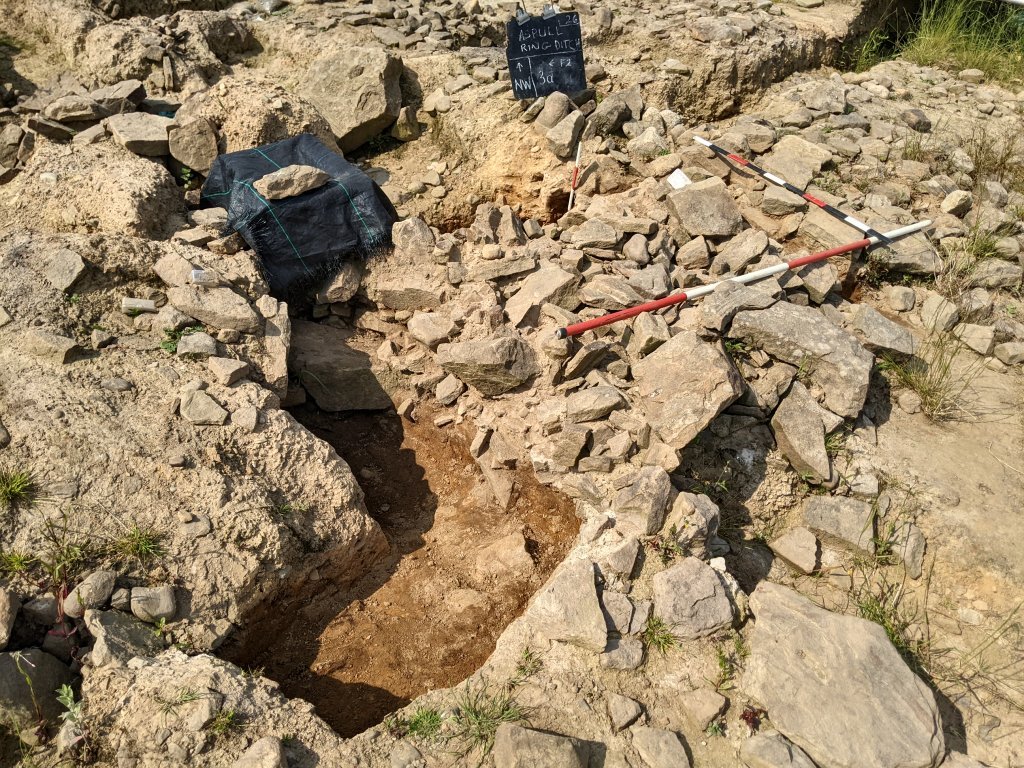
Susan continued with her work on the embedded stones in the rising central sandy clay mound while Dave worked on the trench to the northeast side of F2. This was revealing the extent of the stones embedded in the rising central mound. 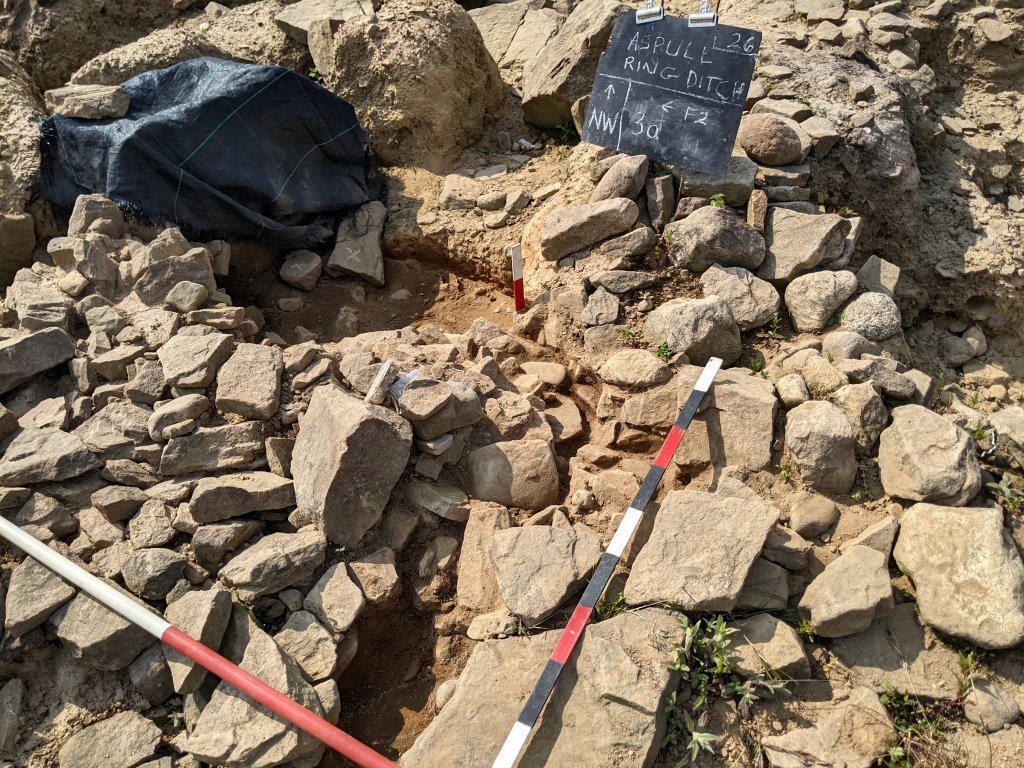
Thursday 18th June
Day 11
Another great turnout, joining Bill, Chris and Patrick were Andrew, Jen, Isabel, Gaby, Paul Langin, Paul Wale and Chris Haws. Nice also to see Nicole Tunnicliffe joining us for the first time this year bringing with her new starter Bob Huddart (Bob is long-time chairman of Bury Archaeological Society). In the afternoon we had a visit from Society members Heather and Gordon Harrison, along with Heather’s brother-in-law John Davies. This time It was Chris who gave them the site tour.
We’ve being having problems trying to understand what is going on on the west side of the northwest edge of Trench 1b where the earlier Trench 1c cut through. Jen therefore, helped by Nicole continued trowelling through the stony layer there. Paul L and Bob were also tasked with cleaning up the stony layer further along the northwest edge so a clearer picture could be seen. At the east end the edge of the consolidated stony layer can clearly be seen. 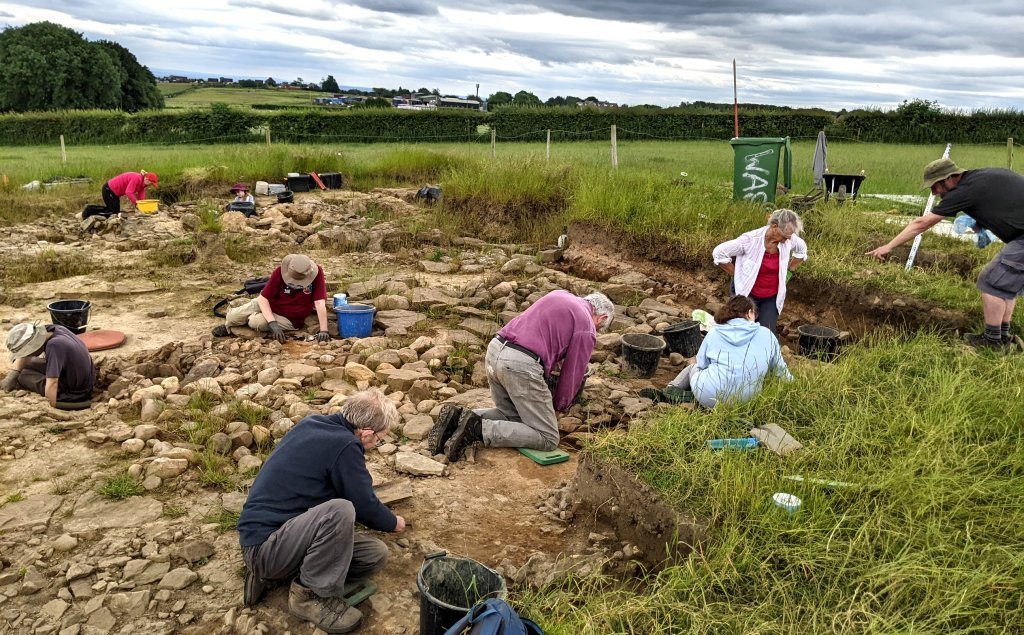 The stones are lying directly under the plough soil but, as we move further to the west, the standard arrangement of mottled clay on top of a thin band of burning develops. However as we get closer to Trench 1c, there is a gap in the stony layer before a higher layer of stones emerge with the burning seemingly sandwiched in it. It now seems clear that Trench 1c only went down as far as this stone layer so it is hoped a cut along the northwest edge would clarify the situation. Before removing all the stones, Nicole gave them a good cleaning, while Jen pursued the arc of burning and soft brown sandy clay discovered on Tuesday (producing a section offset from the intended section).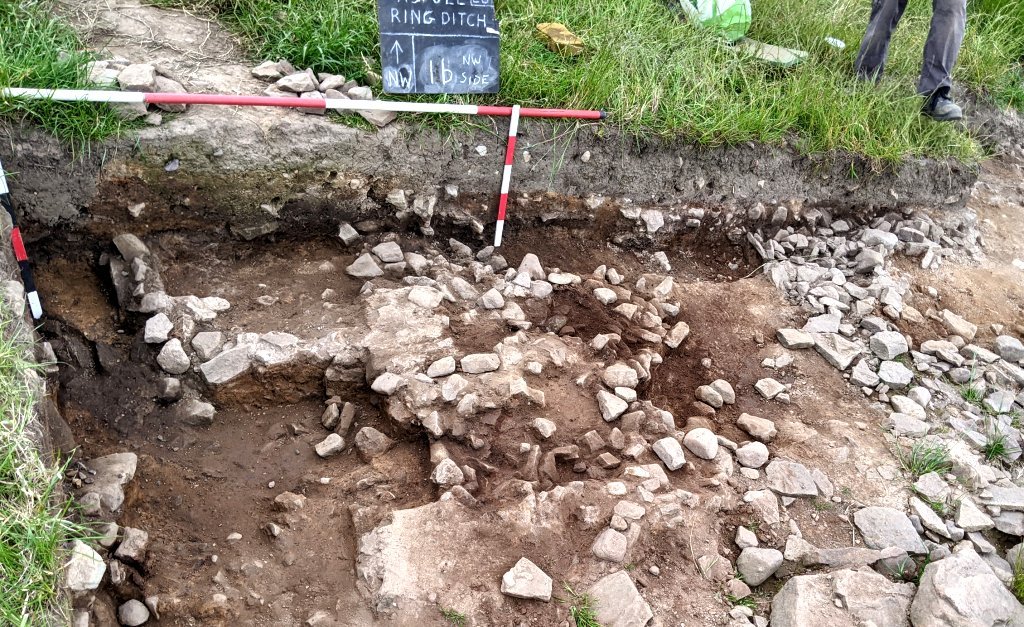
Paul W and Chris H continued working on the southwest end of Trench 1b. Helped by Andrew they were asked to dig a 1m x 1m cut into its northwest edge in an attempt to chase the edge of the stony layer on that side. Soon after lunch Paul had to leave but before he did the pair had managed to get down through a thick layer of mottled clay onto the burning layer. Stones where just beginning to emerge on line with the edge already exposed but didn’t seem to continue all the way to the end of the trench (more to see next time out). 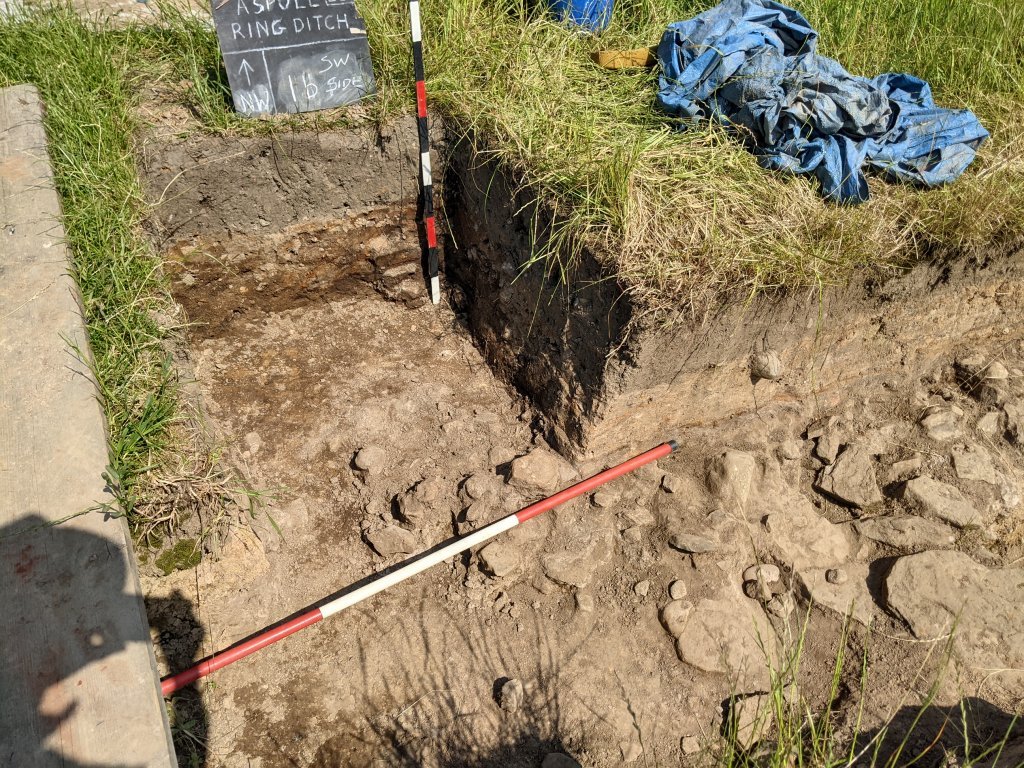
Susan continued with her work on the embedded stones in the rising central sandy clay mound. She was helped by Gaby who worked on the the southeast section (in sondage 3a.S5 Ext) exposing more of the large stone block near the bottom of it which Patrick had started to work on last month.
Patrick, Chris D and Andrew meanwhile continued the work on the trenches being cut around Feature F22 (the strange arrangement of stones at the centre of our stone circle feature). Andrew worked on the northeast side of the sondage (1d.S1), Chris in the middle southeast side and Patrick on the new area (1d.S2) on the southwest side. 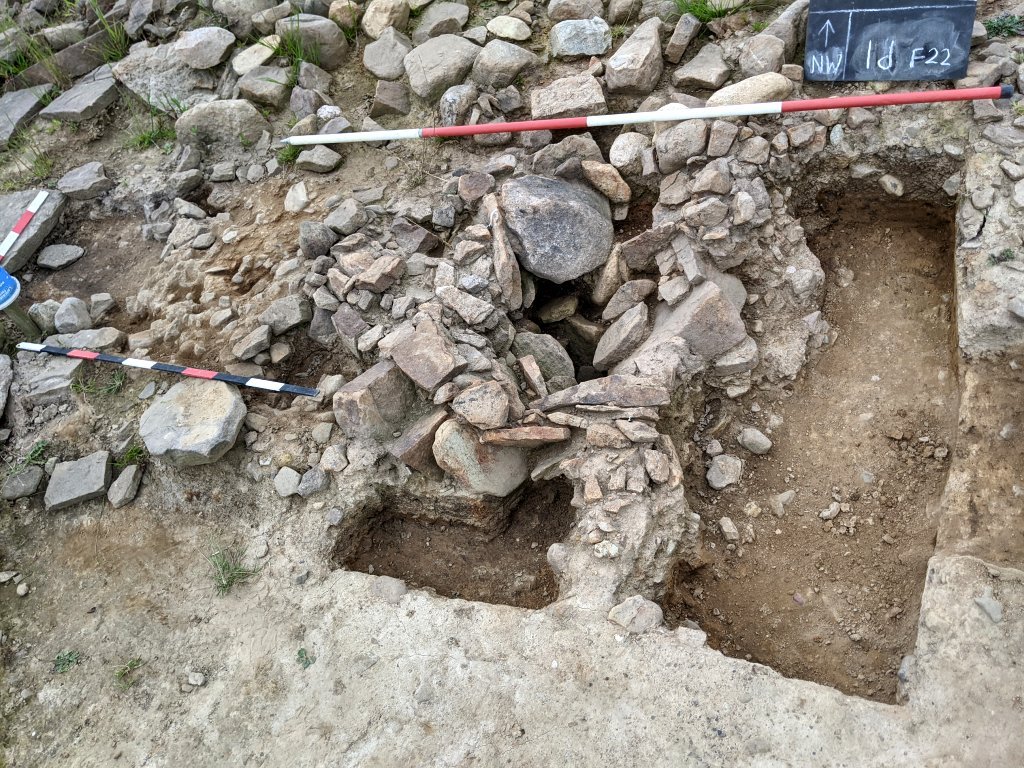
Bill had left the dumpy tripod up so he asked Paul L to help him take some more heights (Tuesday’s figures had turned out to be to surprisingly accurate, being within centimetre of the readings he’d got in 2022 when the first survey of the central mound had been carried out). This had encouraged Bill to take more readings this time at the southeast edge of the central block containing Peg3a, so that he could set up a string line to record the section Alison had cleaned up on Tuesday. Paul helped Bill then to record this section. Bill also took a reading on the other side of this trench so that he could complete his drawing of this section which Alison had also cleaned up. 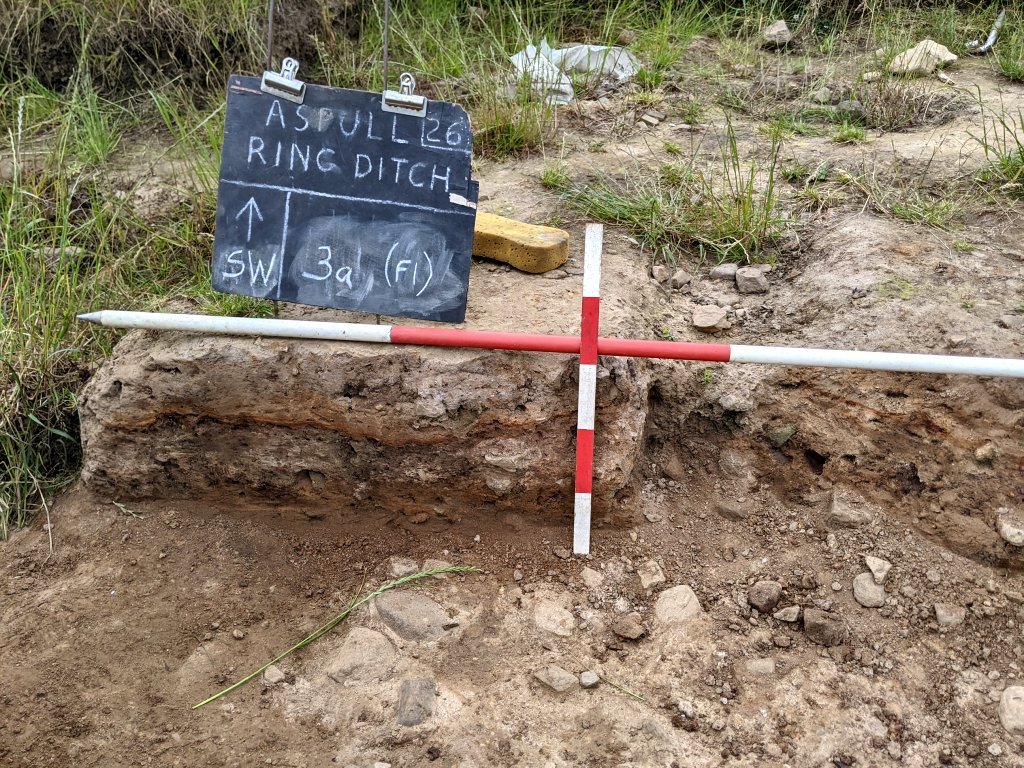
Tuesday 16th June
Day 10
Great turnout today with 11 on site. Joining Bill, Chris and Patrick were Jen, Susan, Isabel, Emma, Alison, Colin and two new starters Paul Wale and Chris Haws. 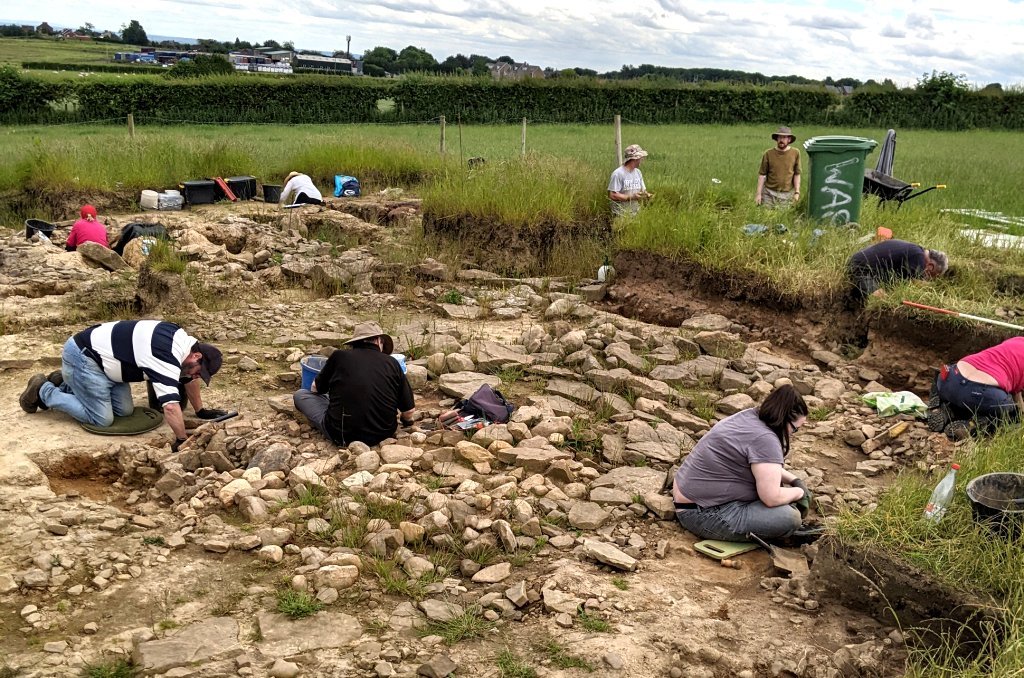
Before setting the the new starters Paul and Chris on their task for the day, Bill gave them the usual tour of the site. Once this was over Bill set them to work on the southwest side of the original Trench 1b. This hadn’t been looked at for a couple years and was getting overgrown. Their first task therefore was to clean it up and remove the build up of soil fallen in off the section. The reason for looking at this area was that there seemed to be a disconnect between the edge of the stony layer in this trench and the edge revealed in Trench 1e. We needed therefore to chase the edge by extending the southwest end of Trench 1b in the northwest direction. Before doing so we needed to re-establish the edge of the stony layer. After removing the vegetation and fallen in spoil the edge was clearly picked up and Paul and Chris did a great job in revealing once again the burning layer and a good depth of mottled clay. 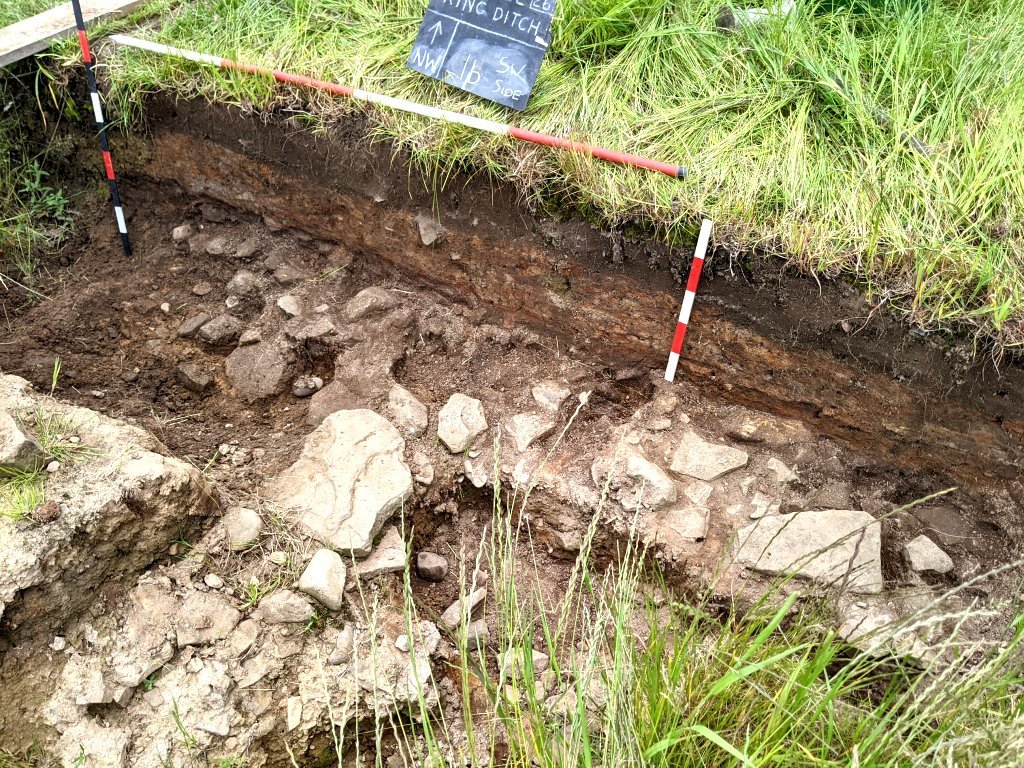
Bill got Emma going on the area she had been working on the last time she came i.e. the NW section of the extended Trench 1b – while Jen, helped by Isabel continued with the work on the southwest side of the section going into Trench 1c. Issy worked on the southwest section while Jen worked on the northwest side. Last week they had both worked on cutting a slot along the northwest face of this trench to reveal more of the section. The idea was to try to confirm if, as previously detected that the burning and mottled clay layers were diving down below a layer of stones embedded in a soft brown sandy clay layer. Confusing the issue was the previously dug and backfilled Trench 1c. After taking the cut down in this area it could be seen that the original trench had not removed the stony layer. It still wasn’t clear though what was happening to the burning layer. On the southwest section the picture was very confusing with the burning and mottled clay layers appearing and disappearing seemingly at random. Perplexingly an arc of burning and soft brown sandy clay was revealed lying below the orange soft sandy clay. 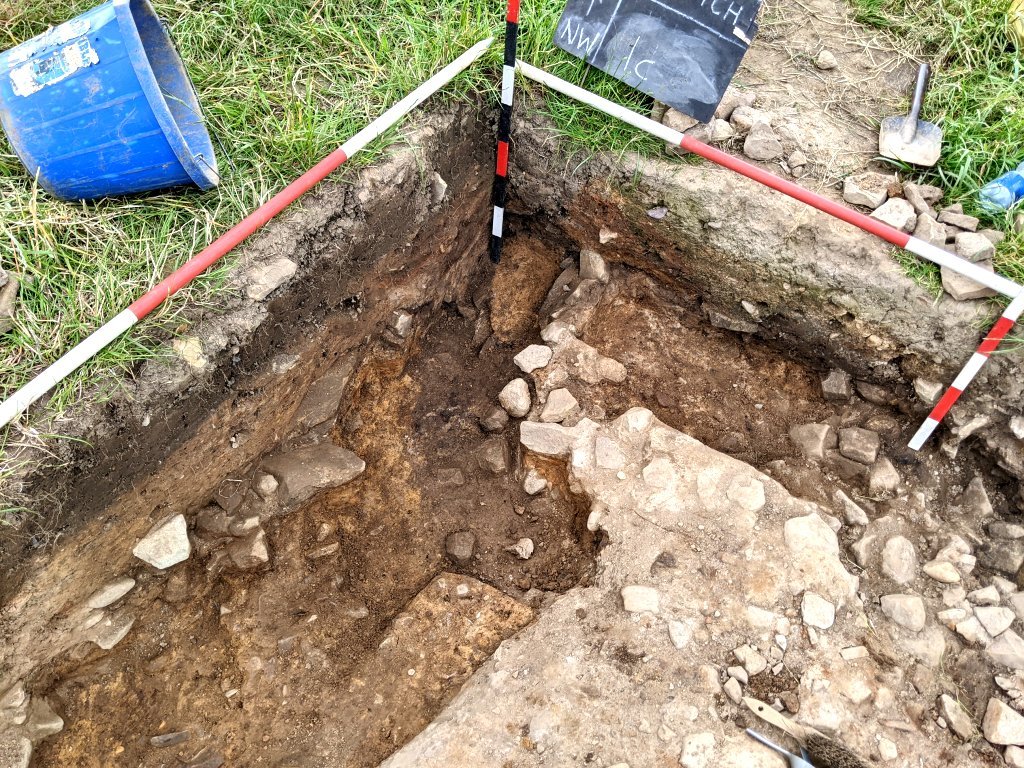
Things were a lot simpler in the adjacent Trench 1e where Andy had been working a couple of weeks before. He had cut a small extension to the northwest and taking it down layer by layer had revealed the burning layer as a small patch. This seemed to explain why this layer kept appearing a disappearing in the sections. Colin was tasked with taking his extension down to the next level. This reveal that there were no stones in it confirming that stony layer was turning to the north. It also revealed that the burning and mottled clay layers terminated at this point being replaced by a thick layer of soft brown sandy clay. 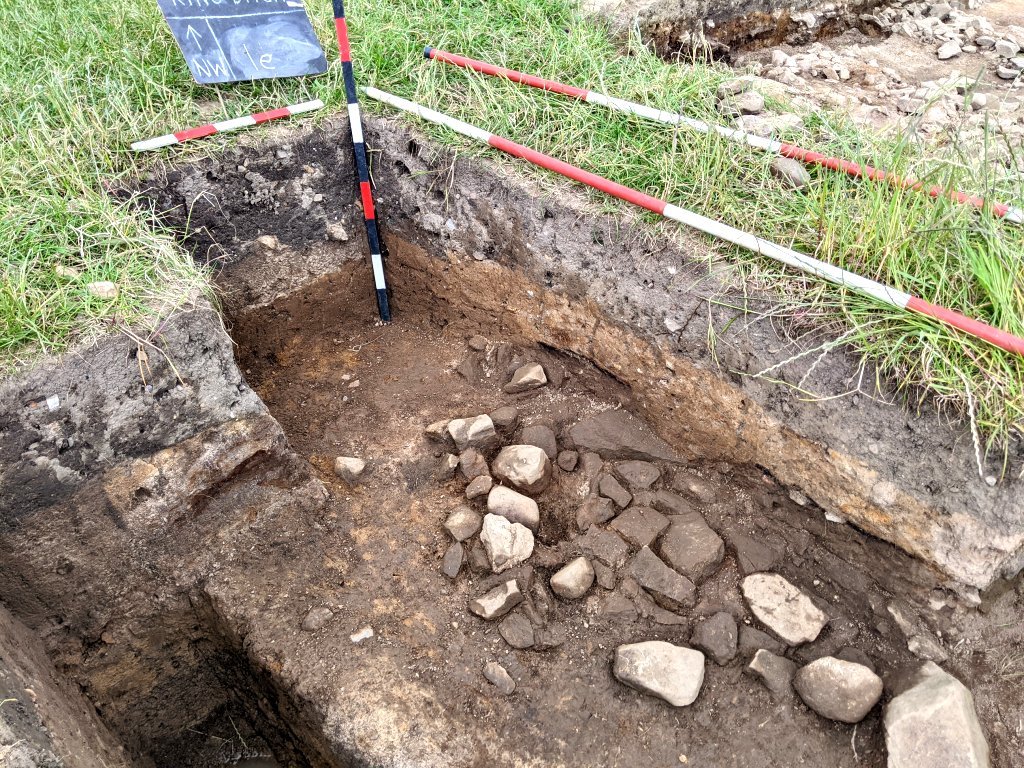
Susan continued to micro-excavate our clay-lined feature removing another section under the central partition. There was still some bone left under what was left of the partition but it was decided to leave it at this point and see if our osteologist Dr Sam Walsh would be happy with the amount he had retrieved. We have exposed enough of the base now to perhaps investigate its construction. 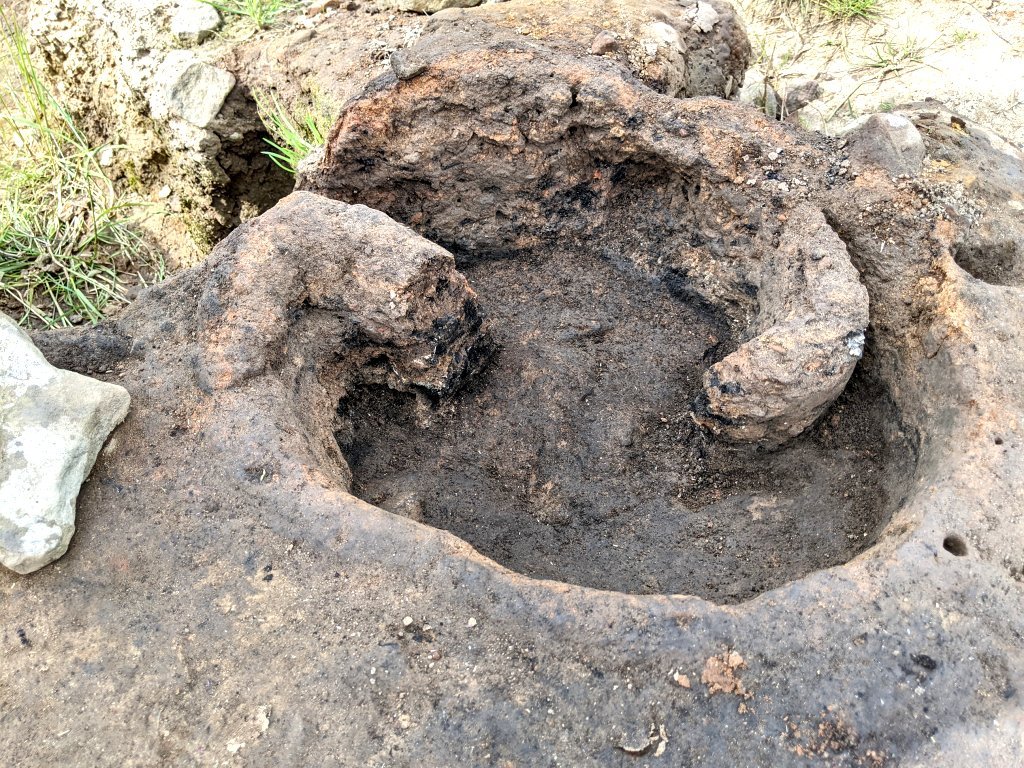 Susan finished the day by transferring to the area around where Urn2 had been (F2), looking at the stones embedded in the rising central sandy clay mound. Understanding its build will help us with knowing the sequence of the whole site’s construction.
Alison meanwhile worked on the section on the northeast side of where our Urn1 had been that Jon worked on last time he was out. She was able to re-establish the burning layer and significantly the layer of whitish clay lying below it toward the southeast of the section. This had previously been seen when this trench was first excavated and recorded. 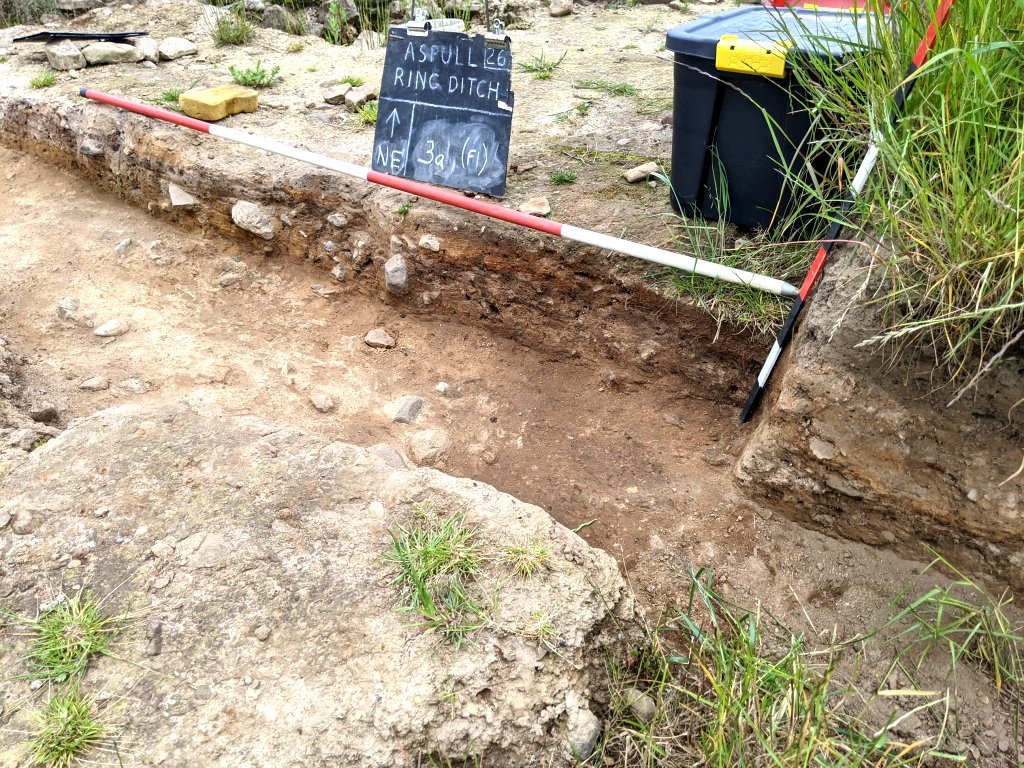 Bill will now be able to finish his drawing of the section.
Chris and Patrick continued with their work around Feature F22 (the strange stone arrangement at the centre of our stone circle feature), Chris on the middle southeast side, Patrick on the new area on the southwest (1d.S2).
Before leave Bill and Emma set up the Dumpy Level and recorded levels along the section of Trench 1c. Bill had been recording this section using a string line but had been getting confusing results, so hopefully this method would resolve the issues he was getting. While he had the Dumpy set up, Patrick asked him if it could measure the angle between north (Blackrod Parish Church Tower) and the ‘Two Lads’ monument on top of Winter Hill. This is a stone cairn that can clearly be seen from our site and Patrick has a theory about its position to ours and the sun rise on the summer solstice. Although the Dumpy cannot measure angles accurately below one degree Patrick was delighted when Bill revealed the angle to be around 47 degrees which was precisely on the the summer solstice sun rise (the implication being that the ancients selected this position for or monument based on its alignment with the Two Lads monument).
Wednesday 10th June
Day 9
Another rain affected day both braving the elements were Chris, Patrick, Jen, Alison, Jon and first time out this year Francesca Usher.
Patrick and Alison marked out a new slot on the southwest side of Feature F22 (the strange arrangement of stones at the centre of our stone circle feature) to explore that side (we’ll call it Sondage 1d.S2). At the southwest end of the slot a dark patch (not burning) appeared. 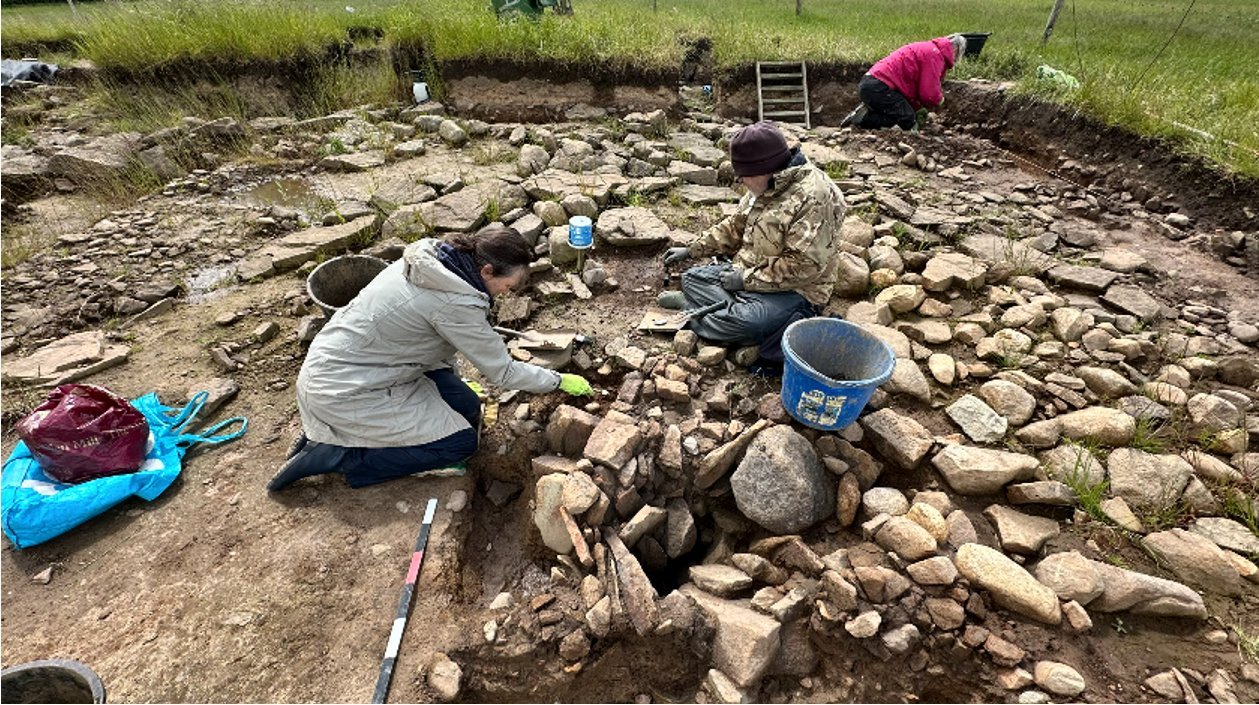
Jen and Francesca continued to work on the new slot along the NW edge of the extended Trench 1b. They were trying to find out if the red/black line that we find all over the centre of the site ran above, or below the layers of stone they had exposed (as had been detected in Trench 1c when it was first exposed in 2023 – Day41). It seems to run above the stones, but more work is required to check this. 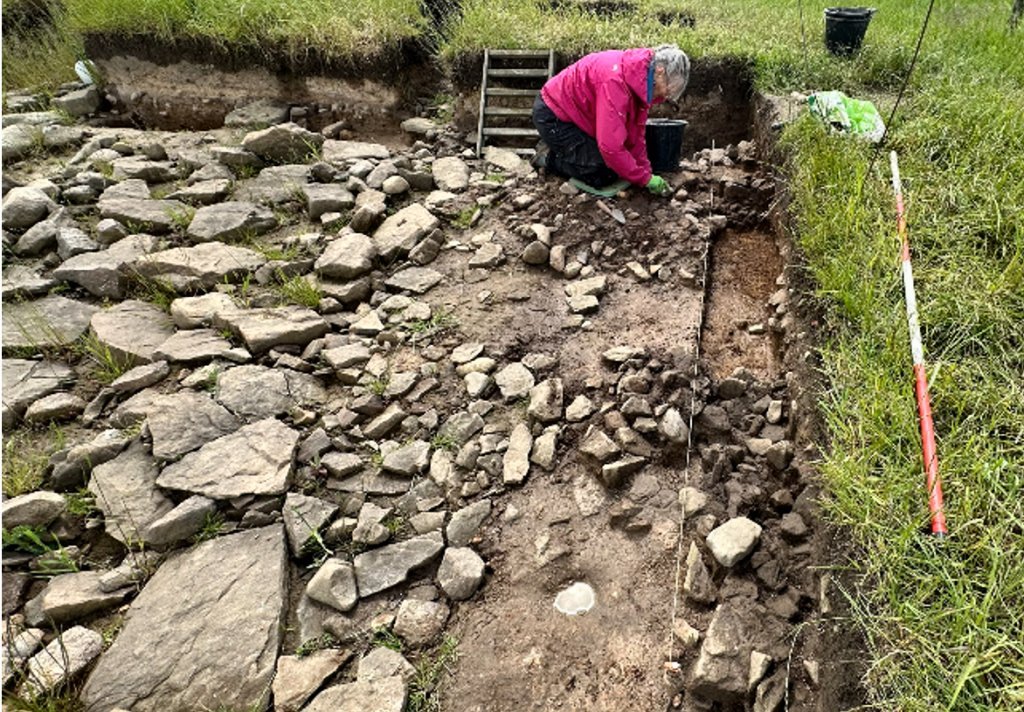
Chris and Jon headed to higher ground away from the waterlogged areas to the feature we discovered in 2024 just to the east of the site of Urn2 (which was removed last year and now in Bolton Museum Stores). This is an area of stones seemingly embedded in the rising sandy clay mound the urn was buried in. Jon carefully removed the material between the stones to show cavities lower down beneath them. 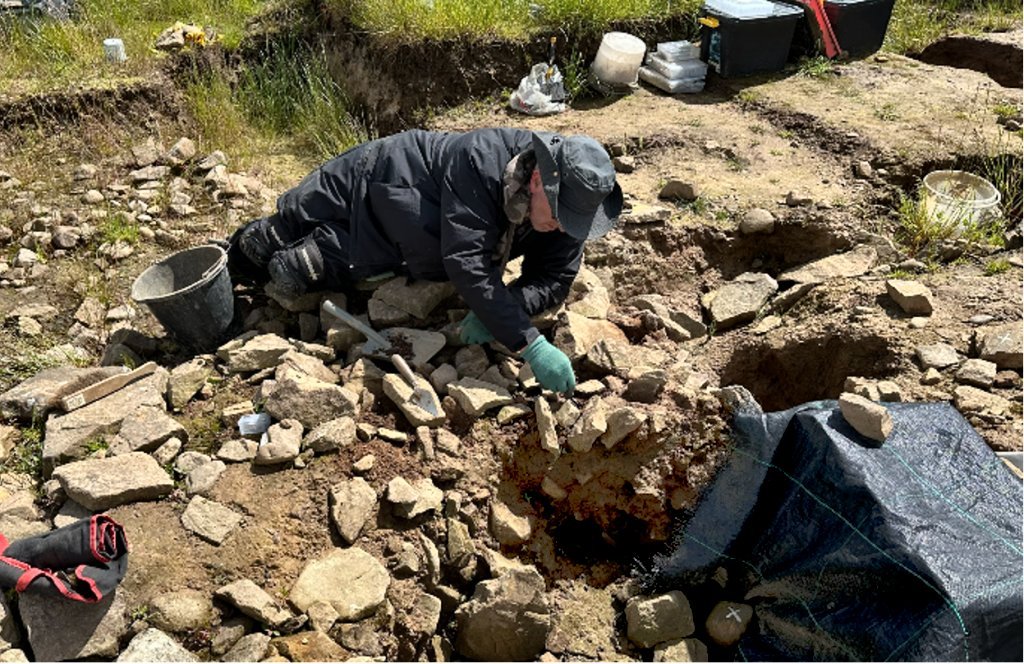 Several layers of stone were revealed suggesting this feature could be a cairn. As these layers overlie the large stone block under the pit containing the burial (B9) and also under the position of Urn2, we should be able to determine a sequence of events here.
 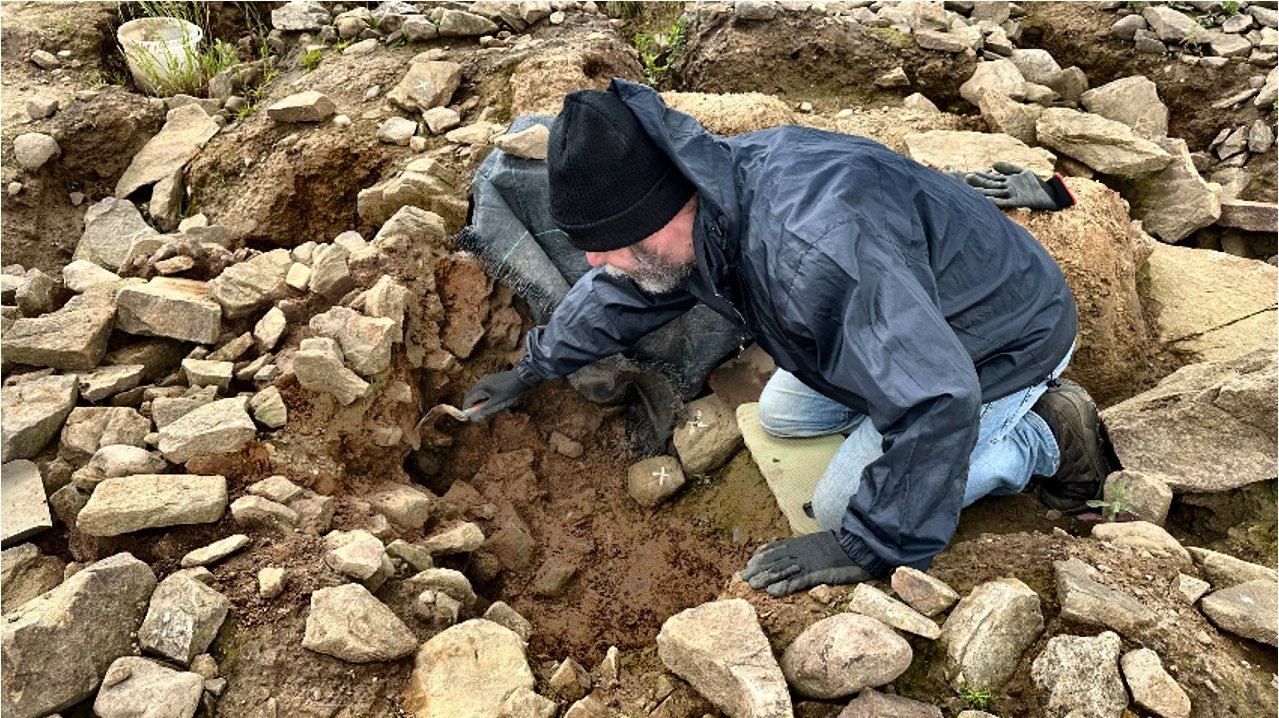 Also if we can demonstrate that this feature is cairn, then the lower level must be sitting on a lower ground surface, which we may be able to project across the rest of the site (the original ground surface is something we have always been struggling to identify in the central area).
Over lunch, in addition to the usual drone survey of the site, Chris also undertook a drone survey of the field as crop marks from an old field boundary were visible on the ground. 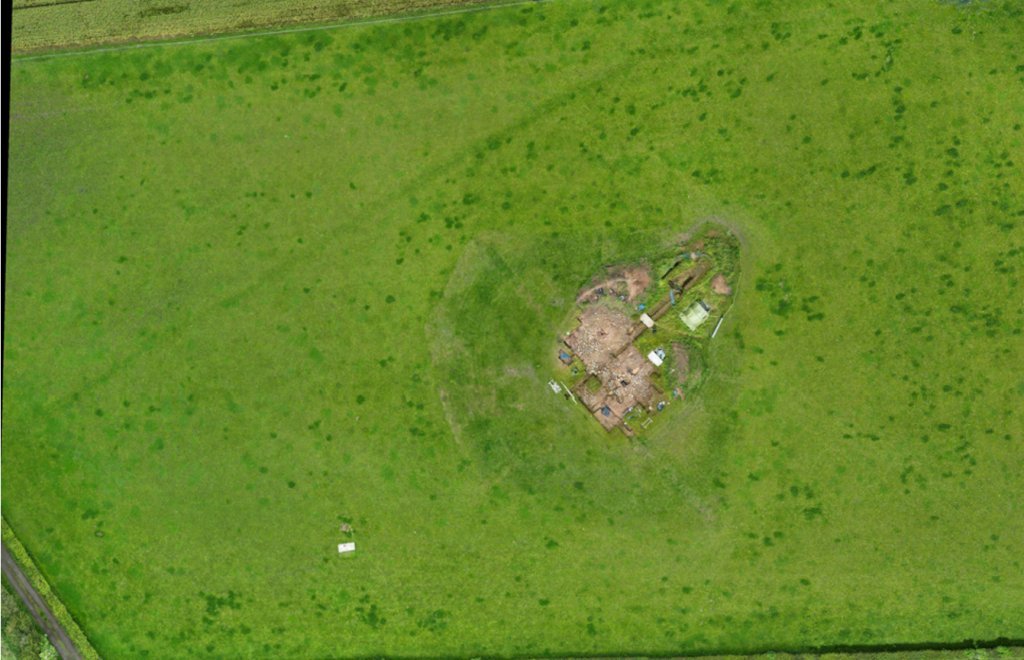
Tuesday 9th June
Day 8
Another dodgy week weather-wise and with Bill away, Chris was in charge. Joining him were Patrick, Jen and Isabel.
Jen and Issy were asked to cut a slot in front of the partially exposed section on the NW of the extended Trench 1b. As mentioned last week this section needs to be recorded as there is a significant change from one side to the other. After measuring and marking out the area they started in the centre, which was an area clear of stones. 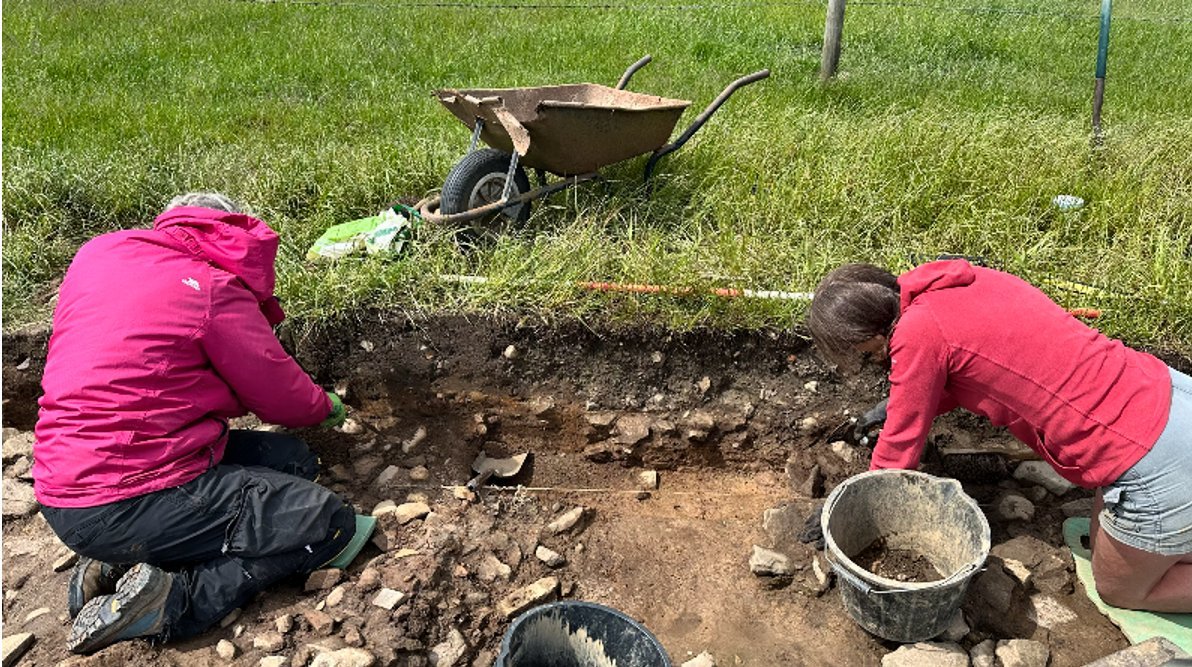 By the end of a rain affected day, they had found an edge of a patch of stones that were at angles rather than lying flat.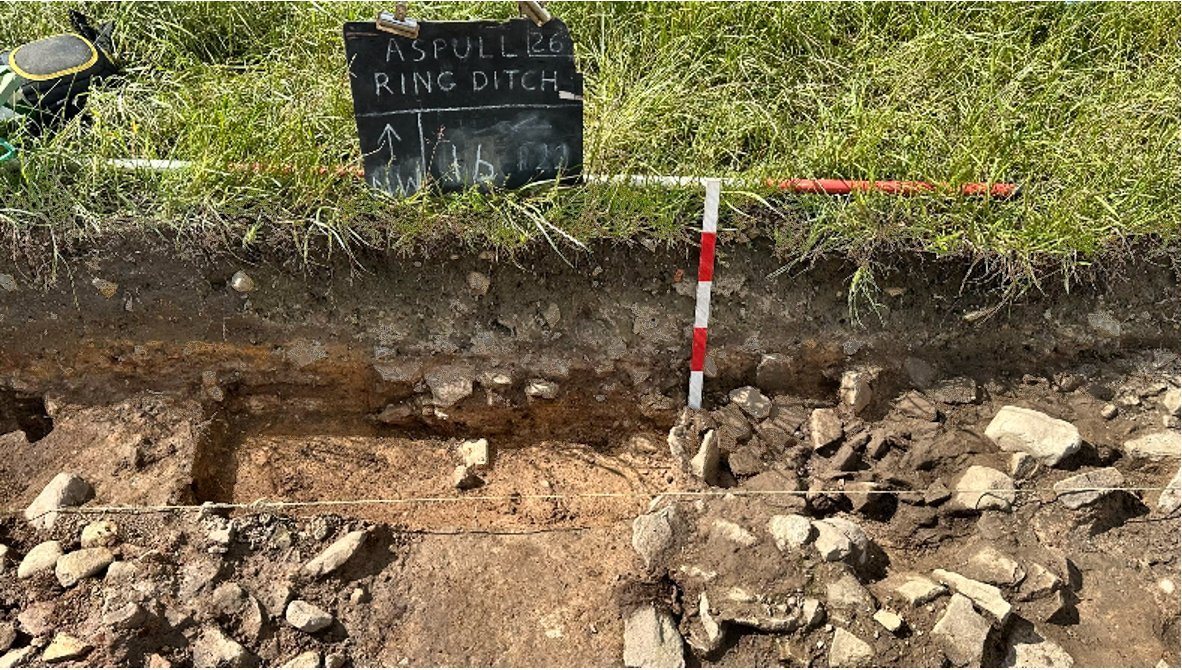
Chris and Patrick continued to work on the eastern and southern edge of Feature F22 (the strange arrangement of stones at the centre of our stone circle feature) to try to find both the sides of the stones and if they are in a pit. 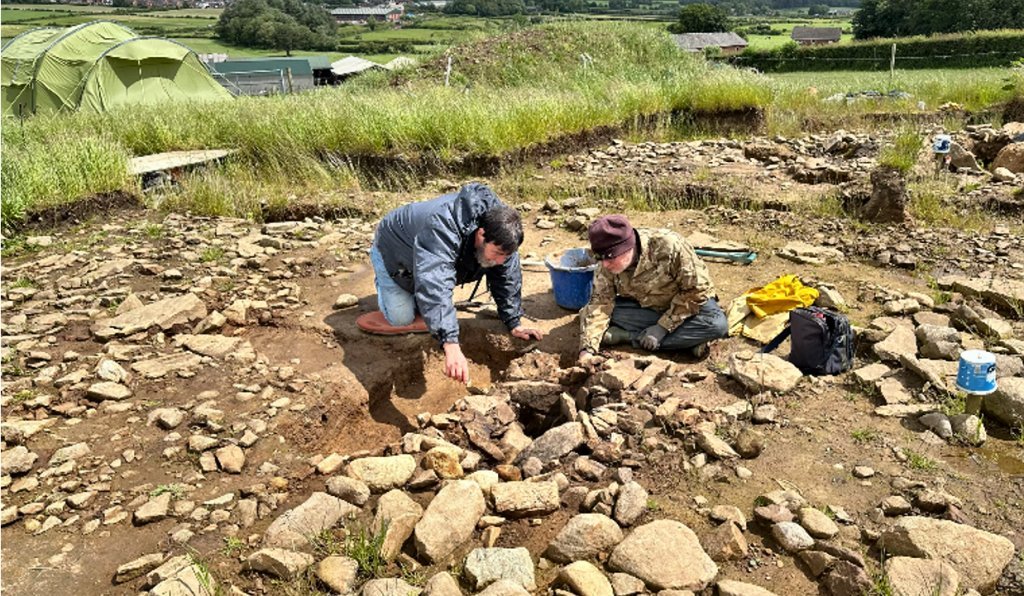 As it rained very heavily over lunch and the area was flooded, Chris and Patrick removed some of the top smaller stones on the eastern side. The exercise was recorded on video so that the position of each stone could be recorded. This exposed the large block (see last week) which looked as if it had at some point moved away from the side of the collection of stones.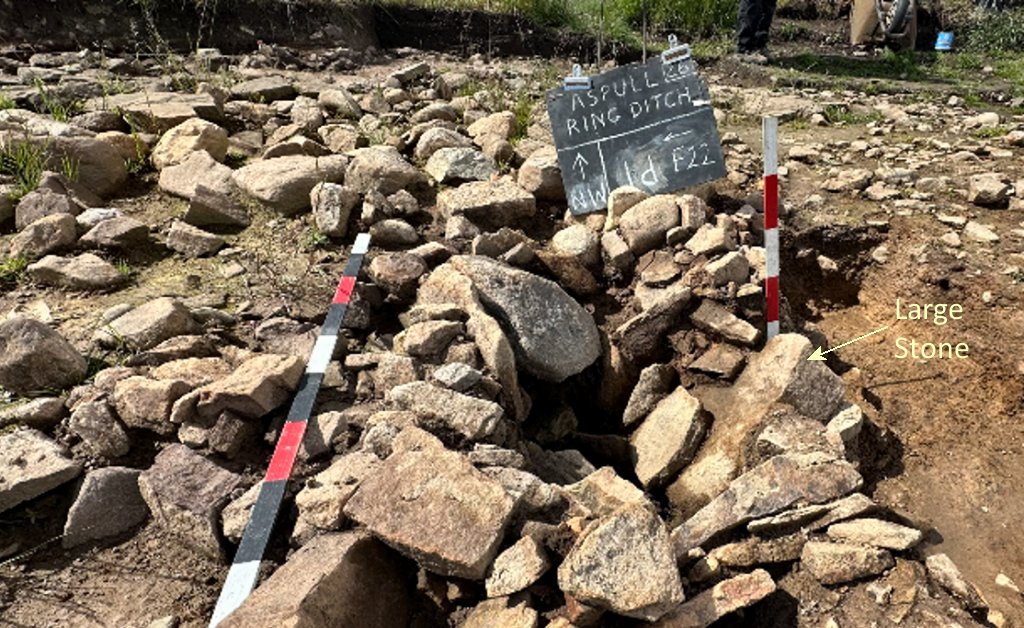
Thursday 4th June
Day 7
Not a great day weather-wise today with a constant drizzle all morning – just thankful that we had the tent which was just about surviving the gusting wind (although needing some maintenance from time to time). Braving the elements today with Bill, Chris and Patrick were Andrew, Susan and Paul Langin – and also new starter Emma Porter.
After giving Emma the obligatory site tour, Bill gave her the task of cleaning up the northwest end of Trench 1b. At some point this will be extended to find out the extent of the stony layer on this side of the central area. 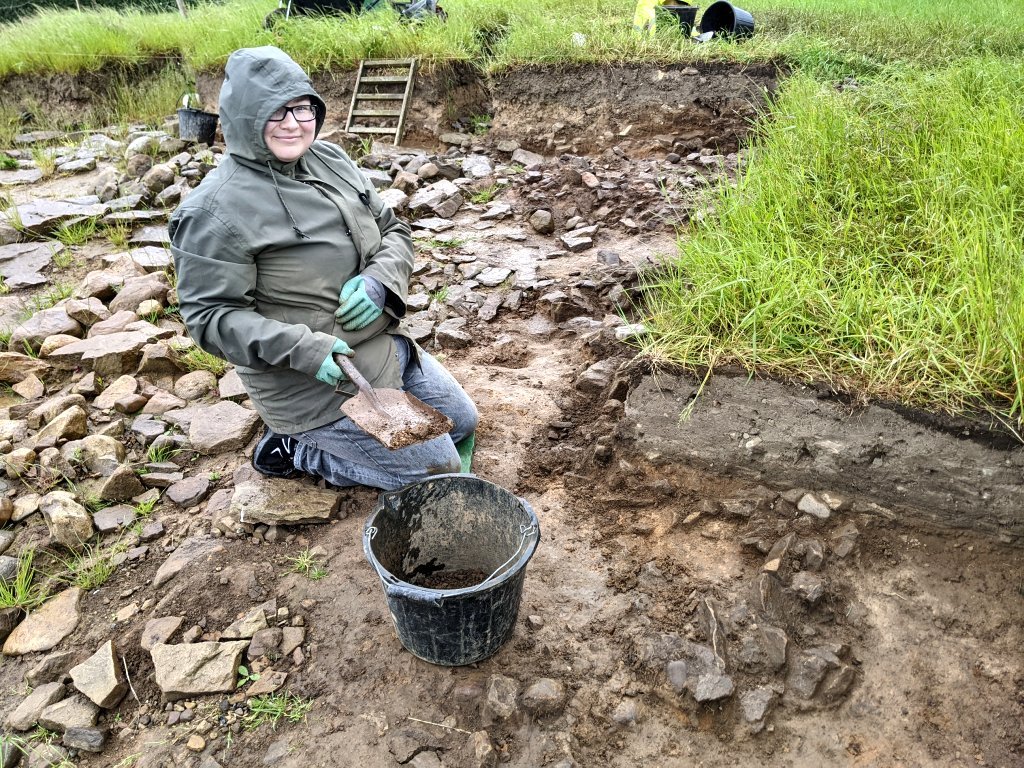 Before that though, the section needs to be recorded as there is a significant change from one side to the other. On the northeast side there is no sign of the mottled clay layer and only sparse indications of the burning layer.
 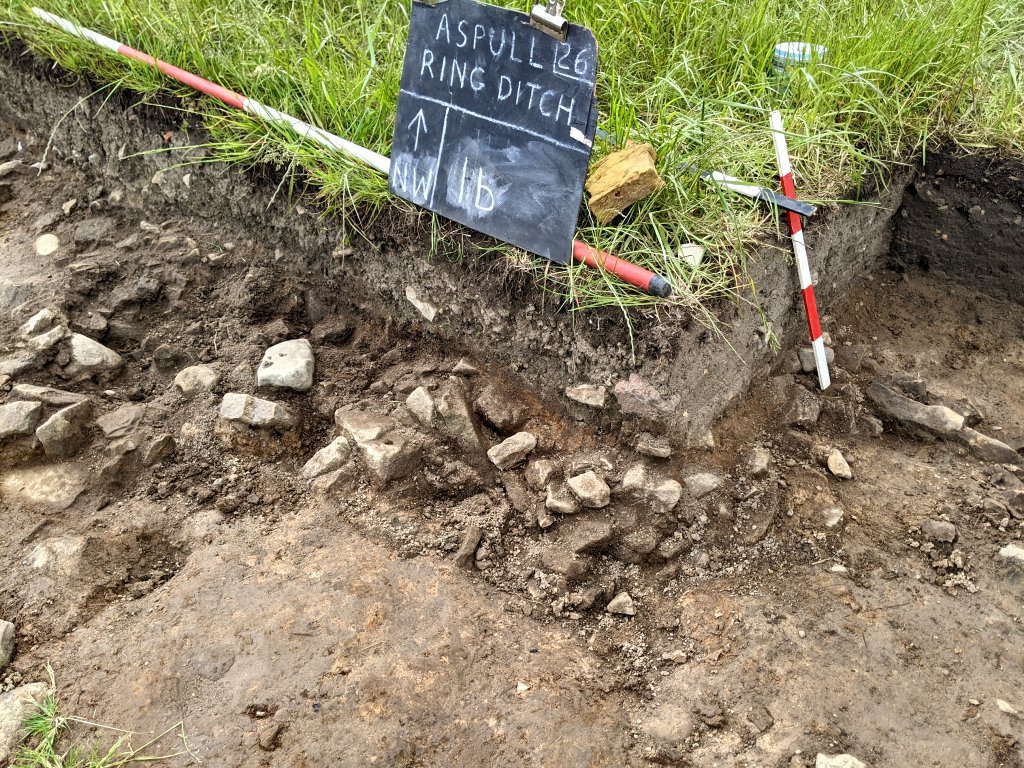 Whereas on the southwest side, the mottled layer is clearly evident – in fact gets to be quite a thick layer by the time it reaches Trench 1e. In the area around Trench 1d however the story become complicated as we have the issue of the ‘soft brown sandy clay layer embedded with stones’ layer. As mentioned last time out, the high level of the stones here might mean the burning layer is running underneath it. As cut therefore along this section should hopefully help us to understand what’s going on here.
Bill carried on digging out the sondage in Trench 1c looking for the base of the soft sandy clay layer. When Paul arrived, he took over and was able to reach a harder, stonier layer. However, as has been the case in other sondages looking for the base, it didn’t prove to be particularly definitive. 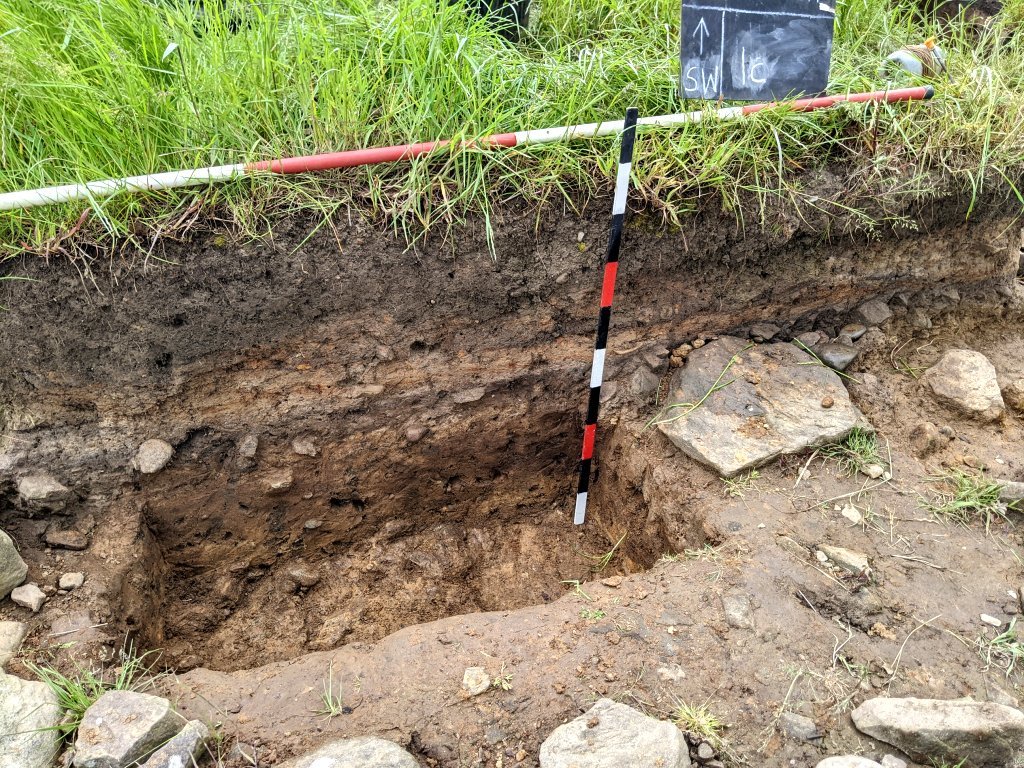
Andrew continued with his work in Trench 1e. His first task was to cut a sondage on the southwest side to see how deep the underlying soft sandy clay was. This revealed it to be very similar in depth and nature to the sondage Bill and Paul had dug in Trench 1c. It also showed that the brown sandy clay in the corner, although cutting through the burning layer, did not extend into the soft sandy clay below. To understand what was going on in the opposite corner, it was decided to extend the trench in the northwest direction by another half metre. 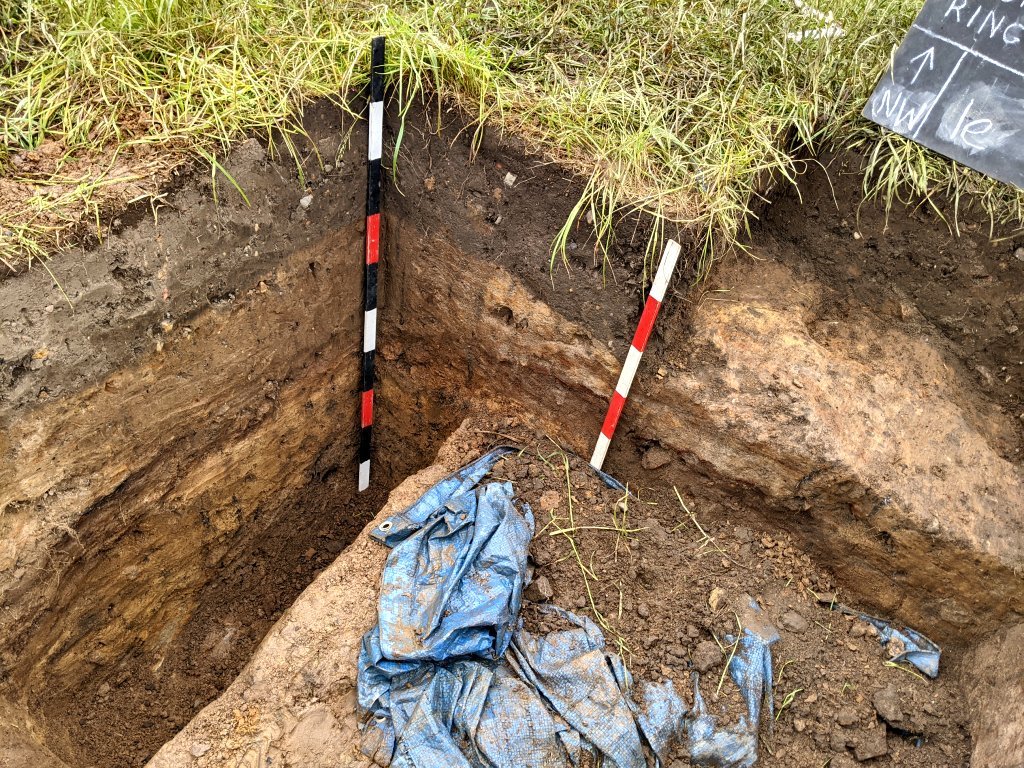 The mottled and brown sandy clay was recorded and various levels.
 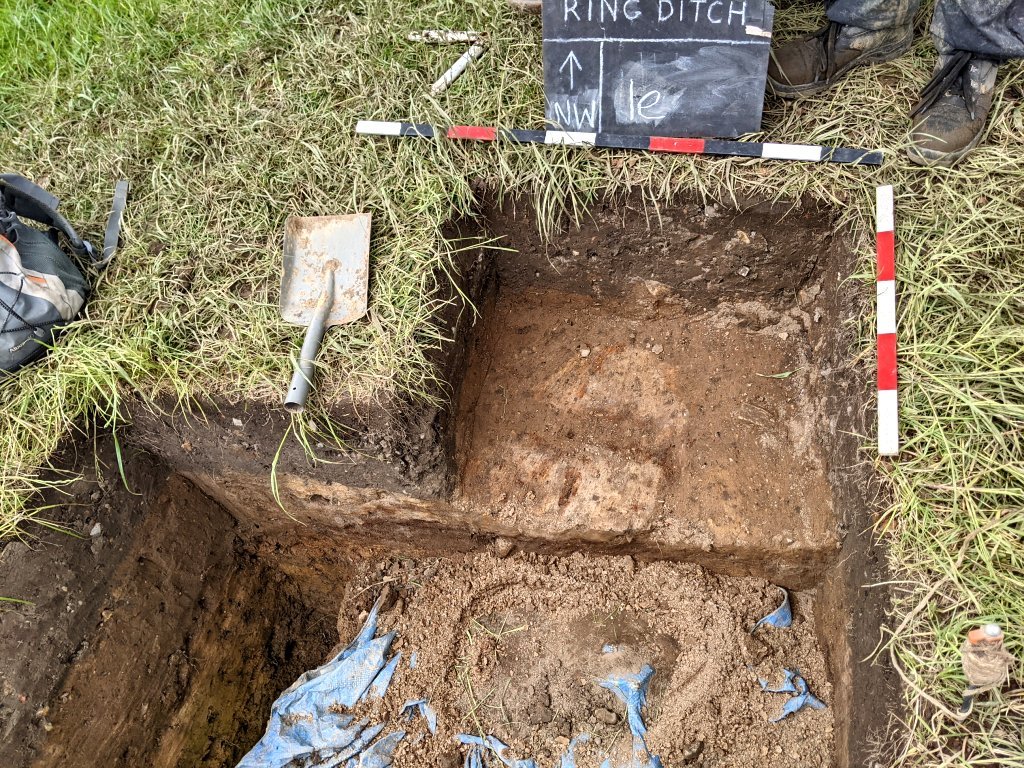 Reaching the burning layer, revealed it to be an isolated patch.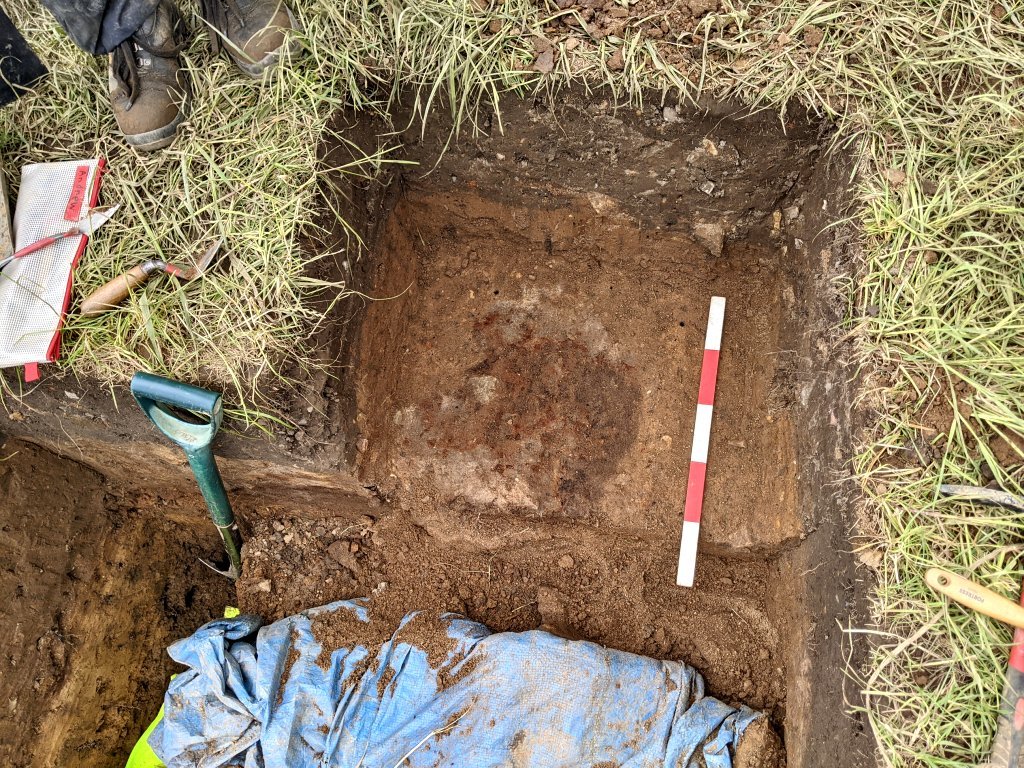
Chris continued his work on Sondage 1d.S1 next to Feature F22, extending it this time towards the northwest. This revealed a compacted stony area on the edge of the feature and a large stone angling down into it. Patrick joined Chris working on the southeast side of the feature. This revealed a thin brown patch running away from it. 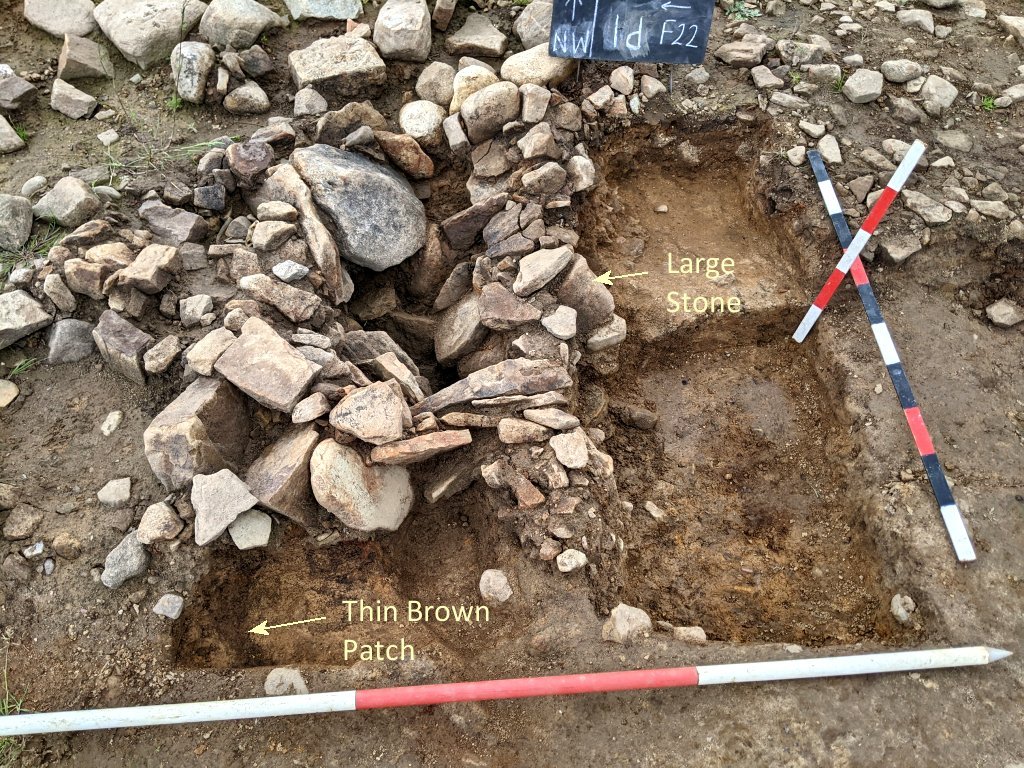
Susan carried on working on our clay-lined feature, eventually reaching the stony base. It’s difficult to determine the nature of the base at the moment, whether it’s one solid stone or a collection of stones. There is definitely a stone poking through on the west side. The base also seems to be rising on the south side, also most bowl shaped (could it be ceramic? surely not). Once the rest of the bone is remove, a proper examination of the base can be carried out. 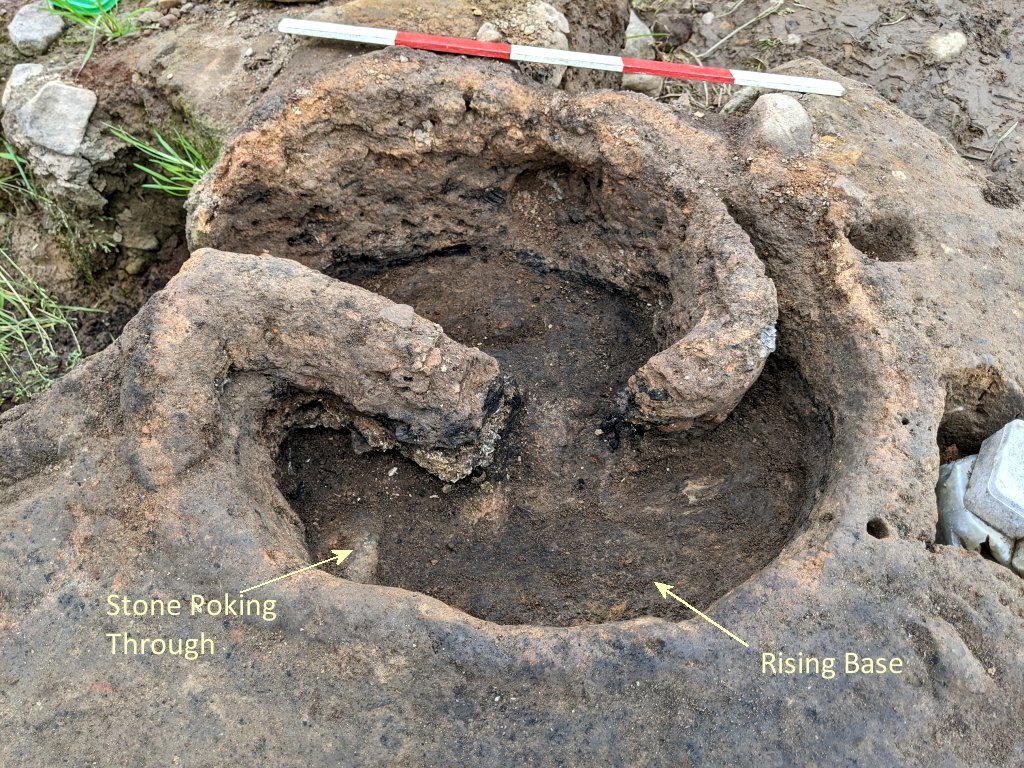
Tuesday 2nd June
Day 6
Excavations were rapidly reorganised for today due to the ever changing forecast, still though we had a decent turnout. Joining Bill and Chris were Andrew, Susan, Jon and Jen Harrison (making her first appearance this year).
There was still a lot to do on the original Trench 1c section before Bill could get it properly recorded. One of the issues was the depth of the underlying soft sandy clay and with this in mind, Bill started a sondage (where Phil had been working last week) to check this out. 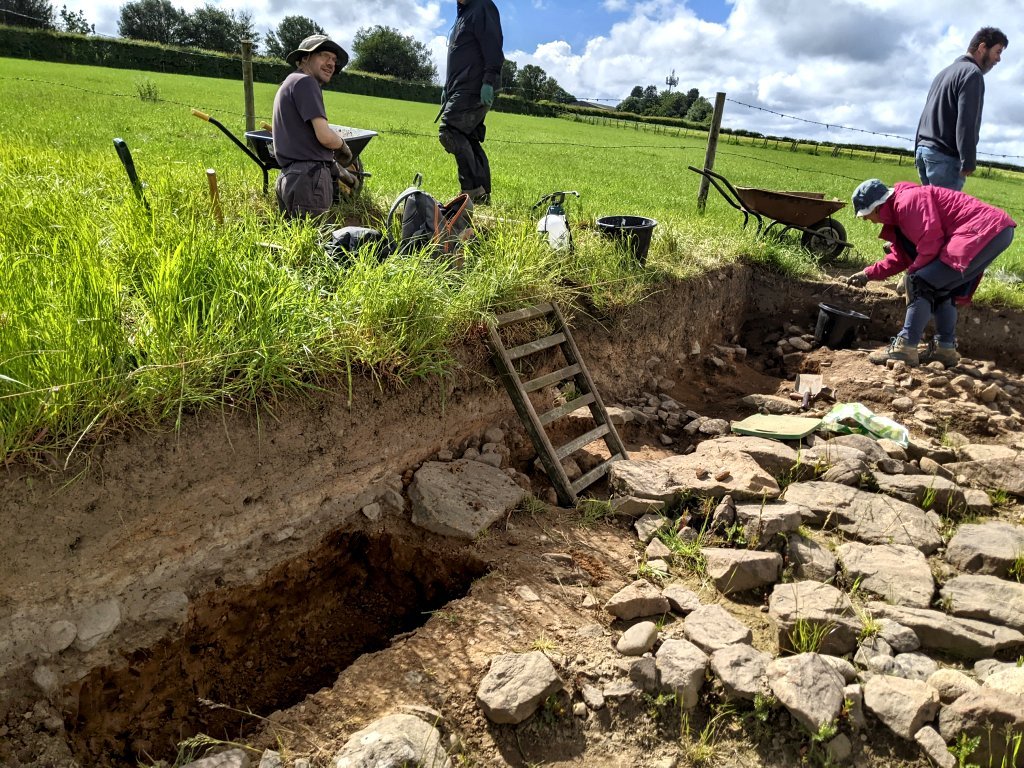
Jen meanwhile worked at the northwest end of it (where Isabel and John N had been working last week) to see if she could clarify what was going on. Bill had previously recorded a layer of stones embedded in soft brown sandy clay, which overlay the mottled and burning layers that disappeared below it. After a good cleaning it still wasn’t clear if this was true. 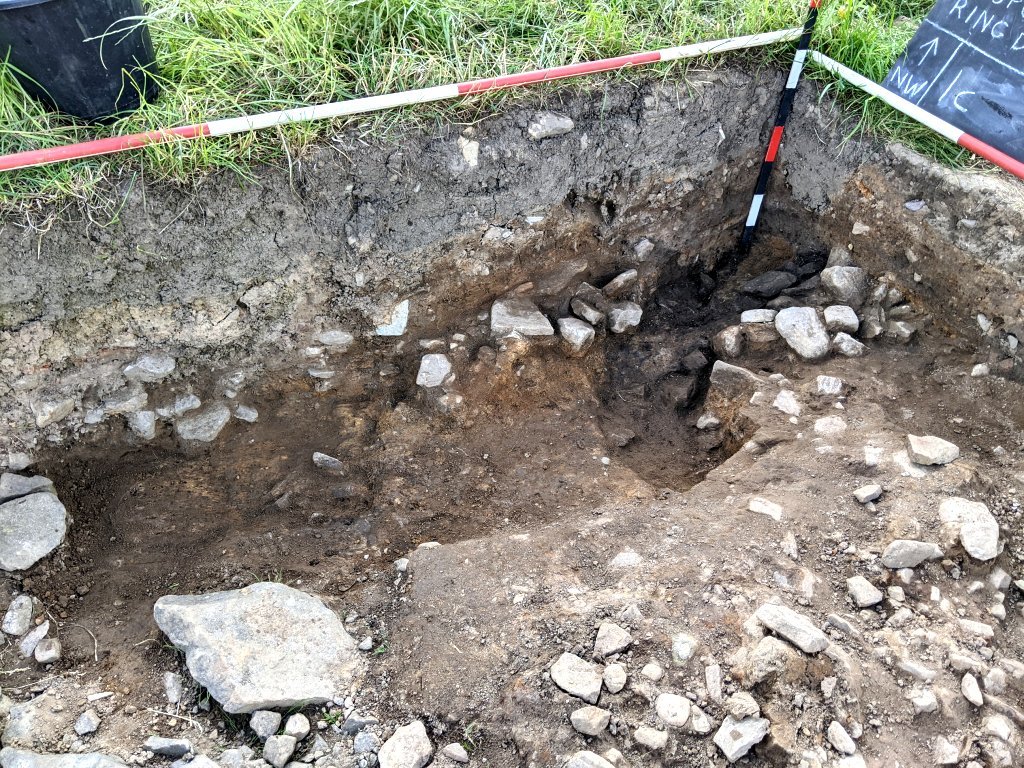 Confusing the issue was that the original Trench 1c had been backfilled and it wasn’t clear if the stones exposed were in situ or in fact part of backfill.
 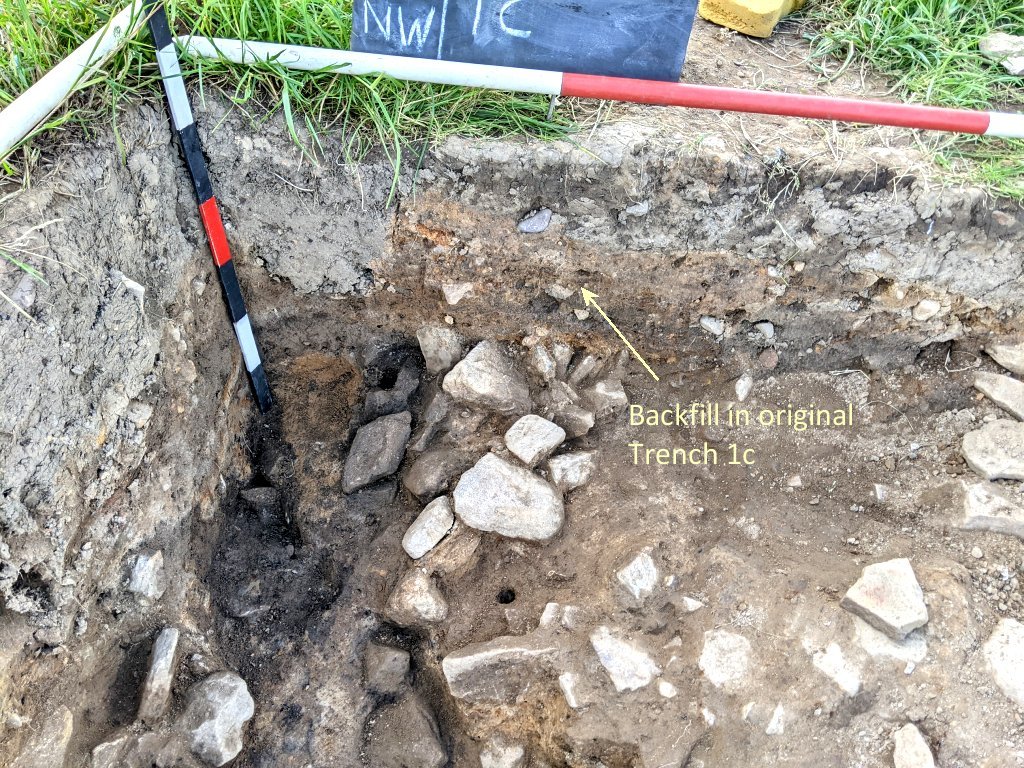 Also the stony layer recently uncovered next to this trench where noticeably higher and it was thought that they may actually be the embedded stones previously recorded (the only way to check this out would be a section along the northwest edge of this trench.
Andrew continued with his work in the adjacent trench (Trench 1e) – showing his ability to multitask.  It is pretty clear now that we have the edge of the stony layer but the mottled clay and burning layers continue.
 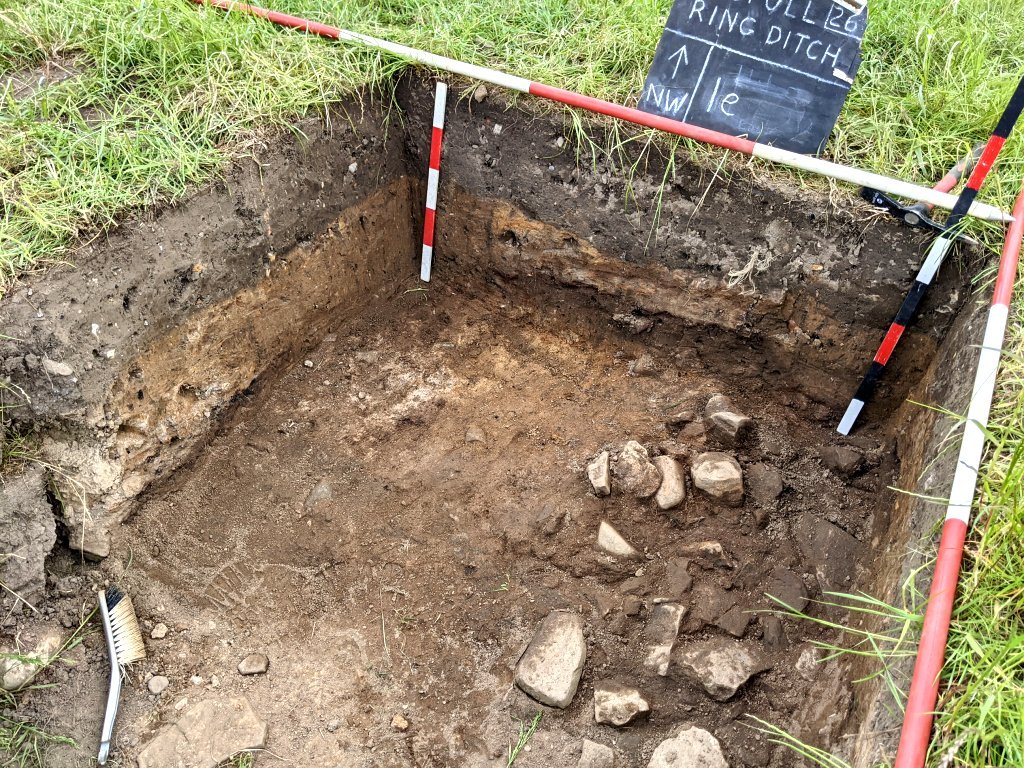 However there are unexplained gaps in these layers in both corners of the trench where brown sandy clay replaced the usual lighter mottled clay. In fact the is also a gap in the northeast section which (gratifyingly for Bill) corresponds with the gap he had recorded on the other side in Trench 1c (which he’d not been able to detect this time) showing it to be some sort of linear feature.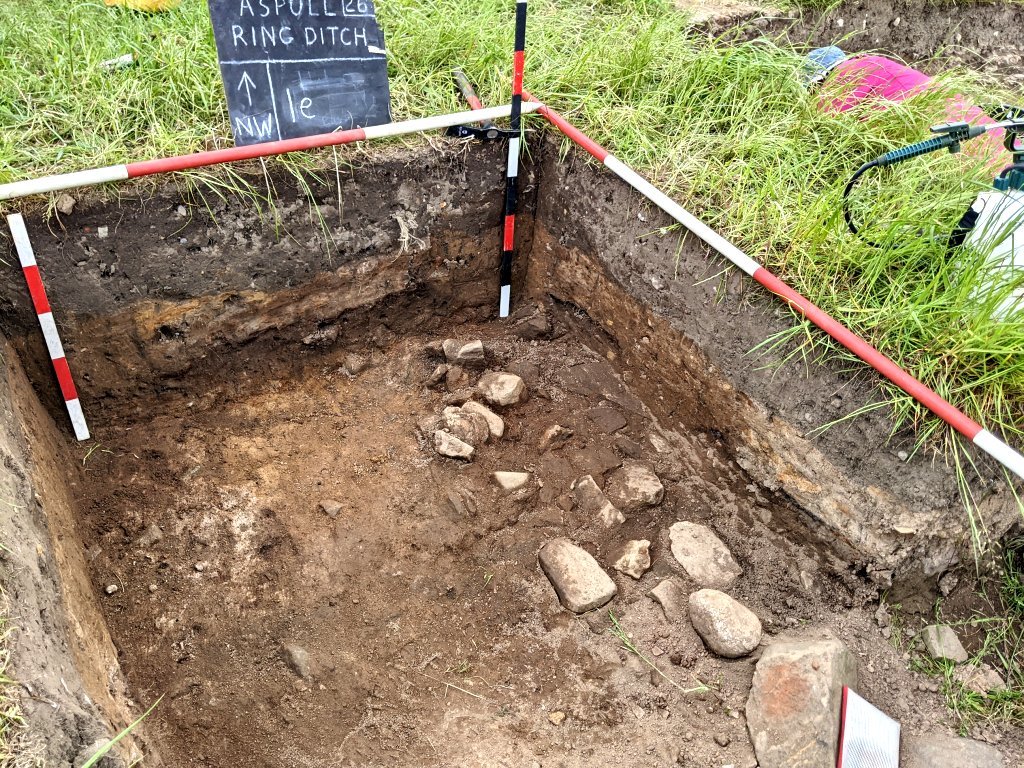
Jon was tasked with cleaning up the trench where Urn1 had been so that the section previously recorded could be brought up to date now that the Urn had been removed. He was urged to be particularly careful where the vessel had been to check if there was evidence of the pit dug for it. After careful cleaning, only a shadow of where the pot had been could be detected. 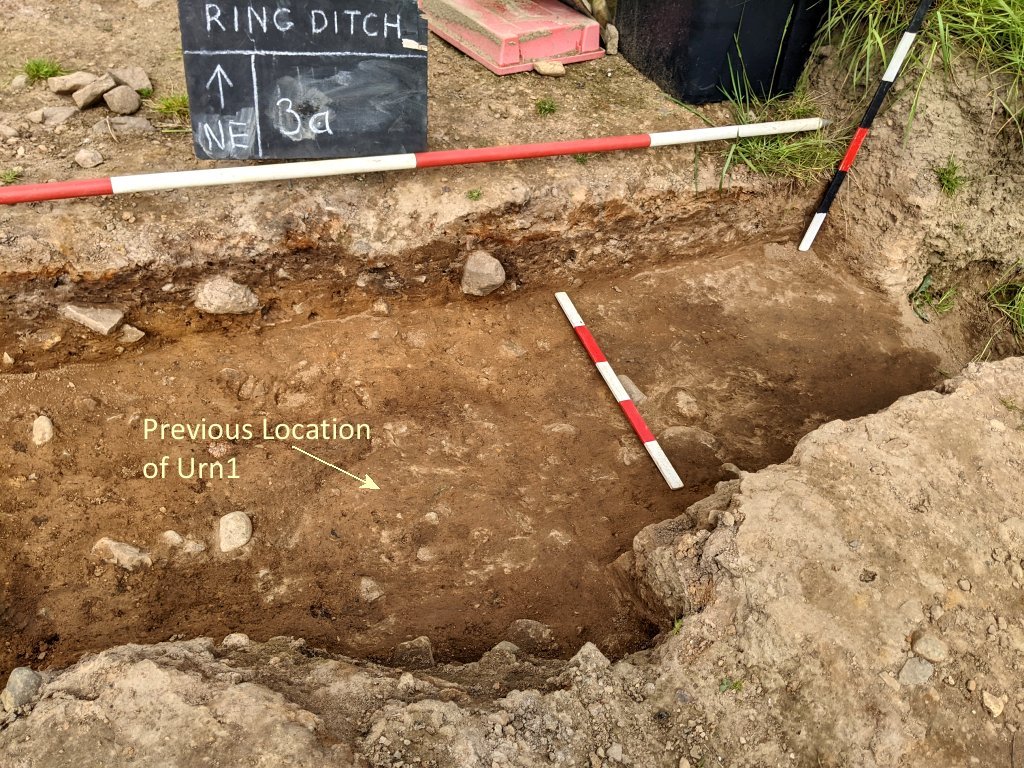
Chris continued his work on the sondage (1d.S1) next to F22 (our possible cist or stone box feature Ben Dyson has recommended we call it – maybe best to just call it strange arrangement of stones at the centre of our stone circle feature). Chris was detecting a possible pit cut for the feature so he extended the trench further to the southeast, showing that it continued in that direction. 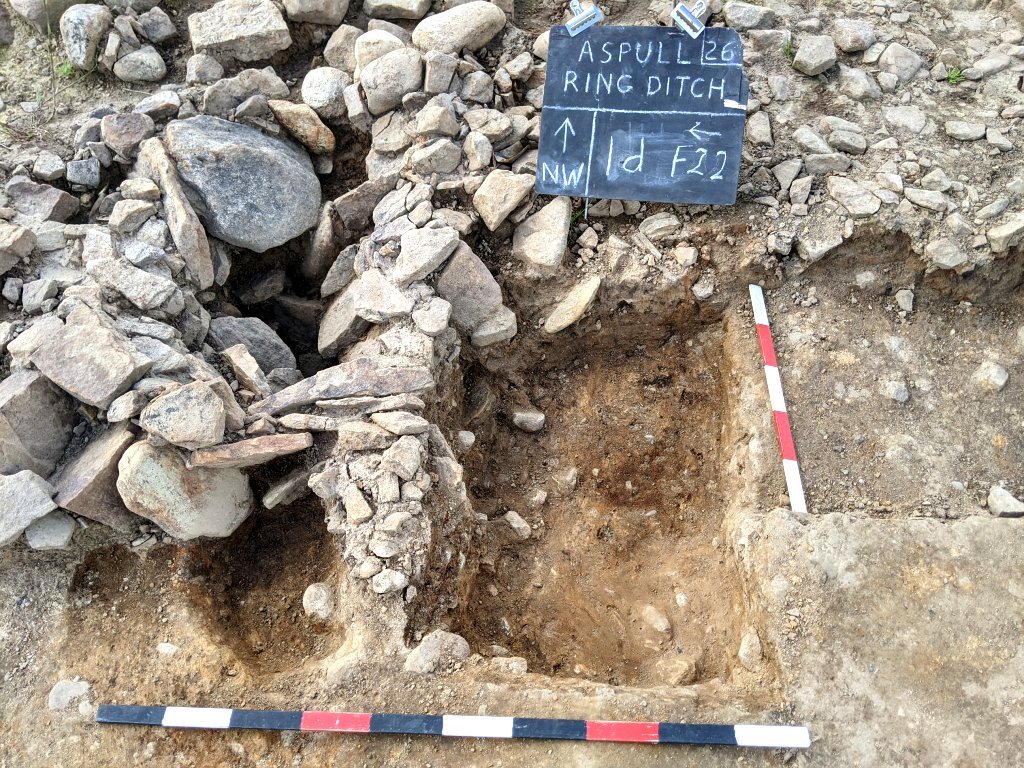
Susan meanwhile continued with her work on our clay-lined feature (F4). She had reached the point where a decision had to be made about the internal partition. The cremated bone spread a long way under it reaching almost to the side wall on the northwest side. Even if all the bone could be removed without touching the partition, the partition would be so weak it is likely it would survive for very long. It was decided therefore to remove it, or at least part of it to see it if as much of it as possible could be retained. 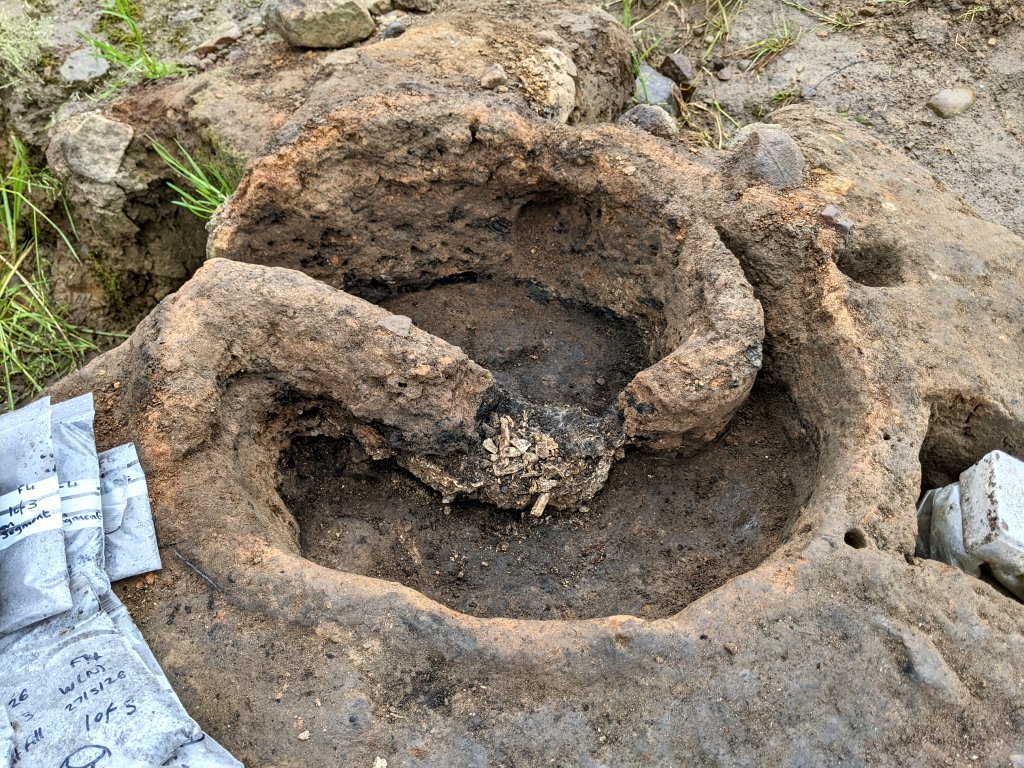
Thursday 28th May
Day 5
This day was added to compensate for the short day on Tuesday. Despite the short notice however, there was a decent turnout. Joining Chris and Patrick were Susan, Alison, Paul Kenyon, Paul Langin and for his first visit of the season Steve Parry.
Susan continued with her work on the clay-lined pit feature (F4), extracting the final layer of bones (spit 4) from the westside chamber. However, it has now become clear that this last collection of bones is running under the partition that splits the feature. This is useful in that it strongly suggests that the partition was added later than the burial, but does pose problems as to how we extract the final collection of bones without disturbing it. 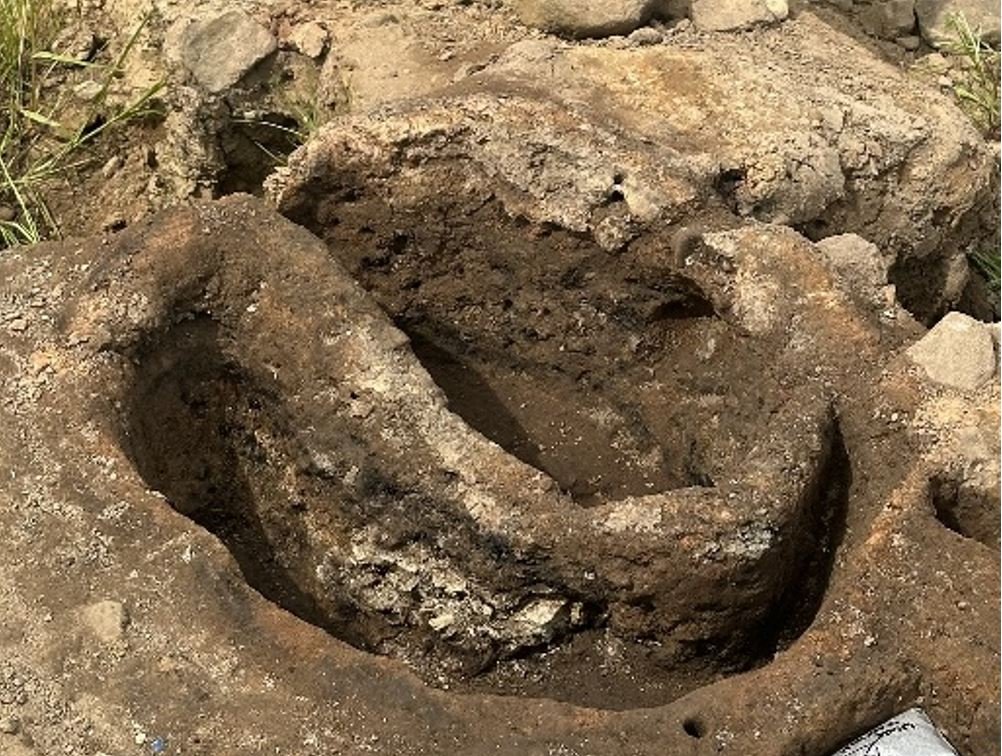
Patrick continued cleaning up the section of embedded stones created when the sondage (3a.S5 Ext.) was dug 2 years ago (adjacent to the location of Urn 2 lifted last year). We can now see that there are several stacked layers of stone built up from the large rock slab at the bottom. Patrick also took advantage of the hot weather, which has at last dried out the bottom of the section, to remove the plastic sheeting exposing the lowest layer. This seemed to be a stone-free darker sandy clay with possibly some flecks of charcoal. 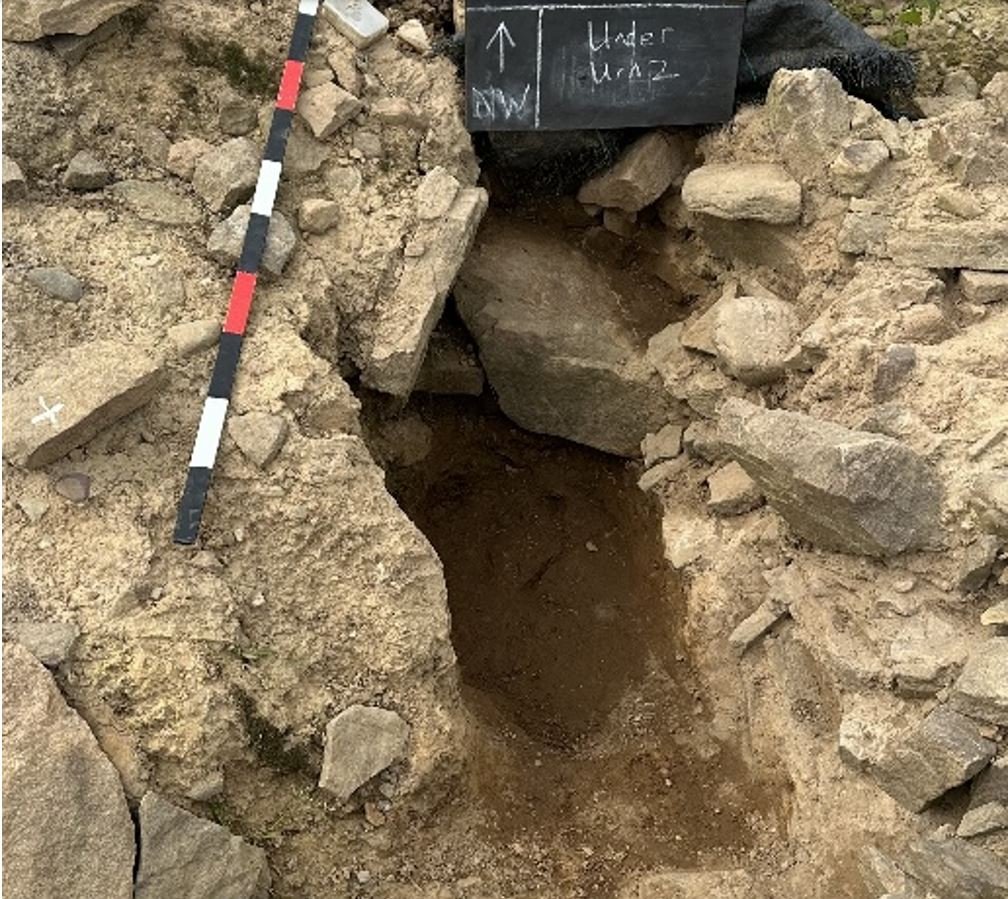
Chris continued with the work on the slot (Sondage 1d.S1) to the east of the stone box feature (F22). So far there is no view of the east side of the box, but at the end of the day finally a possible edge of a stone filled pit came into view. It now looks that a pit has been dug, filled with small stones around the outside which support the larger upright stone that make up the stone box shape. Now the edge of the pit is visible, it can be followed to learn more about the construction of this feature. 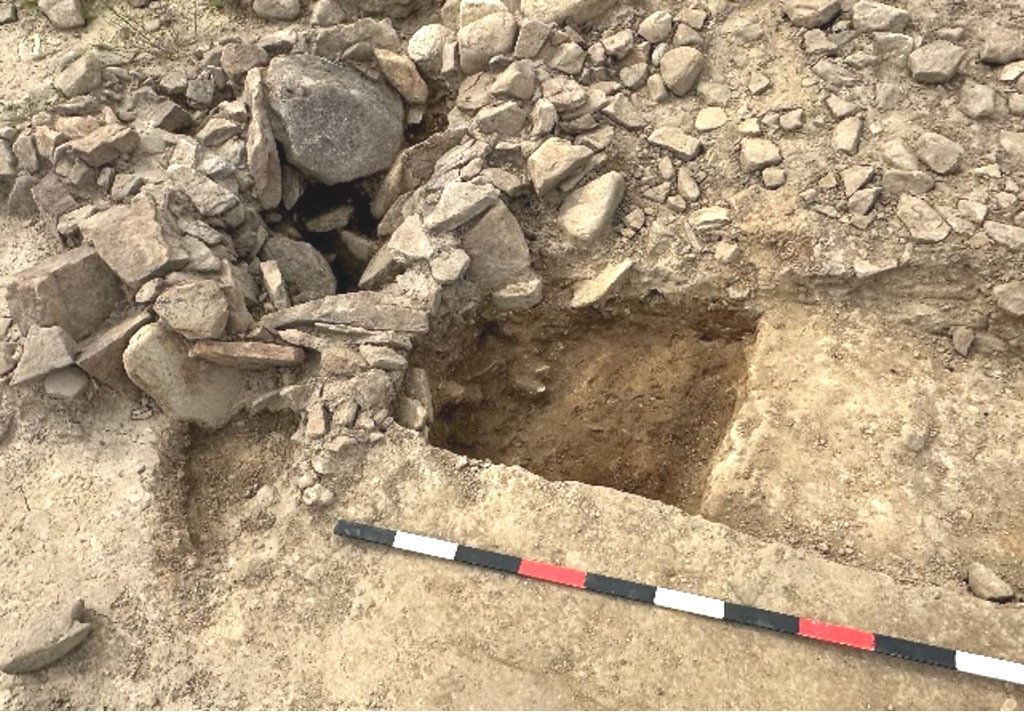
Paul K continued the work he began on Wednesday cleaning the section of Trench 1c (originally dug in 2023) taking the floor down a further couple of centimetres. There were indications of dark material that looked like charcoal but more likely shale. 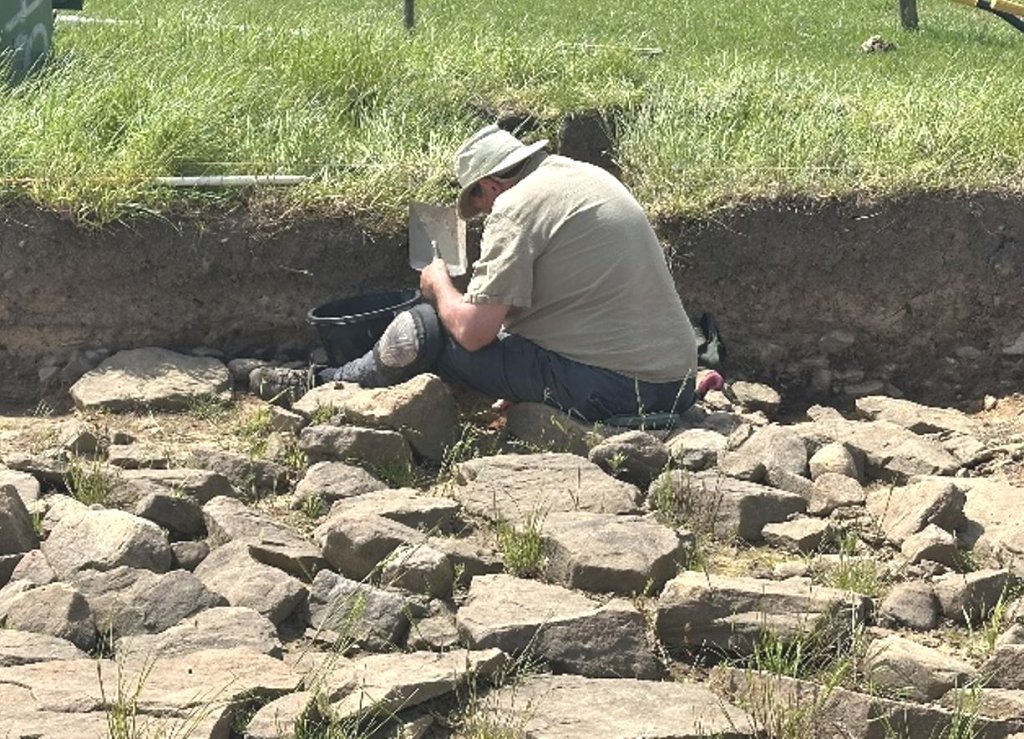
Alison, Paul L and Steve cleaned up the stony layer in the area that had been de-turfed on previous sessions on the NW side of Trench 1b. Steve worked on the section next to Trench 1d 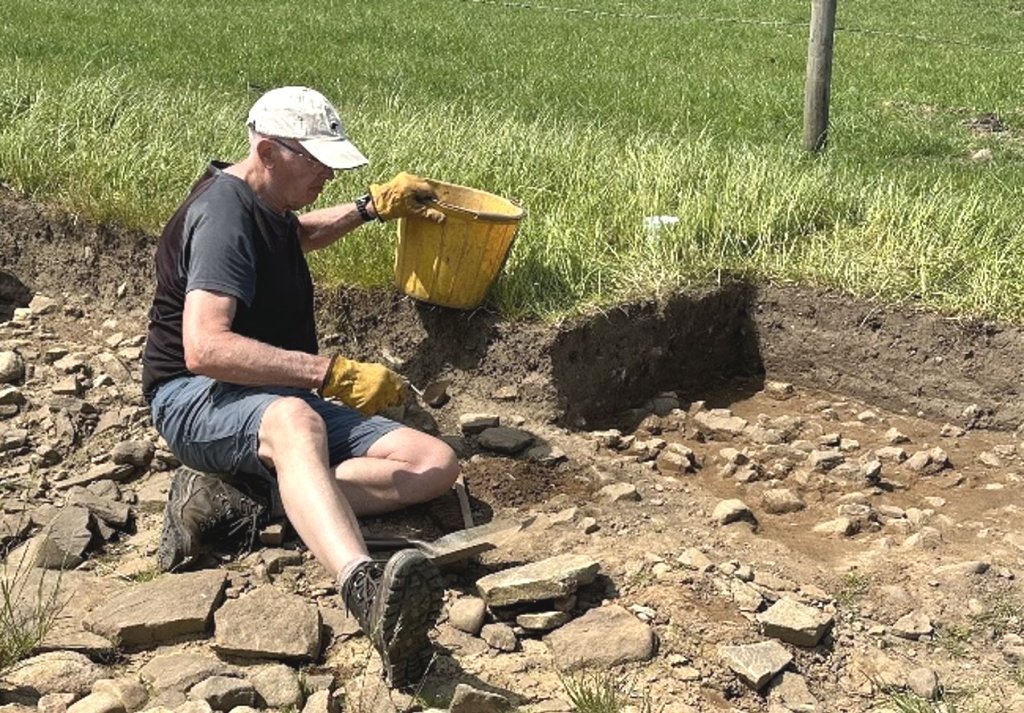 while Paul and Alison worked on the other side next to Trench 1c.
 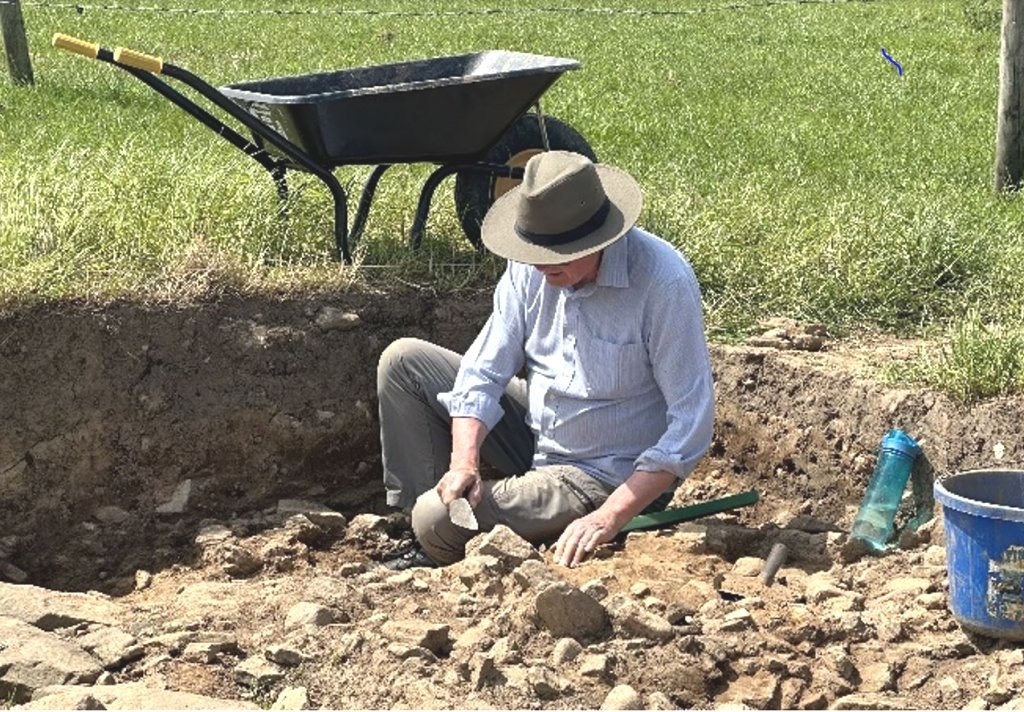 This allowed Chris to do a drone survey over lunch so that in the afternoon they could start removing the stony layer covering to see if there were any significant features underneath.
Ideal light conditions persuaded Chris to attempt two drone surveys. However the very strong wind blowing from the east meant the 5m height survey failed but the second survey at 14m height was successful. 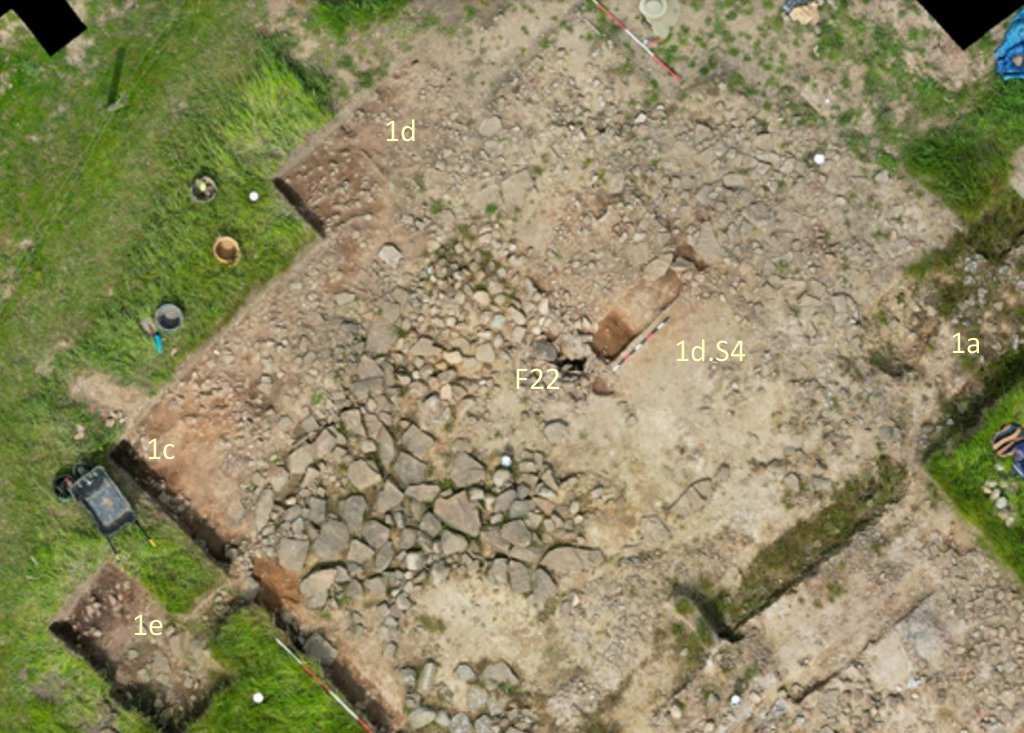
Wednesday 27th May
Day 4
Great turnout today with 13 eager volunteers on site. Joining Bill, Chris and Patrick were Andrew, Isabel, Paul Kenyon, Paul Langin, Gerald Conn – and some familiar faces from last year including Phil Livesey, John Needle, Jon Shelley, Gaby Bamford and Susan Rimmer.
First job was to clear up the mess the strong wind had wreaked over night (which wasn’t predicted) on the tent and gazebo. Perhaps a mistake to leave the gazebo up (although it was on its last legs) but surprised the tent had once again suffered a fractured pole section. Phil and Andrew though, gratefully were able to fashion a temporary repair.
It was great to see so many on site – it enabled us to open up more areas for us to investigate, particularly in our pursuit of the extent of the stony layer on the NW side. 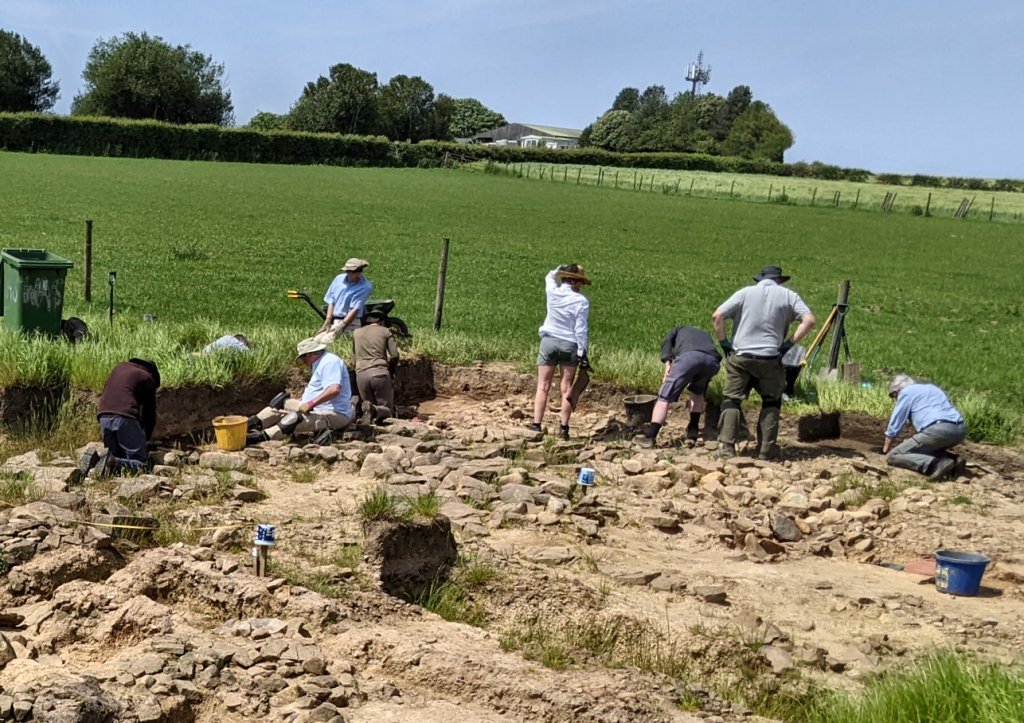
Jon and Paul L set about extending a section away from Trench 1d further towards the datum Peg 10c, in and attempt to chase the edge of the consolidated stony layer. Early days but it seems the stony layer keeps going in the NW direction.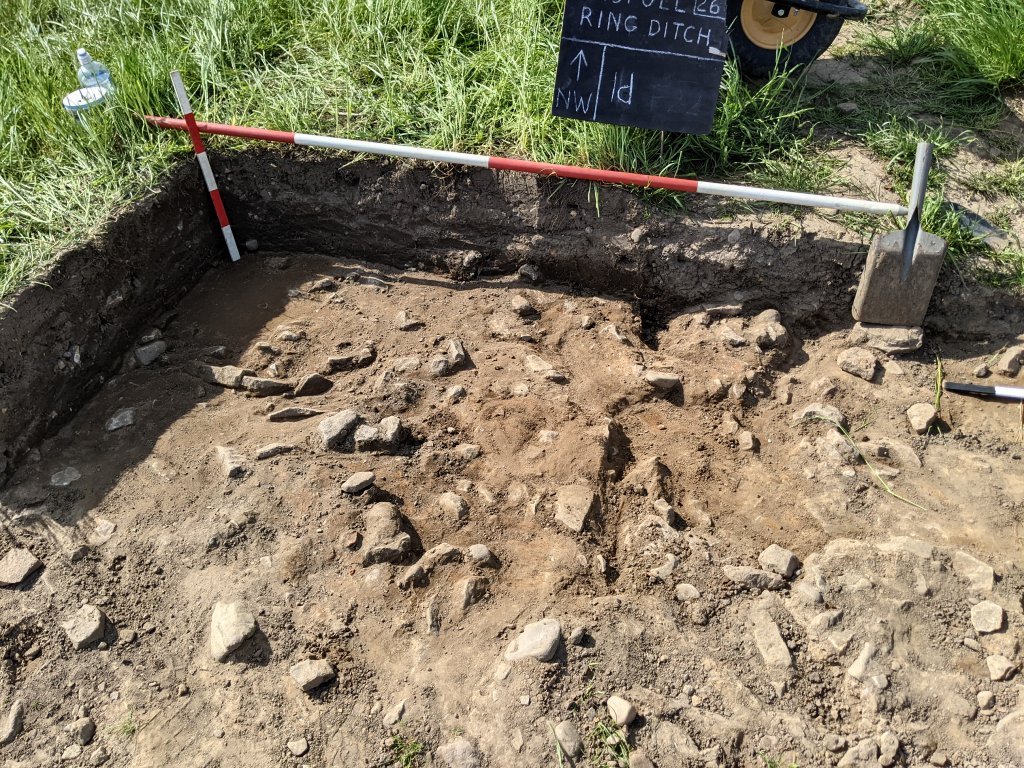
Isabel meanwhile was tasked with cleaning the newly opened area next to Trench 1c while John N continues clearing out the backfill from Trench 1c. Confusingly undisturbed stones started to appear on the SW side but then we realised the trench has grown slightly since last opened. As he neared to bottom, areas of burning began to emerge which corresponded the same thing we’d seen when this trench was first opened i.e. the burning and mottled clay layers dipping down below a layer of stones embedded in a soft brown sand clay. 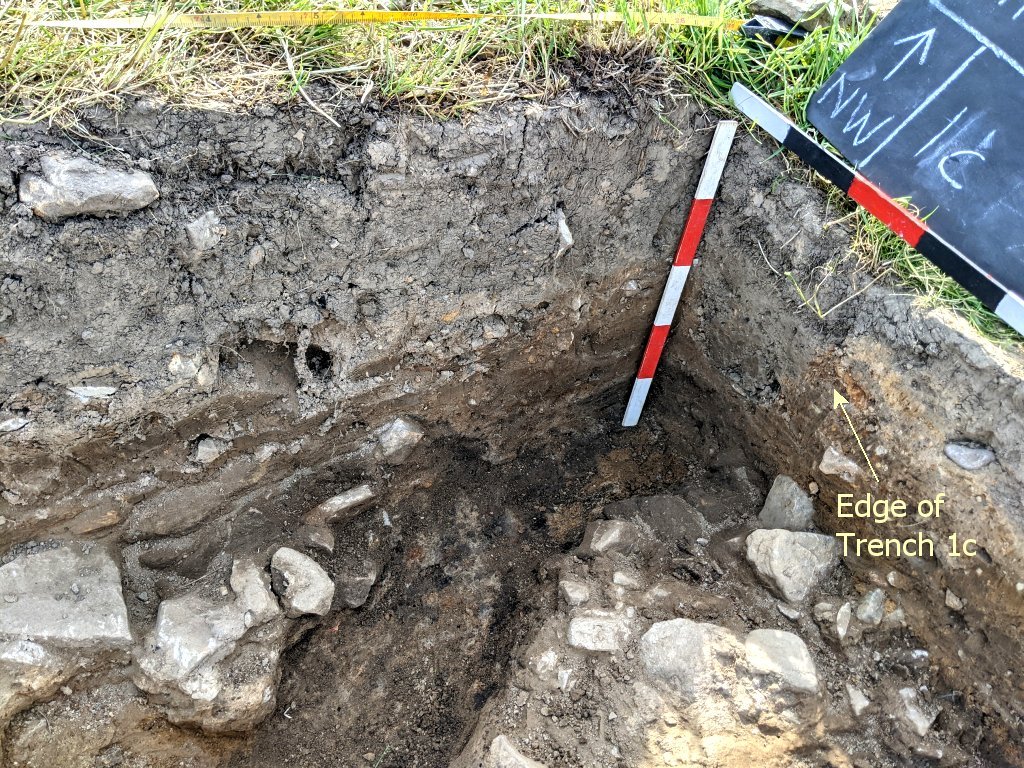
To confirm this, Trench 1c would need to be extended towards the SW which would mean loosing the section. Bill had previously recorded this however when the trench was first opened but his drawing needed to be updated. With this in mind, he asked Phil and Paul K to clean the section up, Phil starting at the end next to the crossing Trench 1b (SW side) while Paul worked on the section from the large stone to where John was working (including the cut for going towards Trench 1e). 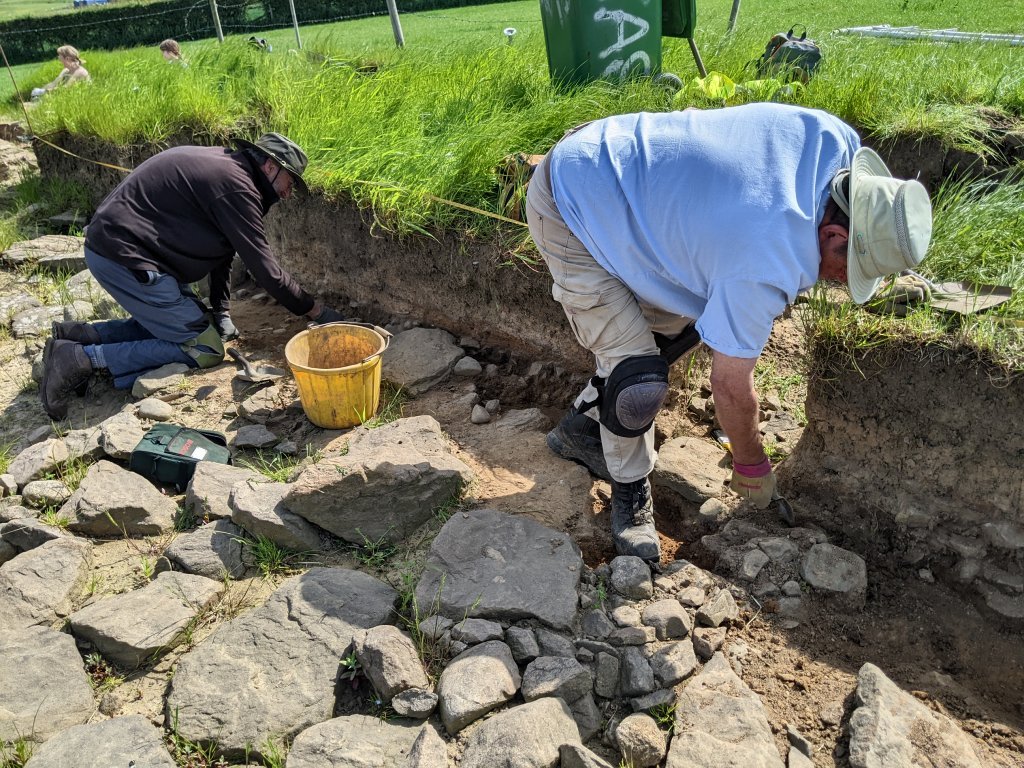
When finish Bill was able to record the depth of the stony layer along its full length. 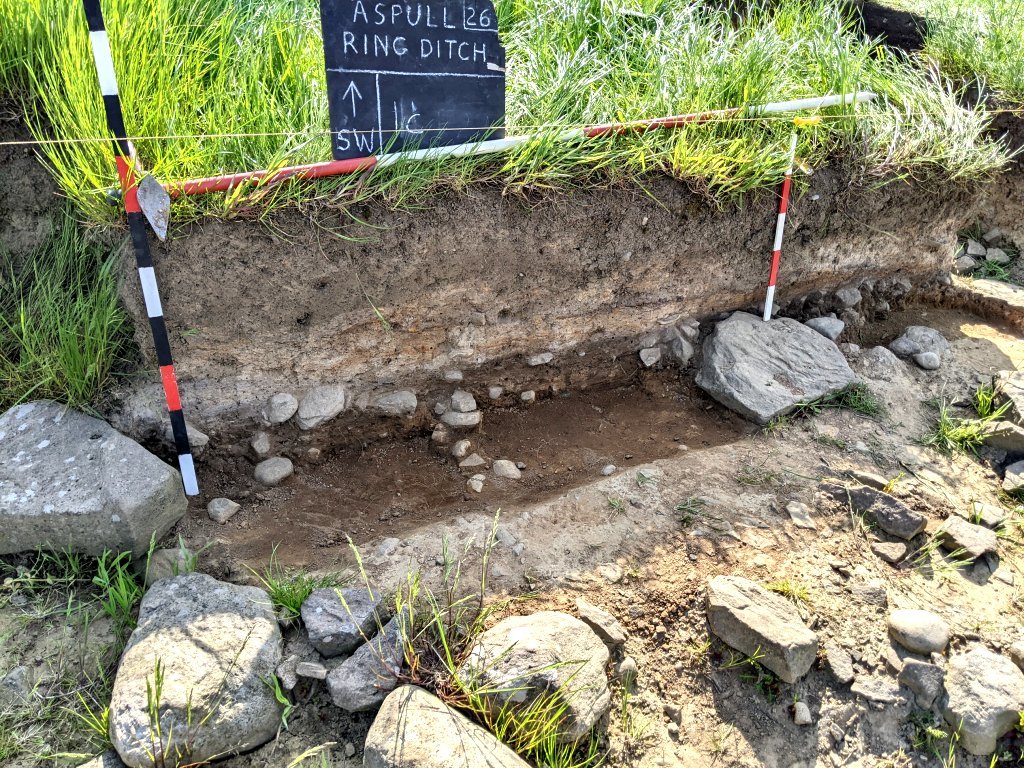
Meanwhile Andrew and Gerald worked on expanding Trench 1e in a NW direction (using the newly cut turfs to block up the original Trench 1e which was devoid of stones). When the got down below the mottled clay layer, which is quite substantial here, stones began to appear but early days to say if an edge had been reached. 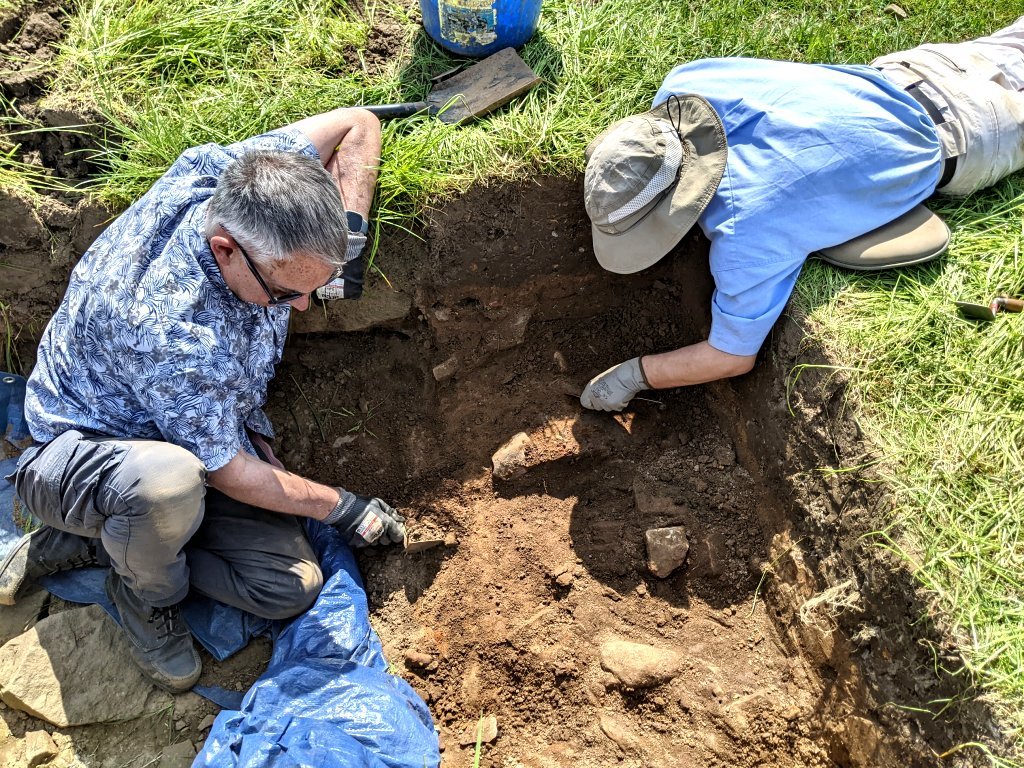
One of Ben’s suggestions was that we should investigate the stones on the east side of the central sandy clay mound. Unlike the stones on the west side which seem to be acting as a revetment on top of the mound, these stones are deeply embedded in it. Patrick therefore started by cleaning up the section created when the sondage (3a.S5 Ext.) was cut into it (revealing a large stone at its base just SE of the burial found under Urn2). Meanwhile Susan and Gaby where given the task of micro-excavating the contents of our clay-lined pit feature (F4). 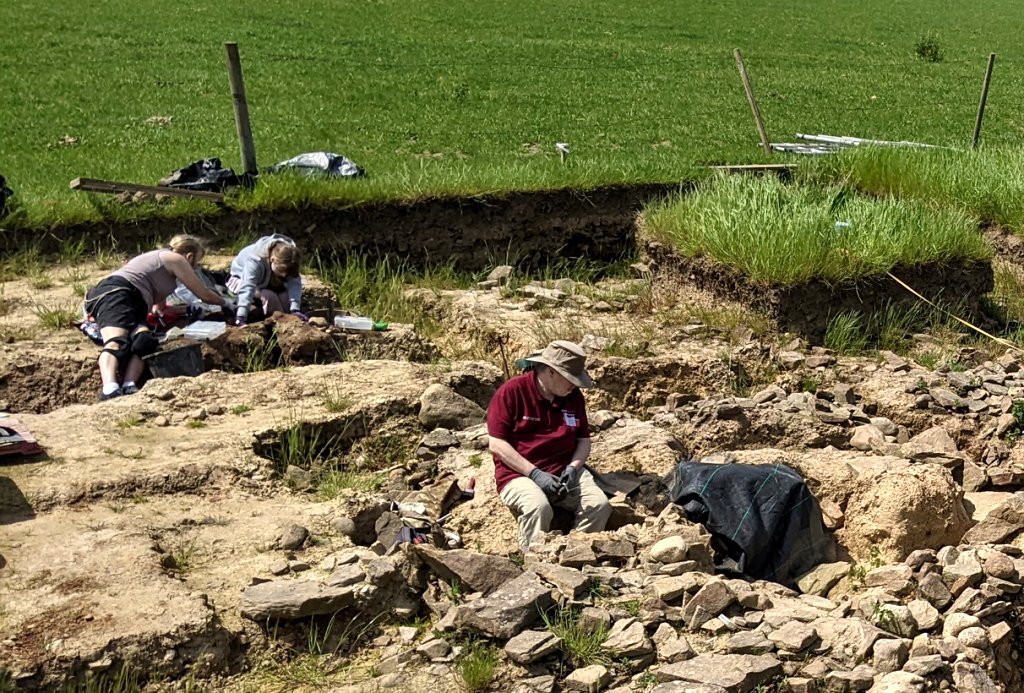
Susan and Gaby made good progress with a package of cremated bone exposed right next to the mysterious central partition. 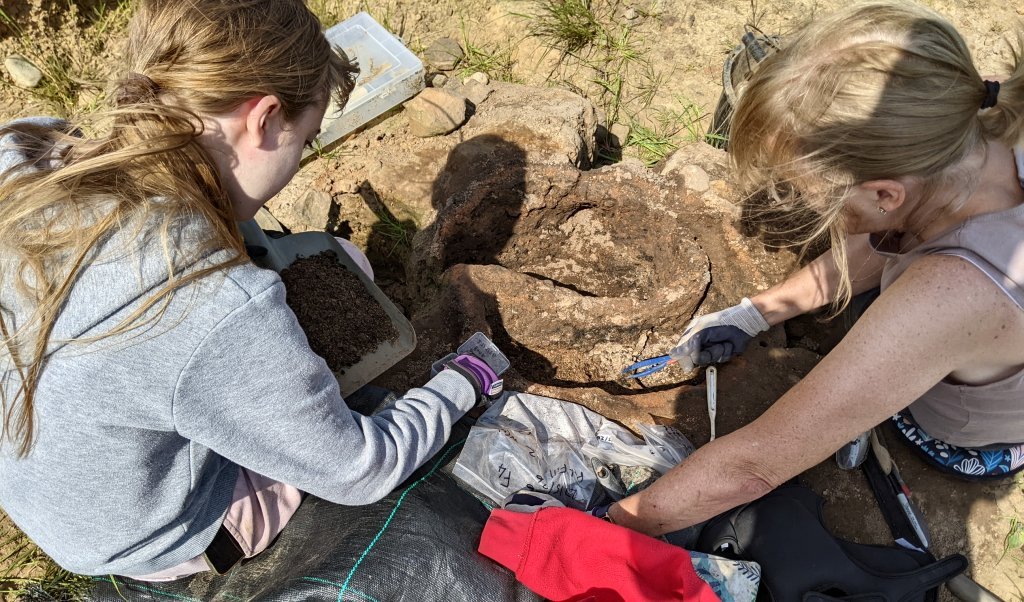
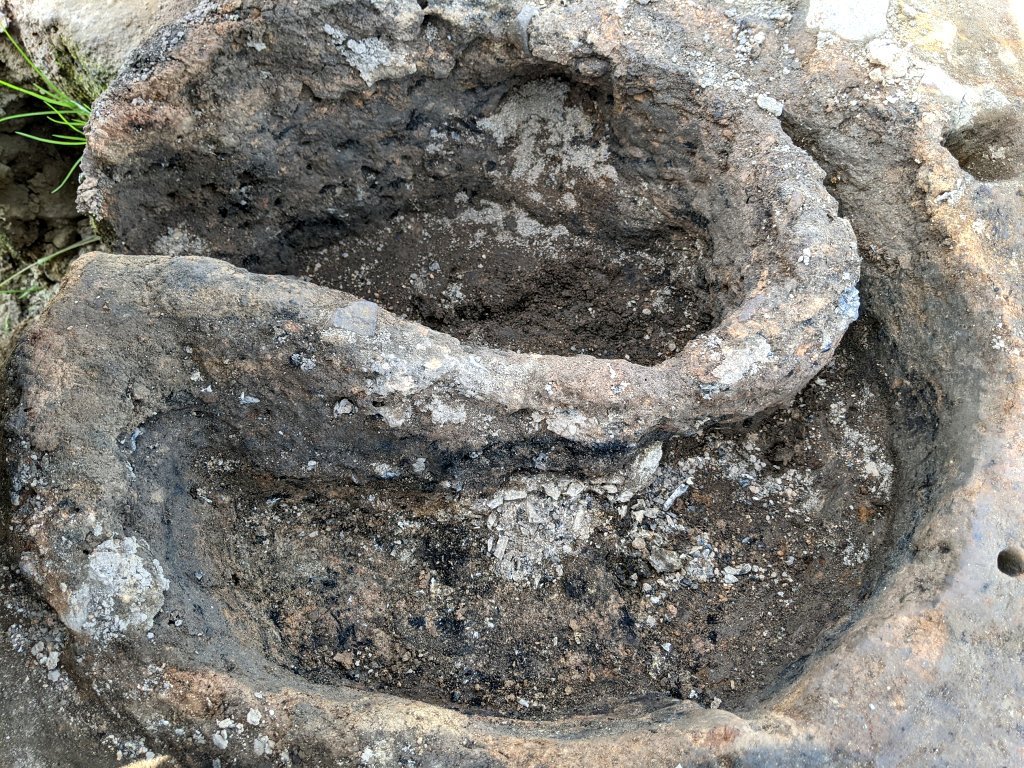
Tuesday 26th May
Day 3
Heatwave this week – mid-day temps reaching 350 so we decided to have just a morning session. Braving the conditions today were Bill, Peter, Patrick and Isabel Vaudrey (we were tempted to cancelled the whole day but Peter was going to be off on his hols – so he needed to catch up with Bill and Patrick on our bid for NLHF grant we has been working on before he went).
Despite the heat, we did managed to make some progress on the areas started last week. Bill’s first job though was to set up the gazebo to provided a bit shade – the tent proving no use for this as it was like an oven inside. Isabel worked on the area next to Trench 1d that Paul L and Gerald had started last Thursday. By cleaning the stones she was able to reveal a clear edge to the consolidated stony layer wandering into Trench 1d. 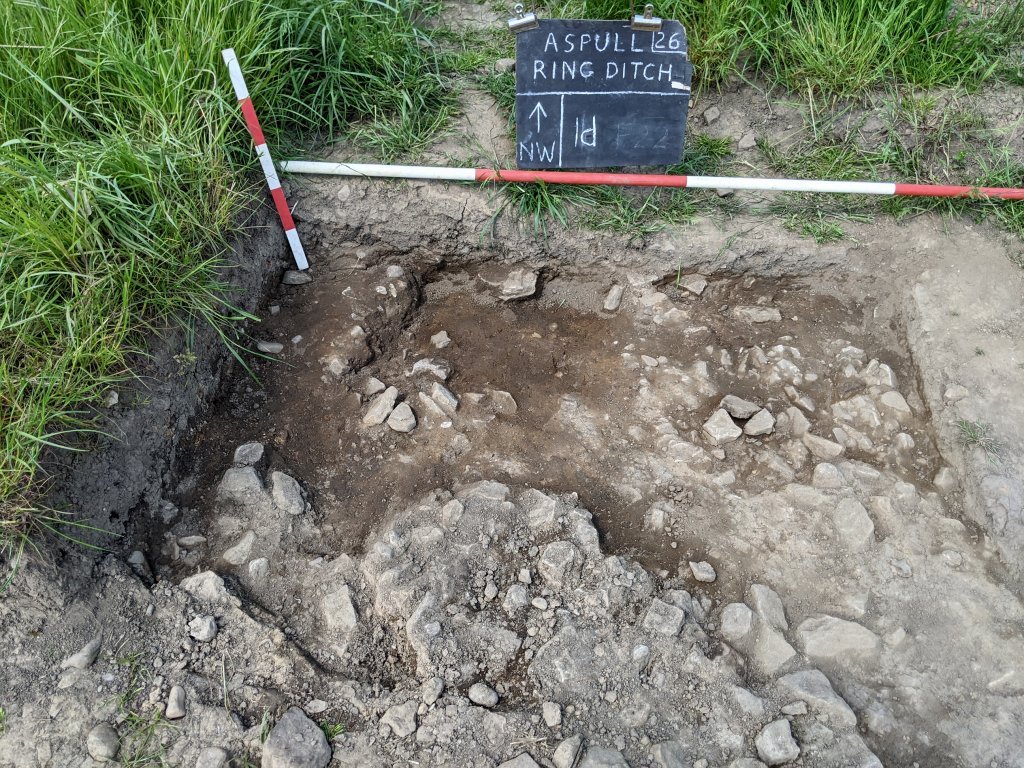
Peter continued with the work of trowelling down the sondage (now labelled 1d.S1) on the NE side of F22. This revealed more of the mottling in the soft sandy clay but most striking was the development of a patch of brown soft sandy clay on the NE side of it. 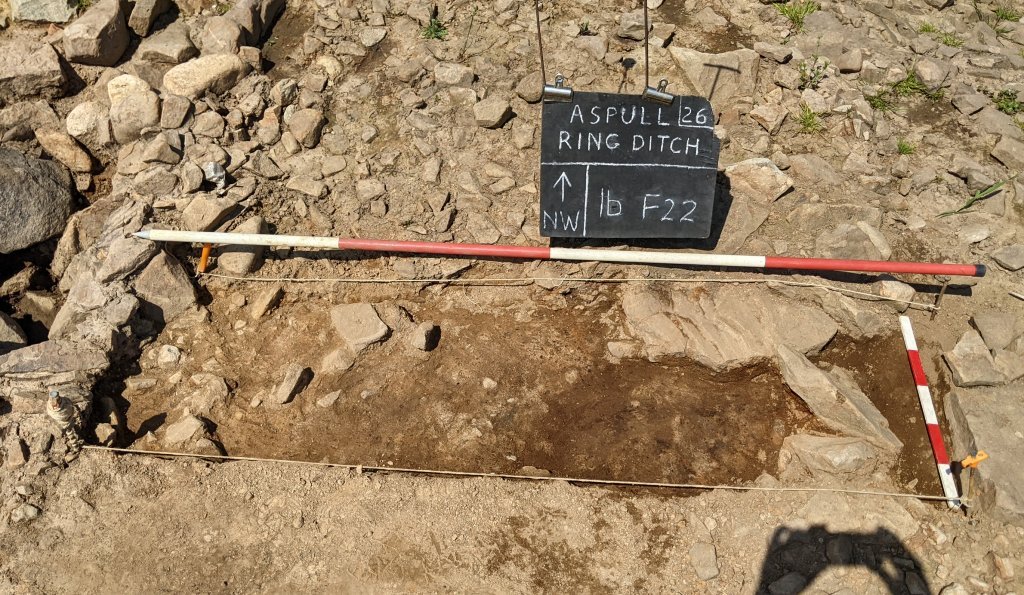
Patrick had a quick look at the condition of the burial under where our second urn had been and assessed how we were going to tackle the embedded stones to the south of it. Bill had brought his drone and before leaving was able to take some aerial shots to record the current condition of the site. 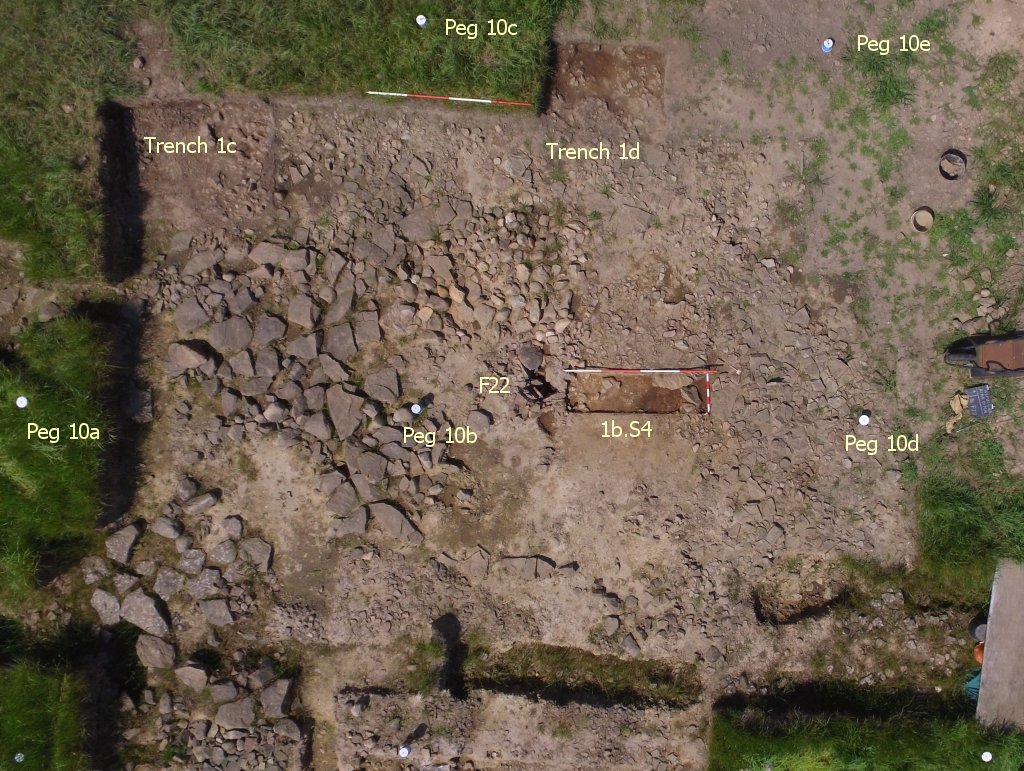
Thursday 21th May
Day 2
Good turn out today with Chris and Peter joining Bill and Andrew and also two new starters Paul Langin and Gerald Conn. Alison also came later, as did Paul Kenyon with Derek Winstanley (former chair of Wigan Local History and Heritage Society) – Derek came just to have a look around and Bill was able to give them all a tour of the site.
Paul K had to leave early and when Derek left, Paul Langin and Gerald were keen to start digging, so they were give the task of extending Trench 1b on the NW side. The area selected for them was next to the previously excavated Trench 1d that had previously been backfilled. The task was made easier with the area having had its top soil partially removed by Nick the farmer when moving the spoil heap back for us. This particular area would hopefully reveal more of the edge between consolidated stony layer and stony scatter laying beyond it. There is very little mottled layer if any here, so they quite quickly came down onto the stony layer. More cleaning needed though if an edge is to be discerned. 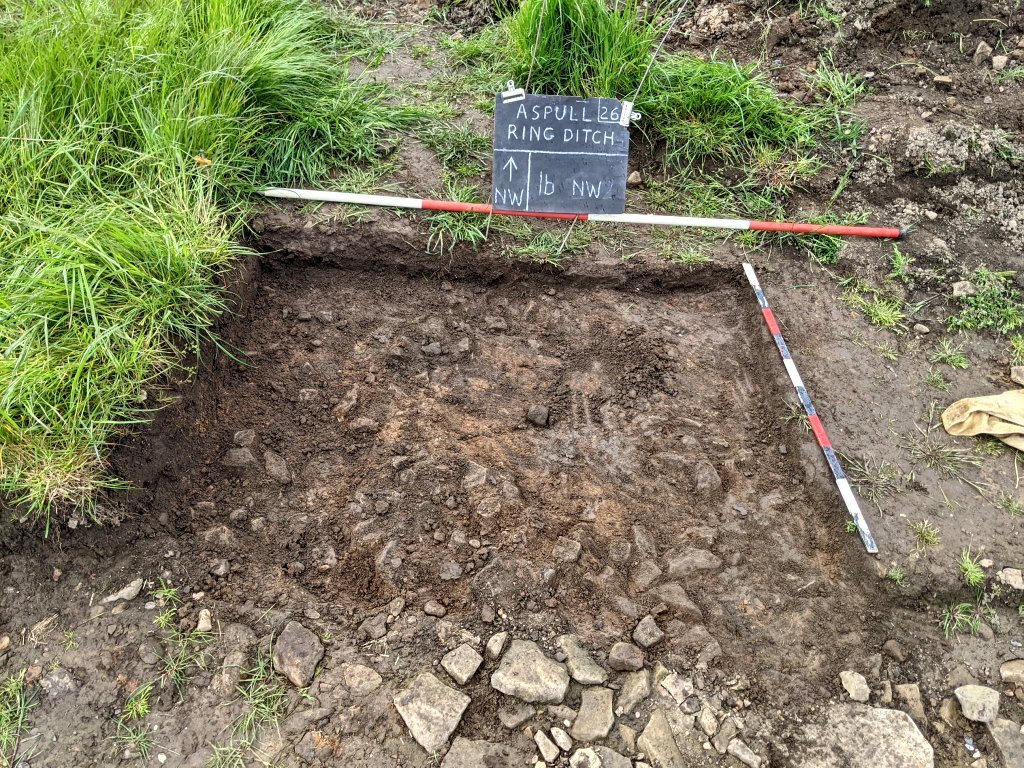
Meanwhile Alison and Andrew continued with the task of extending Trench 1b on the side next to the previously backfilled Trench 1c (started yesterday). There is a depth on mottled clay here which Chris recorded before trowelling through it to expose the stony layer below. Bill also joined them to remove the backfill from Trench 1c. The drawings that records this trench show a gap in the stony layer but the mottled clay and burnt layers continue before diving under a brown soft sandy clay that had stones embedded in it. These stones Bill thinks are the ones that have a greenish tinge to them, found also in Trench 3b on the extreme SE side and Trench 10 on the east side. As he dug, some of these stones turned up in the backfill from the trench.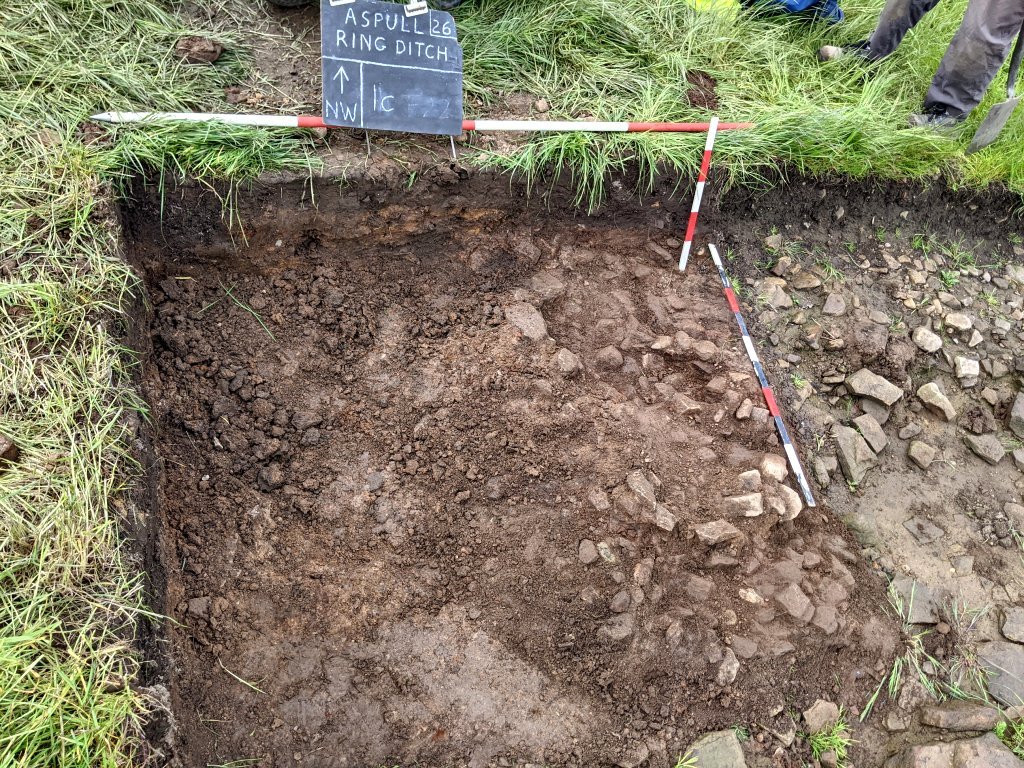 It will be interesting to see how the stony layer continues on the SW side of this trench.
One of Ben Dyson’s suggestions from the previous day was how to tackle F22 (our possible cist or stone box as perhaps it should be called). This was to open up a trench to the side of it, starting from the inner edge of the perceived stone kerb and working our way towards the feature. This would allow the feature’s depth to be understood without removing any of the stones from it (thus retaining the structure). It would also inform the nature of the soft sandy clay that the stony layer and large stones are sat on.
With this in mind Chris and Peter laid out a sondage on the NE side of the feature on the line of the datum points Bill had put in the previous day. Trowelling down the few centimetres revealed a mottling in the soft sandy clay which suggests it not to be natural.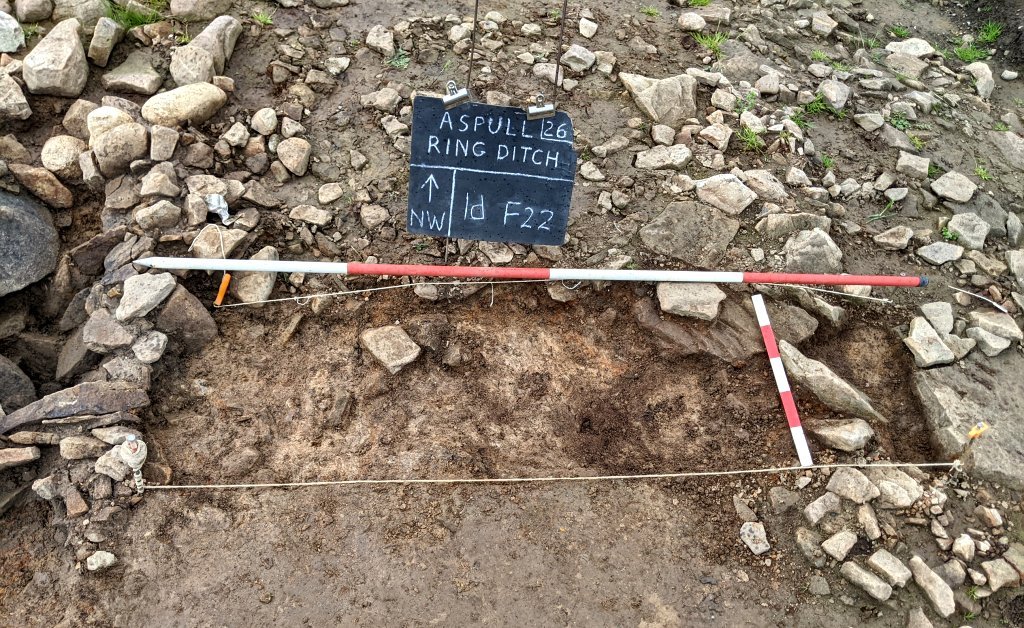
Wednesday 20th May
Day 1
Late start this season due to various commitments our leaders have had this year. On site today raring to get going we’re Bill, Chris and Andrew with joining later in the morning Patrick and Paul Kenyon. We were also joined by Ben Dyson from GMAAS who we had invited to help us with how to tackle the two potentially sensitive areas i.e. the possible cist features in both the central sandy clay mound (F11) and the newly discovered ring kerb (F22). For location of these features see our plan drawing here.
Chris and Patrick had been on site the previous day to remove the covers and check out how it had survived the winter. Bill’s first job was to set up the tent as showers were predicted but find a spot on our newly reduced area wasn’t easy (spoil heap location was also going to be a problem and we may have to ask Nick to enlarge our fenced off area.
At our committee meeting earlier this month we set out our aims and priorities for the coming season, one of which was to investigate these features and agreed we would need professional advice as they may contain the primary burials of the monument.
Ben spent some time talking us through how he would approach the task and after he left Chris made a start on the F22. His first task was to remove the loose stones to see if the feature had a solid floor. This revealed more stones going down but still wasn’t clear if he’d reached the bottom.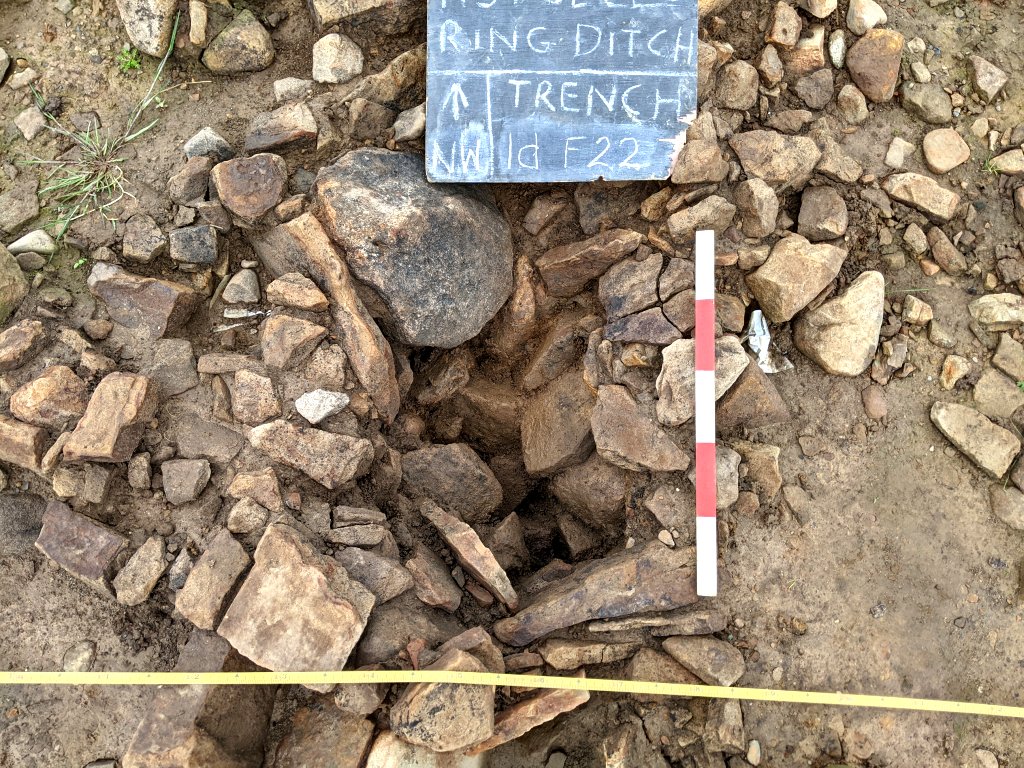
One of the aims mentioned at the meeting was to establish the extent of the stony layer on the north and northwest side. Not necessarily the highest priority but certainly something that could be started straight away. Andrew and Paul were given the task of extending Trench 1b on its NW side on the side next to the previously excavated Trench 1c (which had previously been backfilled).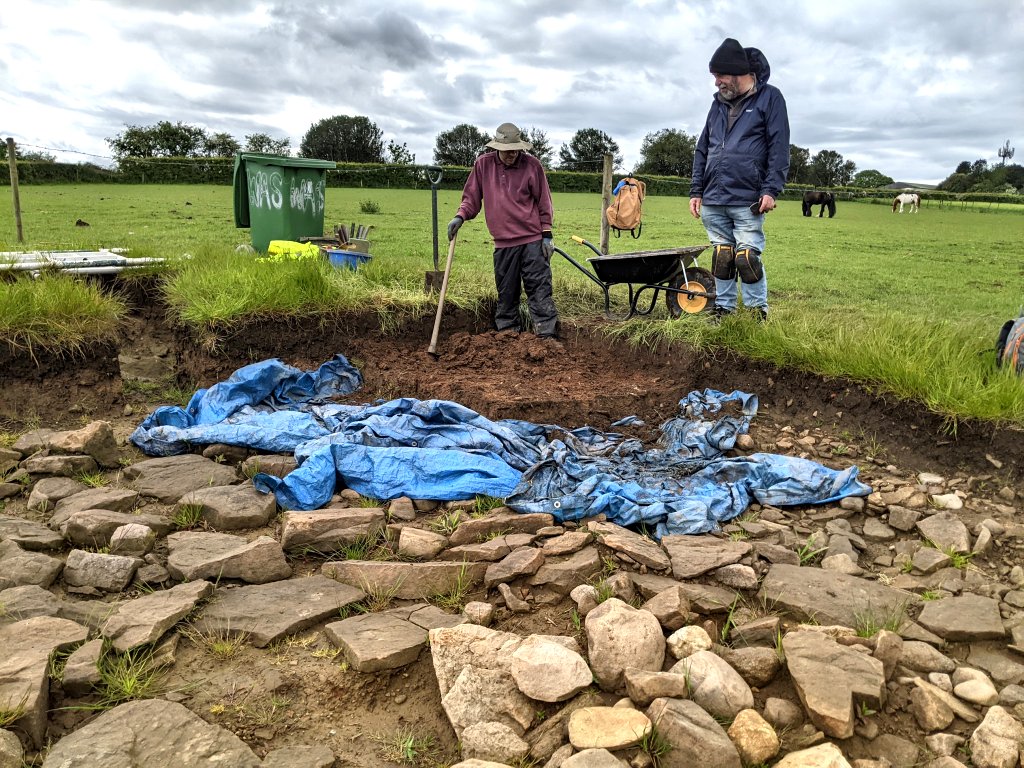
Despite our late start on site, work has been continuing at the Bolton Archive facility. As mentioned last year all our cremated bone material, urns and pit fill has been sent to the facility. It has been worked on (employing a process of cleaning, washing and drying) and a batch was sent over to Dr Sam Walsh at the University of Lancashire (B10 from the F13 pit). As reported in our Newsletter No.284, the result back from Sam were quite spectacular with almost 70% of the bone fragments being identified. Included in the assemblage were teeth and pieces of petrous (sections of the skull) which enabled the person to be identified as a young adult (but not enough to estimate the sex). As reported in our Newsletter No.287 a second batch from the contents of Urn1 is also ready to go. This could potentially be even more interesting, as the the process of micro-excavation enabled us to record in detail the distribution of the bone and pyre material in the Urn. Hopefully this will give us an insight into the ancient’s burial practices.