






| No.287 May 2026 | Monthly Newsletter |
Aspull Ring Ditch Restart |
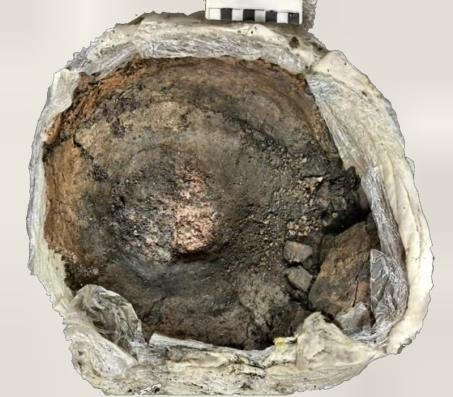 Due to other commitments we are having to have a late start this year. However we have had our pre-season planning meeting now, so we hope to be back in the field within the next week or so. Work has been continuing though, on our post-excavayion activity at the Bolton archiving facility. I reported in February (Newsletter 284) on the spectacular results from Dr Sam Walsh’s analysis of the first batch of cremated bone. Our second batch is now almost ready, having been completely removed from the Urn No.1. This could potentially be even more interesting, as the the process of micro-excavation enabled us to record in detail the distribution of the bone and pyre material in the urn. Hopefully this will give us an insight into the ancient’s burial practices. A curious find amongst the fill were two pieces of burn flint. Although the smaller piece was obviously broken off from the larger one, the two were found at different levels in the vessel. 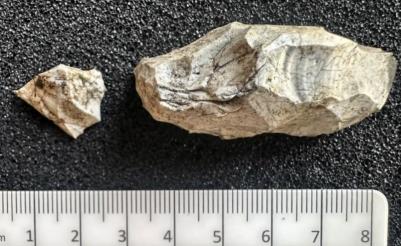 Another curious obsvervation was the discovery of a layer of pinkish clay at the base of the urn. It is not clear what this represents, but it does seem to be a deliberate deposition. Chris has produced a short video explaining this in more detail which you can view here: https://www.youtube.com/watch?v=C9rziawBOcU Wigan History Festival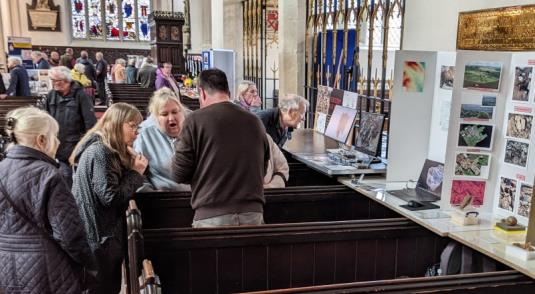 Last month saw another great weekend at the Parish Church, with lots of stands on view from a wide variety of heritage groups. There were many interesting talks over the two day event. We of course had our stand, set up by Chris Drabble, displaying the latest results and finds from our Aspull Ring Ditch Project. The event was opened by the Mayor of Wigan, Jenny Bullen, the Rev Roland Harvey and St John’s Ambulance President, Ian Bithell. 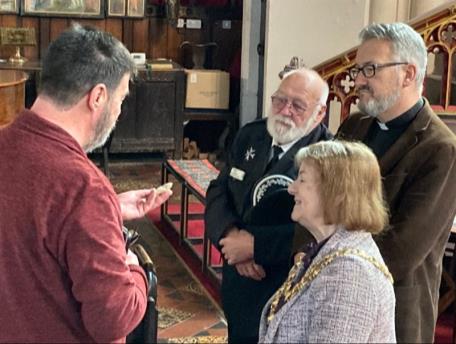 Chris was able to spend some time explaining our work to them, presenting our finds and showing a rolling video and 3D computer models of our excavations. Chris was also able to talk with the team from the Wigan Museum stand who showed great interest in our fascinating four-year project (artefacts from our dig will likely end up in the Museum). Patrick was on the Friday programme with a presentation of our project and I was able to join them on the Saturday, adding information about Roman Wigan. This included the huge Roman bathhouse found in 2005, when the Grand Arcade was developed, and our long-term quest to find the Roman roads coming in and out of the town. This, together with a rolling presentation of our Parish Church Tower project, attracted a quite lot of attention to our stand. Just across from us, Phil Livesey had his Friends of Wall Hey stand, showing off all the coal mining memorabilia from around the area. The Friends aim is to try to get funding for the preservation of the large ventilation shaft located on Haigh Road in Aspull. 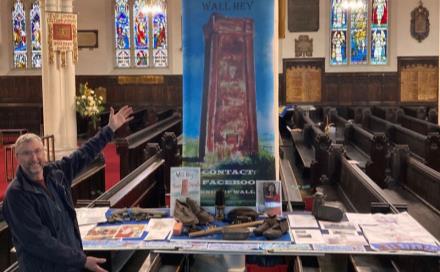 It is a fascinating relic from the Victorian era, deserving recognition as a rare example of our intense industrial past. Phil and his team deserve every credit for their efforts in trying to secure its future. You can see more details about the Festival on our blog site: https://www.wiganarchsoc.co.uk/blog/?p=4804 Next MeetingWednesday 6th May – at the Real Crafty on Upper Dicconson Street starting at 7.30pm as usual. There have been many excavations over the years on the Roman fort and settlement at Manchester. It’s been over ten years since we had our last talk on it, so it’s great to be able to welcome Graham Mottershead to bring us up to date on the latest findings. Graham is a consummate archaeologist who for many years worked for Salford Archaeology. He is now part of the Civic Civil Engineering group that deals with the heritage environment. His long experience in field ensures this will be a really fascinating talk, hope to see you there. |