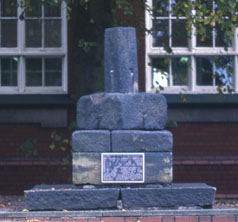
 Mab's Cross |
In 1086 Wigan was part of the barony of "Neweton" (Newton-le-Willows), so the phrase in the Domesday Book, "the church of that manor, " probably refers to Wigan parish church.
In 1246 Wigan achieved borough status by a charter of Henry III and was equal in standing to Liverpool, Preston and Lancaster.
Bell founding and pewter making were in evidence in the late medieval period.
One of the few medieval remains in Wigan is Mab's Cross which stands in Wigan Lane. It is associated with Lady Mabel Bradshaw.
A legend states that she remarried as her husband, Sir William Bradshaw, had failed to return from a crusade.
On his eventually reappearance, Sir William killed the usurper. Mabel did penance for her unwitting bigamy by walking, once a week, barefoot and barelegged from her home at Haigh to the cross in Wigan which now bears her name.
The truth, however, is somewhat different. William Bradshaw was not a hero of the crusades - there were none at that time.
He was, in fact, a violent, unsavoury character who disappeared in 1315 after being
declared an outlaw, following his participation in a rebellion against the Earl of
Lancaster. He returned to Haigh in about 1322 but was killed in a fight in 1333.
In 2005, a dig in the Millgate area by Oxford Archaeology North revealed a 13th century
medieval pit with pottery.
To read Mab's story click here.
To read "Mab's Cross Legend and Reality" by Bob Blakeman click here.
Article by Adrian Morris